

Jing: reading a well from the bottom to the mouth
Content version · · Sources & references
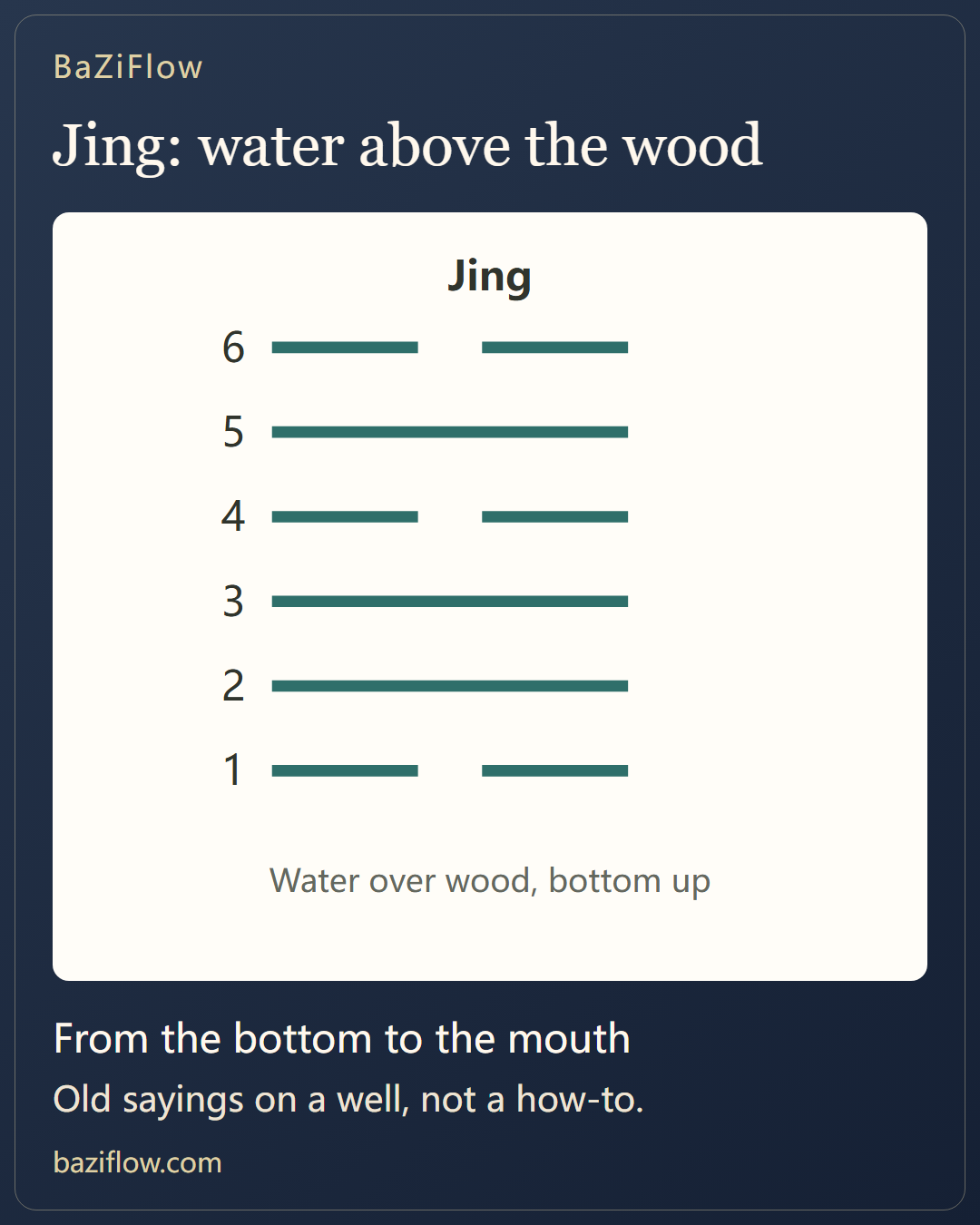
Jing is the 48th hexagram: Kan (water) above Xun (wood). Read “change the town, not the well”, “nourishes and is never exhausted”, and six lines from mud to lined wall, cold spring and an uncovered mouth.
The short version7 min read
The six statements of Jing follow the depth of one well: mud at the bottom, then a leak, dredging, a lined wall, a cold spring, and at the top water drawn and the mouth left uncovered.
- Jing puts Kan (water) over Xun (wood). In the Shuo Gua Xun is wood and also “straight rope”, and the Commentary says wood goes into the water and raises it.
- The first half of the judgment is about what stays the same: change the town, not the well; no loss, no gain. The second half is about the last step going wrong: almost there, the rope not yet reached the well, the jar smashed.
- The six statements run from the well’s bottom to its mouth: mud, leak, dredged, lined, cold spring, uncovered. Lines 1 and 3 both say “not drunk”, one because of the mud, the other although the well has been cleaned.
Read first
The Sixty-Four Hexagrams: How Upper and Lower Trigrams Form One Figure ↗
Judgment and Line Statements: Whole Hexagram or Single Line? ↗
Water above the wood: Kan above, Xun below
Jing (井) is Kan (water) above and Xun (wood) below. The lines, bottom to top, are yin, yang, yang, yin, yang, yin. The Shuo Gua makes the upper trigram water, and the lower one both wood and “straight rope”. A rope hangs straight down, a bucket sinks into the water and brings it up: water above wood, and the figure matches a well.
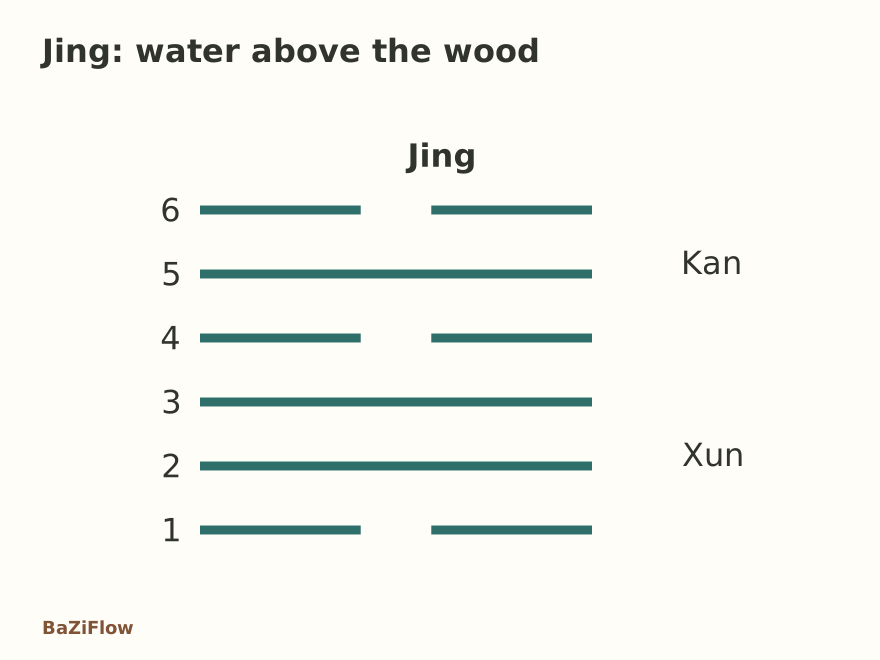
Jing: the lower trigram Xun is wood, the upper trigram Kan is water. Counting from the bottom, the six lines are also six places in a well, from the bed to the mouth.
Enlarge diagram · scroll sideways to read
Three words in Jing
- Jing
- The Commentary’s verdict is “the well nourishes and is never exhausted”: it feeds people, and cannot be drawn dry.
- Rope
- The rope for drawing water. In “almost there, yet the rope has not reached the well”, the first word means nearly: nearly arrived, but the rope has not gone down into the well.
- Smashing the jar
- The jar is the clay vessel for drawing water, and the word for “smash” is traditionally read as ruin or break. The whole phrase says the water jar is broken, and so misfortune.
The judgment and the Commentary: the well stays, and misfortune waits at the last step
The judgment of Jing has two parts. First: change the town but not the well; no loss, no gain; people come and go, and each takes the well as a well. Then: almost there, yet the rope has not reached the well; the jar is smashed: misfortune.
Wood, going into the water, brings the water up: that is the well. The well nourishes and is never exhausted. “Change the town but not the well”: it holds the firm in the middle. “Almost there, yet the rope has not reached the well”: nothing has yet been achieved. “The jar is smashed”: this is why there is misfortune.
Enlarge diagram · scroll sideways to read
The Commentary first says what a well is: wood goes into the water and raises it. Tradition usually reads the lower trigram’s wood as the vessel for drawing water. “The well nourishes and is never exhausted” says that it feeds people and cannot be drawn dry. “Change the town but not the well” means a town can be moved and a well cannot, and the Commentary gives the reason as the firm being in the middle, that is, the central yang line.
The second half holds the only misfortune in the hexagram. The well is always there and the water is always there; what goes wrong is the last step: almost there, with the rope not yet let down, or the jar smashed. The Commentary gives each a short comment: “nothing achieved”, “hence misfortune”. In the judgment what goes wrong is not the well itself but the last step of drawing water.
The Great Image: water over wood, easing the people’s toil
The Great Image (大象) of Jing begins with water standing on top of wood, and ends with the noble person easing the people’s toil and urging them to help each other.
Enlarge diagram · scroll sideways to read
The first word of “ease the people’s toil” is traditionally read as to console or encourage, and the second phrase as urging people to give one another a hand. The whole sentence lands on “the people”: both acts in the Image are directed at them, first to console them, then to urge cooperation. A well is water for everyone, and the two can be read side by side.
Six lines: from the mud to the mouth
The six statements are arranged by the depth of the well: line 1 at the bottom, line 6 at the mouth.
Enlarge diagram · scroll sideways to read
Line 1: “mud in the well, not drunk; an old well, no birds”. The bottom is mud and cannot be drunk, and an old well attracts not even birds. The Small Image: it is at the bottom; the time has put it aside.
Line 2: “in the well’s valley the water goes to the little fish; the jar is worn out and leaks”. The water at the bottom is a thin trickle, enough only for small fish, and the jar for drawing it is broken. Readings of the word “goes to” differ, and only the gist is given here. The Small Image: no one stands with it.
Line 3: “the well is dredged yet not drunk from; it makes my heart ache. It could be drawn from. If the king is bright, together we will receive blessing.” To dredge is to clear the silt. The well has been cleaned and still nobody drinks; “my heart aches” is the only time “I” appears in the hexagram. Then: it can be drawn from, and if the king sees clearly, all receive blessing together. The Small Image: seeking a bright king, in order to receive blessing.
Lines 1 and 3 both say “not drunk”, differing by a single character: line 1 is “mud in the well”, silted up; line 3 is “the well dredged”, already cleaned. In both, nobody drinks: in one the well is not fit, in the other the well is fit and not used. The Small Images differ too: line 1 is “it is at the bottom”, and line 3 is “going on, he grieves”.
Line 4: “the well is lined with brick: no blame”. To line is to build the wall with brick and stone; a wall that does not fall is without fault. The Small Image: it is mending the well.
Line 5: “the well is clear; cold spring water is drunk”. The water is clear and cold, and what is drunk is spring water. The Small Image: central and upright.
Line 6: “the well is drawn from and not covered; there is sincerity: primal good fortune”. Water is drawn up and the mouth is not covered; the word for “drawn” is traditionally read as take up. With sincerity, great good fortune. The Small Image: primal good fortune at the top, a great completion. The well stands open, and that is how the hexagram ends.
Kun, Shihe and Kui: from the well to renewal
The reversed hexagram (综卦) of Jing is Kun (困): turn Jing upside down and it is Kun. The inverse hexagram (错卦) is Shihe (噬嗑): every yang line of Jing becomes yin there and every yin line yang. The nuclear hexagram (互卦) is Kui (睽): inside the middle four lines of Jing sit Dui (lake) and Li (fire), and lake under fire is Kui.
Enlarge diagram · scroll sideways to read
In the Xu Gua, Jing comes after Kun (困) because those hemmed in above have to return below. After Jing it goes on to Ge (革), and the Xu Gua says the way of the well cannot do without change, so Ge comes next. Jing itself already writes of repair: dredging at line 3 and lining at line 4 are both ways of mending an old well, which can be read alongside that line of the Xu Gua.
Questions readers ask next
Is Jing about how to dig a well or manage water?
The text borrows the well. Its lines show one well in several states: a muddy bottom, a leak, dredged clean, a brick wall, clear cold water. The Commentary’s verdict is that it nourishes without running out, and no sentence says how to build one.
What does “change the town but not the well” mean?
Literally a town can be moved but a well cannot. The Commentary gives the reason as the firm being in the middle of the figure. The next clauses, “no loss, no gain; people come and go”, say the well itself neither grows nor shrinks while people keep coming and going.
Does “drawn and not covered” tell you to leave a well open?
Literally the water is drawn up and the well is not covered; “with sincerity, primal good fortune” follows. The Small Image calls it “a great completion”. It is the last line of the hexagram and the only one where the mouth of the well stands open.
Was this article helpful?
Sources & references
Continue reading
Kun (困): a lake with no water, from “stuck on a stump” to “stuck in vines” ↗
Ge: fire inside the lake, from “the hide of a yellow ox” to the tiger’s change ↗
The Sixty-Four Hexagrams: How Upper and Lower Trigrams Form One Figure ↗
Judgment and Line Statements: Whole Hexagram or Single Line? ↗