

The fourteen major stars: learn the roster and its structure
Content version · · Sources & references
Recognize the fourteen Zi Wei major stars through two placement groups. A six-star exercise shows why names, positions and transformations need separate records.
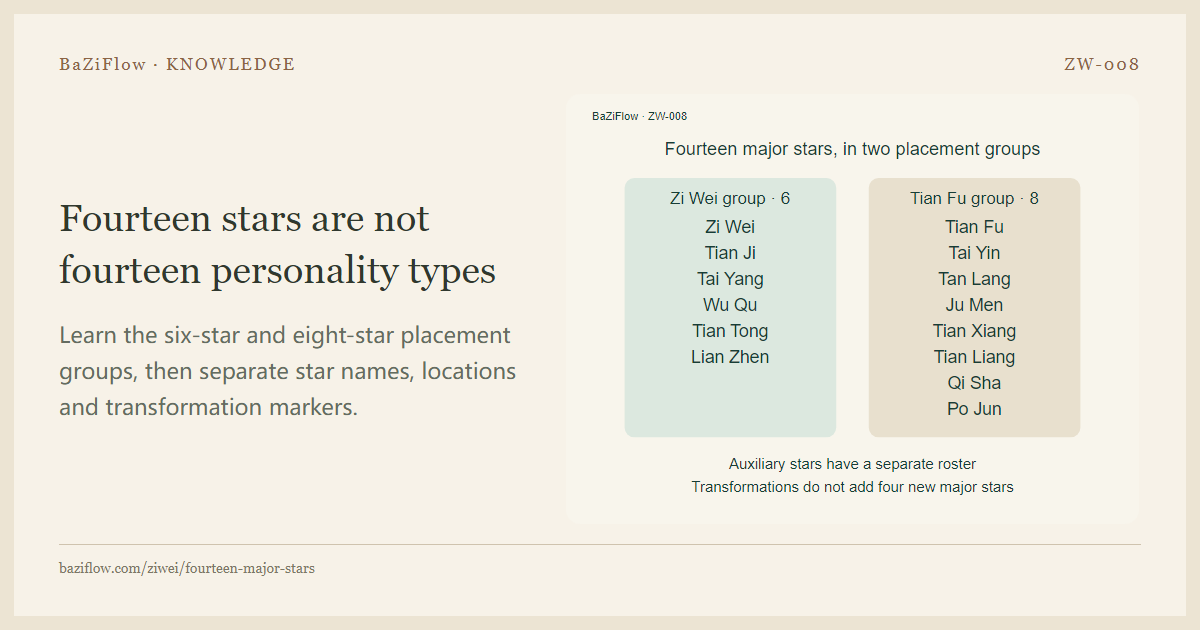
Learn the six-star and eight-star placement groups, then separate star names, locations and transformation markers.
Read first
Count names, not personality types
The phrase “fourteen major stars” identifies a particular roster in Zi Wei Dou Shu. It does not mean there are fourteen mutually exclusive kinds of person. A palace may contain two members of the roster or none of them. Neither condition, by itself, means the chart is incomplete.
A chart can also display many names outside this set. Before reading a description attached to a star, identify whether the label is a major star, another kind of star, or a transformation marker. Otherwise, a reader may accidentally count an annotation as an additional star.
The roster below uses romanized names so that the same item can be recognized across different English translations. A translated epithet such as “Emperor” can be useful for reading a text, but it is not a job title or evidence about the chart owner's social position.
Two placement sequences make the roster manageable
A placement verse in Zi Wei Dou Shu Quan Shu, volume 2, organizes six stars around Zi Wei and eight around Tian Fu. These two sequences provide a practical way to learn the complete list.
| Placement group | Members |
|---|---|
| Zi Wei: six | Zi Wei, Tian Ji, Tai Yang, Wu Qu, Tian Tong, Lian Zhen |
| Tian Fu: eight | Tian Fu, Tai Yin, Tan Lang, Ju Men, Tian Xiang, Tian Liang, Qi Sha, Po Jun |
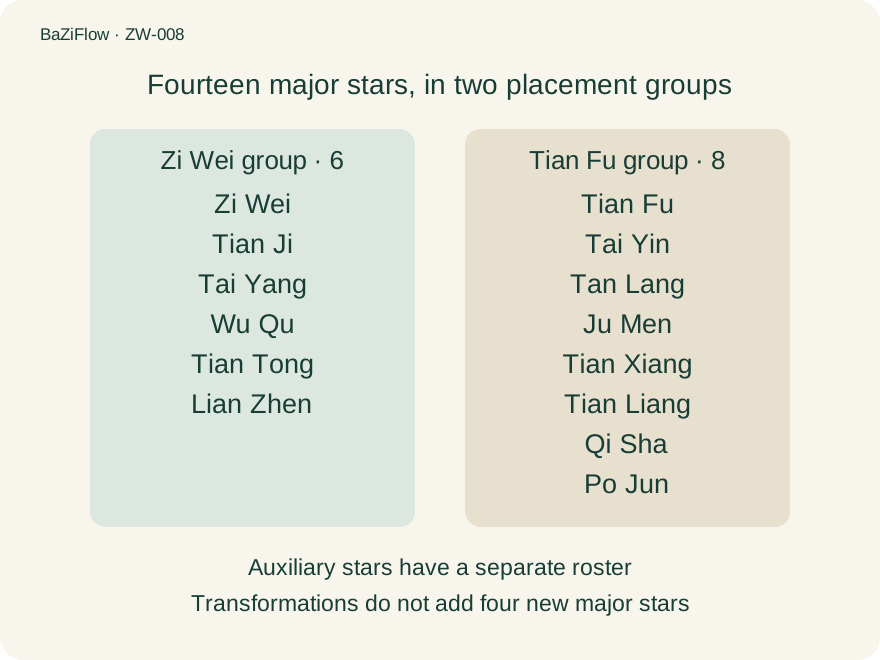
Original BaZiFlow roster. These are placement groups, not a Northern-versus-Southern Dipper classification.
Other classifications distinguish the Northern Dipper, Southern Dipper and central stars. They answer a different question. A star's membership in a sequence anchored on Zi Wei does not automatically give it Zi Wei's classification in that other scheme.
Wen Chang, Wen Qu, Zuo Fu and You Bi are not members of this fourteen-name roster, despite appearing prominently in many charts. Excluding them from this count does not imply that they are irrelevant to interpretation. It keeps two categories from being confused.
Reproduce one sequence without inventing a birth chart
For a limited exercise, suppose Zi Wei has already been placed at Yin. Applying the first sequence in the cited verse puts Tian Ji one position backward, at Chou. After leaving one intervening palace, Tai Yang is at Hai; Wu Qu follows at Xu and Tian Tong at You. After two further intervening palaces, Lian Zhen is at Wu.
| Star in this sequence | Exercise position |
|---|---|
| Zi Wei | Yin |
| Tian Ji | Chou |
| Tai Yang | Hai |
| Wu Qu | Xu |
| Tian Tong | You |
| Lian Zhen | Wu |
The six results are related placements, not six independent random draws. Yin, Xu and Wu also show that Zi Wei, Wu Qu and Lian Zhen lie at triad positions in this example. They are not three stars occupying one palace.
We have not calculated the starting position from a birth date, placed the Tian Fu sequence, or added other stars. The table is therefore a partial procedure rather than a complete personal chart. A gap in this one sequence does not establish that the corresponding palace in a finished chart has no stars.
Keep a star and its annotations distinct
When a chart marks a star with Hua Lu, Hua Quan, Hua Ke or Hua Ji, record the star's name once and the transformation separately. These four labels are not four new members of the major-star roster. Also note whether the displayed transformation belongs to the birth-year layer or a selected timing layer.
An inventory can consequently have three sections: major-star names and locations, other stars, and transformation annotations with their sources. This is useful even before learning the interpretations. It lets another reader check what was actually shown rather than reverse-engineering your prose.
If a palace contains no major star, do not promote an auxiliary star into the roster merely to fill the space. The empty-palace guide explains the distinction between lacking a major star and having no relevant information. A palace with two major stars likewise requires both names to be retained.
What a name can and cannot tell you
Qi Sha and Po Jun can sound alarming when translated literally. Their names do not establish that someone is dangerous, unsuccessful or unsuitable as a partner. Tai Yang and Tai Yin likewise function here as traditional chart symbols; their names do not authorize substituting observed solar or lunar positions into the placement method.
The classical questions-and-answers section discusses stars with palace conditions and accompanying configurations. Its historical titles and moral judgments should remain attributed to that text rather than being restated as established facts about a modern person.
Two major stars in one palace also require more than pasting together two personality descriptions. Opposing adjectives can produce a paragraph that fits almost anyone unless the interpretation explains the particular combination, palace and relevant conditions. The guide to star combinations continues from this point.
A useful first exercise is to hide the prepared reading and submit only a roster with locations for someone else to check. Look for omissions, duplicates and category mistakes. Being able to identify all fourteen names and distinguish their annotations is a concrete skill; it does not require issuing a personality verdict.