

Free and Easy Wandering: the great bird and the small
Content version · · Sources & references
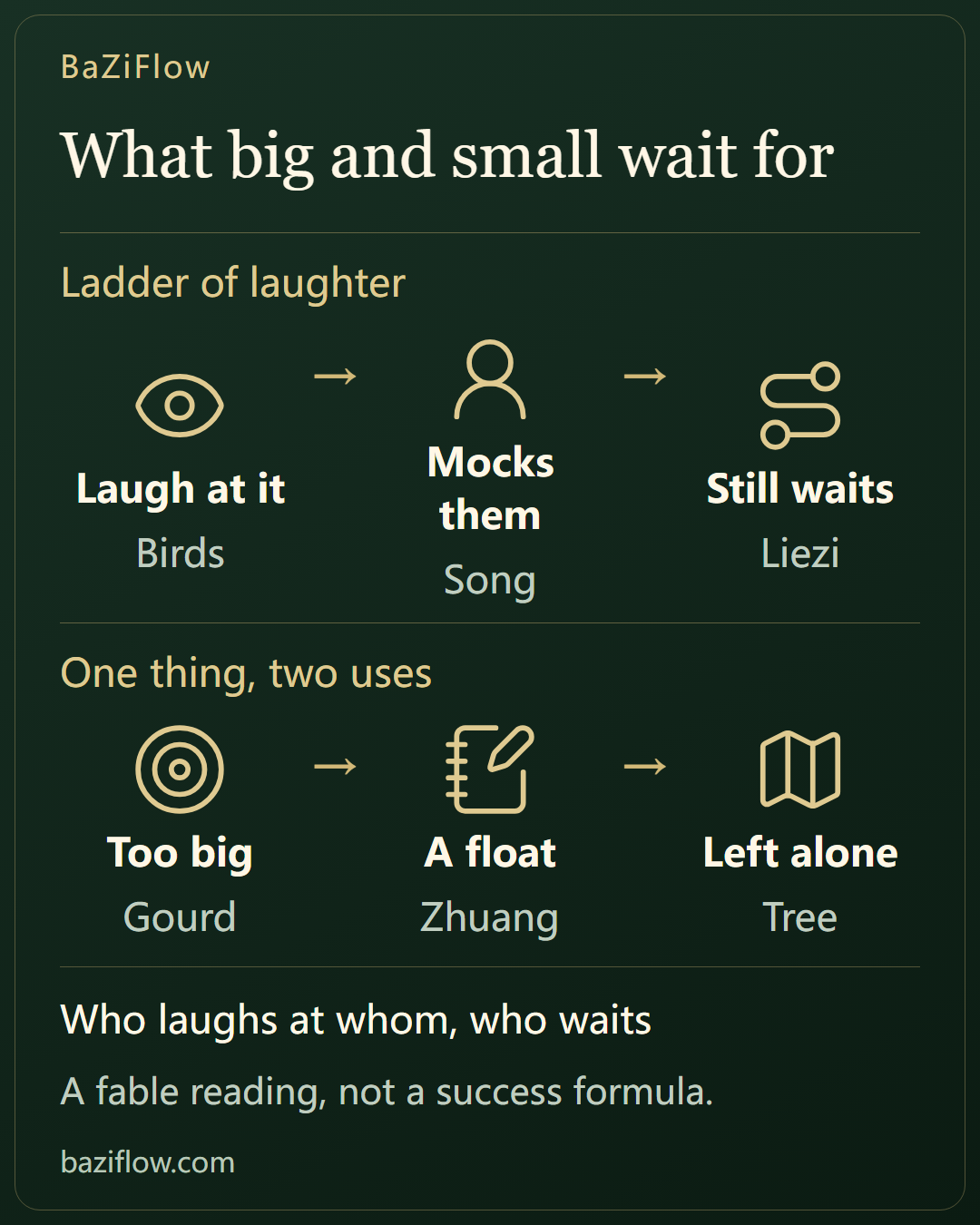
Read the chapter in its own order, from the Peng and the small birds to Song Rongzi and Liezi: each laughs at the one below, and each still depends on something. Then the gourd and the tree.
The short version10 min read
In "Free and Easy Wandering" small birds laugh at the great bird for flying so far, Song Rongzi laughs at people who see themselves like small birds, and Liezi, riding the wind, still "depends on something"; only this chain of laughter shows what the chapter argues about.
- The great bird reaches ninety thousand li only on wind that has piled up deep enough; the text says so first, and that is what later "depending on something" builds on.
- The cicada, dove and quail laugh at the Peng, Song Rongzi laughs at those who see themselves like small birds, and Liezi on the wind "still depends": the laughter points one step higher each time.
- The second half turns to "use": the empire, a ceremonial hat, a salve, a huge gourd, a huge tree. One thing is useful to one person and useless to another.
Read first
The Zhuangzi: Inner, Outer and Miscellaneous Chapters, Mapped ↗
The great bird has to wait for wind
The chapter opens with a very large picture. In the northern darkness there is a fish named Kun (鲲), so vast that "no one knows how many thousand li" across; it changes into a bird named Peng (鹏), whose back is also "no one knows how many thousand li". Before the Peng takes off, the text first says what it needs.
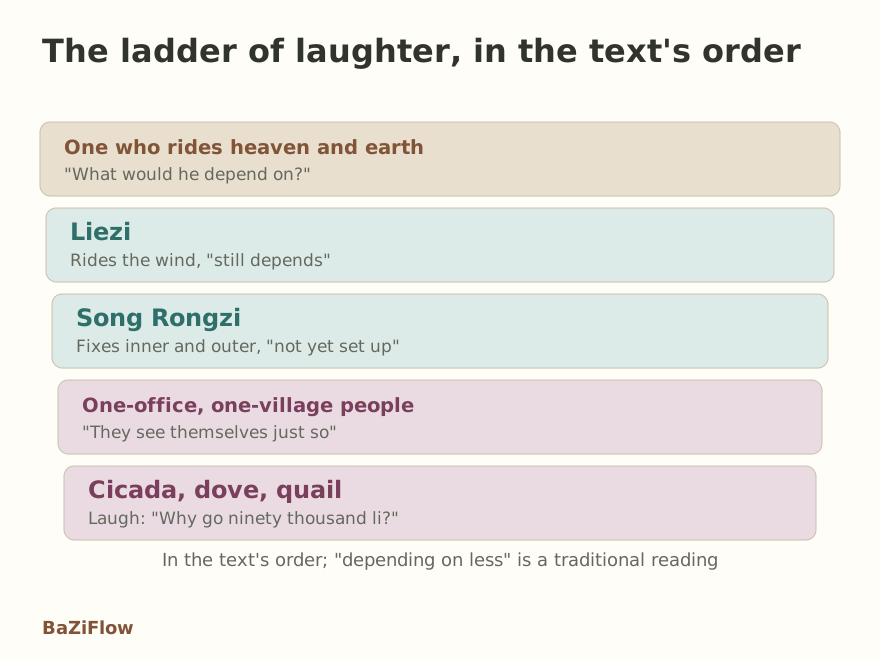
Ladder in the order of the text. The text gives verdicts only on the top three steps; reading the whole ladder as depending on less at each step is a common traditional reading.
The ladder above sums up the whole chapter; below, the text is read in order, starting from the lowest step. First the Peng itself:
Enlarge diagram · scroll sideways to read
If water is not deep enough, a great boat will not float. Pour a cup of water into a hollow in the courtyard and a blade of grass can serve as its boat; set the cup itself there and it sticks, because the water is shallow and the boat is big. Wind is the same: it has to be piled up thick enough to carry great wings.
If wind is not piled up thick enough, it cannot bear the weight of great wings.
This is the first "depending" in the chapter: even the largest bird relies on something. The text names the idea later, as "depending on something".
The cicada, the dove and the quail: three ways to fly
The Peng's aim lies in the southern darkness. The small birds see it and each answers in its own way.
Enlarge diagram · scroll sideways to read
The cicada and the little dove say:
We start up with all our might and fly to the elm or the sandalwood; sometimes we do not make it and just drop to the ground. Why would anyone go ninety thousand li to go south?
The quail says much the same. It springs up and comes down within a few fathoms, flutters about among the weeds and brush, and that is "the best flying there is". It cannot make out where the Peng could possibly be going. The text sums the passage up: "This is the quarrel of small and large."
From where they stand, their words hold: the elm and the weeds are all the sky they have. The text's comment is "what could these two creatures know", which says that where they stand they cannot see so far. Later, when Jian Wu questions Lian Shu, Lian Shu says: "Is it only the body that has its deaf and blind? Knowledge has them too." Deafness and blindness lie in understanding as well as in ears and eyes.
Distance and years: each scale has its own measure
The text then uses two sets of figures to make "small knowledge" and "short years" concrete. First, three journeys:
The farther the trip, the more the supplies
Back after three meals
Out and home the same day, and the belly is still full.
Grain milled overnight
The grain has to be milled the night before.
Three months of stores
Supplies for the trip take three months to gather.
The farther the trip, the more it takes, and the Peng too must first pile up its wind. Now the years:
Enlarge diagram · scroll sideways to read
The morning fungus does not know that a month has a start and an end; the summer cicada does not know that a year has spring and autumn. A spring of the Ming ling is five hundred years, and of the great Chun tree eight thousand. In the text's words, "the short-lived cannot reach the long-lived".
The last line has a barb: "And Peng Zu is now famous just for living long, and everyone tries to match him. Is that not sad?" Even the yardstick for a "long life" is a human one.
The chain of laughter, and "depending on something"
Further on, the laughter in the text changes direction. After the cicada, the dove and the quail laugh at the Peng, the text goes on:
Enlarge diagram · scroll sideways to read
People whose knowledge "suits one office, whose conduct fits one village, whose virtue matches one lord and who are trusted by one state" see themselves "just so", like the cicada and the dove. Yet Song Rongzi laughs at them: if the whole world praised him he would not try harder, if the whole world blamed him he would not be dismayed; he had fixed the line between inner and outer and had marked out honor and disgrace, "and that was all". But the text adds at once: "Still, he has not yet set something up."
Then comes Liezi:
Liezi rode the wind and went, light and fine, and came back after fifteen days. ... Though this spares him from walking, he still depends on something. But one who rides the true course of heaven and earth, drives the changes of the six breaths and wanders in the limitless, what would he depend on?
Liezi rides the wind and is back after fifteen days. He has been spared walking, but he still needs the wind. The character for "depend" appears only twice in the whole chapter, both in this passage: "still depends" and "what would he depend on". The next line, "the utmost person has no self, the spirit-like person has no achievement, the sage has no name", is read in the tradition by some as three levels and by others as three ways of speaking of one state; the text only sets the three clauses side by side.
One thing, two views of its use
The second half stops writing about birds and turns to people and objects, asking one question: in whose eyes is a thing useful.
Enlarge diagram · scroll sideways to read
The most weighty story is the salve. The same recipe against chapped hands kept one Song family washing silk for generations, earning only "a few pieces of gold". A buyer paid a hundred and took it to the king of Wu. When Yue attacked, the king put him in command; he crushed Yue in a winter battle on the water and was given a fief. The text sums it up:
To keep the hands from chapping was one thing; but one man got a fief by it and another never got beyond washing silk: that was a difference in what they used it for.
When Huizi says the great gourd is too big for anything, Master Zhuang suggests making it into a great float and drifting on the rivers and lakes. Xu You's answer adds a pair of small animals: "the wren nests in a deep forest on no more than one branch; the mole drinks from the river no more than fills its belly", each wanting only a branch's or a belly's worth.
At the very end Master Zhuang tells Huizi to plant the great tree in "the land of nothing at all, the broad and empty wild", and to loiter beside it, "wander free and easy", and lie down under it. The two characters for "free and easy" appear in the body of the chapter only here, under a huge tree no one wants.
Where to read next:
- The structure of the Zhuangzi: where this chapter sits in the whole book.
- Equalizing Things: how different perspectives meet.
- Knowing what is enough: a companion to Xu You's "one branch" and "a belly's worth".
Questions readers ask next
Does "free and easy wandering" mean going wherever you please?
The text does not say so. The two characters for "free and easy" appear in the body only once, in the last passage, where a person loiters beside a huge tree and lies down beneath it; the earlier "wandering in the limitless" is conditional on no longer depending on something. Reading it as doing as one likes is a later borrowing.
Is Master Zhuang saying the great bird is better than the small birds?
The text says "the small in knowledge cannot reach the great, the short-lived cannot reach the long-lived", and it also has the Peng wait for wind. Tradition reads this in two ways: that each creature suits its own nature and is equally at ease, or that one must get beyond the whole large-and-small distinction before depending on nothing. Both can be supported from the text, so they are set side by side here.
Does "the use of the useless" teach people to lie flat?
The text is about points of view. Huizi finds the gourd and the tree useless; Master Zhuang finds the gourd another use and leaves the tree in the "land of nothing at all". Nowhere does it recommend uselessness as a virtue, and "lying flat" is a modern phrase borrowed for these stories, which sit differently.
Was this article helpful?
Part of a learning path
Sources & references
Continue reading
The Zhuangzi: Inner, Outer and Miscellaneous Chapters, Mapped ↗
Equalizing Things: How Different Perspectives Meet, and the Limits of Judging ↗