

Tian Guan: by the year stem, ten stems on nine branches
Content version · · Sources & references
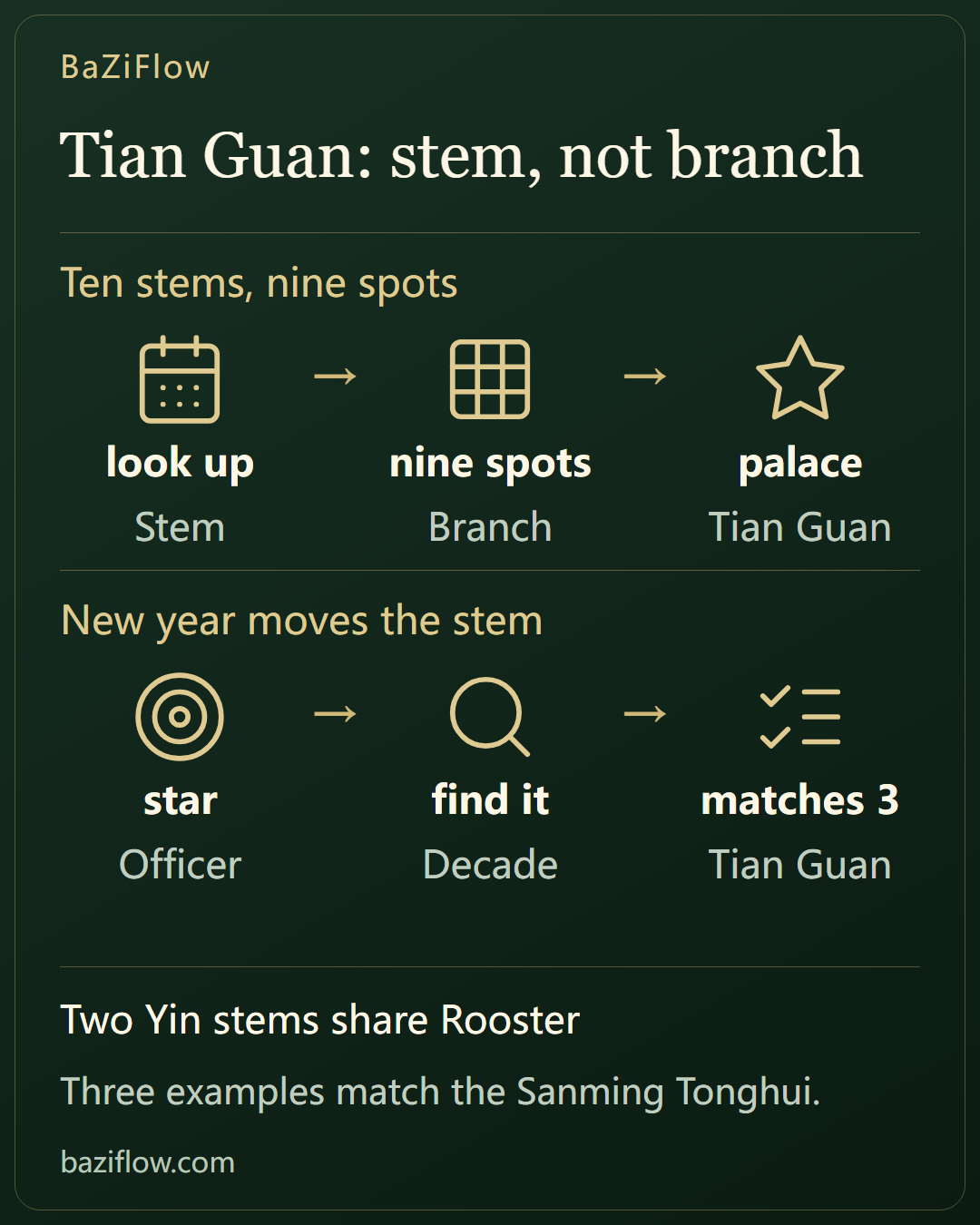
Tian Guan is looked up by the stem of the birth year: ten stems land on only nine branches. A table, a ring, three examples from the Sanming Tonghui, the new-year rule and sample charts show where the table comes from.
The short version6 min read
Ten year stems give only nine landing points for Tian Guan: Yin Earth (己) and Yin Metal (辛) share the Rooster.
- Tian Guan is looked up by the stem of the birth year, not the branch; ten stems map to nine branches, and Rat, Ox and Monkey never appear.
- BaZi has an entry of the same name, the "heavenly officer noble": the three examples in juan 5 of the Sanming Tonghui (Goat, Dragon, Snake) agree with the engine.
- The new-year rule changes the year stem: on 2 February 2003 the lunar-new-year rule gives a Gui-Wei year with Tian Guan on Horse, the Start of Spring rule a Ren-Wu year with it on Dog.
Read first
What do Zi Wei's supporting, malefic and minor stars actually do? ↗
Ten stems, nine landing points
A small question first: do ten year stems give ten landing points? Tian Guan (天官) follows the stem of the birth year, and its table holds only nine different branches, because Yin Earth (己) and Yin Metal (辛) both land on the Rooster.
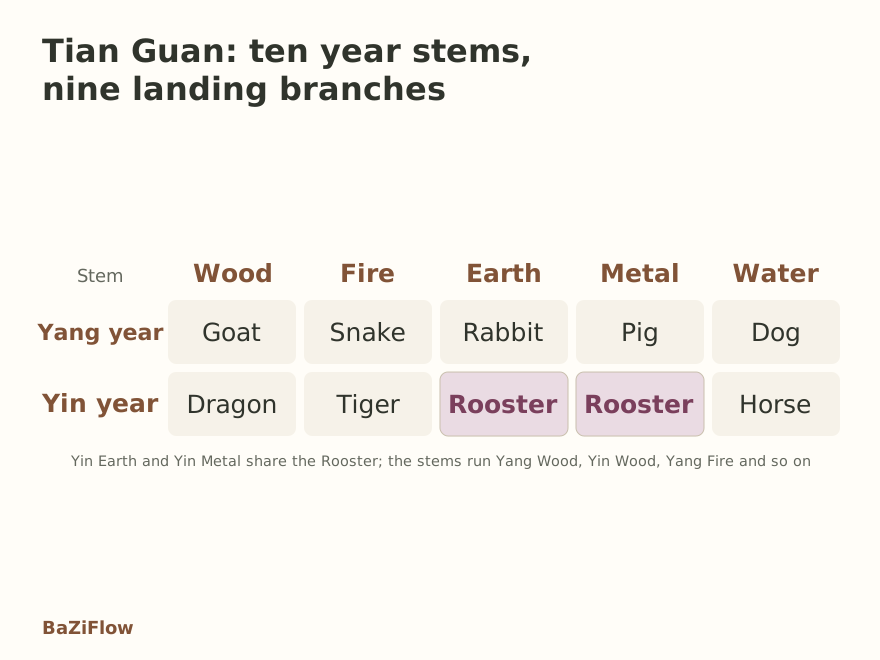
Comparison sketch: the landing points of Tian Guan follow this site's engine (iztro 2.6.0) and agree with the three examples for heavenly officer noble in juan 5 of the Sanming Tonghui; the other seven stems are not worked in that passage.
The two rows are Yang stem years and Yin stem years, and each column is a pair of stems of one element. The Yang stems are Yang Wood, Yang Fire, Yang Earth, Yang Metal and Yang Water; the Yin stems are the five partners. Lined up in stem order, the ten landing points are Goat, Dragon, Snake, Tiger, Rabbit, Rooster, Pig, Rooster, Dog and Horse. The step from one entry to the next jumps back and forth, so there is no "count so many steps" rule to find; it is a lookup.
Enlarge diagram · scroll sideways to read
On the ring, nine places are colored. Rat, Ox and Monkey stay empty: whatever the stem of the birth year, Tian Guan never lands there.
BaZi has an entry of the same name: heavenly officer noble
Juan 5 of the Sanming Tonghui (三命通会) has an entry called "heavenly officer noble", and its first lines give the method:
It means the place where the official star dwells, found by hiding it within its own decade: for a Yang Wood person the official star is Yin Metal, and within the decade it shows as Yin Metal on Goat; for Yin Wood it is Yang Metal on Dragon; for Yang Fire, Yin Water on Snake.
The book first picks one official star for each of the three stems (Yin Metal, Yang Metal, Yin Water), then looks for that stem inside the decade and reads off the branch it sits on, a step called hiding: Yin Metal over Goat gives Goat, Yang Metal over Dragon gives Dragon, Yin Water over Snake gives Snake. How an official star is chosen is explained in the article on the adjective star Tian Fu (天福). Checked against the engine's table, entry by entry:
Enlarge diagram · scroll sideways to read
All three examples agree. For the other seven stems this passage gives no examples, so the engine's table is used as it stands and no derivation is added here.
The new-year rule changes the stem
Tian Guan reads the stem of the year, so the line where one year turns into the next moves the stem. In 2003 the lunar new year fell on 1 February and the Start of Spring on 4 February. Here are three dates, each worked out under both rules by one engine:
Enlarge diagram · scroll sideways to read
On 2 February, Yin Water (癸) and Yang Water (壬) are different stems, so the cells found differ: Yin Water gives Horse and Yang Water gives Dog. By default the site turns the year at the lunar new year; when you check the birth-year pillar, see first whether the date sits between the lunar new year and the Start of Spring.
Which palace: count from Life
The lookup gives a branch, and the palace name has to be counted from Life. Two charts, two year stems:
Enlarge diagram · scroll sideways to read
Both Tian Guan and Tian Cai end up as "count some steps from Life", but they differ in what the year fixes. For Tian Guan the year stem gives the branch directly and the palace name has to be counted; for Tian Cai the year branch gives the palace name directly and the branch has to be found.
Settle the year stem first
Check whether the birth date is before or after the lunar new year, then take that year's stem.
Then look up the branch
Read the branch off the table above; the table has no formula, so do not extrapolate from a pattern.
Count from Life last
Count along the branches from the Life palace to that branch and read off the palace name.
Two checks
Born in a Yin Water year: which branch holds Tian Guan?
Yin Water gives Horse, whatever the birth month or hour; the palace name is then counted from Life to Horse.
Yang Water year, Life on Tiger: which palace holds Tian Guan?
Yang Water gives Dog; counting from Tiger (number 2) to Dog (number 10) is 8 steps, which is the Wealth palace.
Another lookup by year stem is the birth-year four transformations; the neighboring year-stem star is Tian Fu, and the Sanming Tonghui derives both of its noble entries from the official star.
Questions readers ask next
Tian Guan and Long Chi both follow the year; how do they differ?
Long Chi follows the year branch and repeats every twelve years; Tian Guan follows the year stem, repeats every ten, and is a lookup with no counting formula. 1984 and 1994 are both Yang Wood years and Tian Guan is on Goat in each; 1984 and 1996 are both Rat years and Long Chi is on Dragon in each.
Is there a special meaning for Yin Earth and Yin Metal years?
The table only shows that those two stems share the Rooster; the book gives no origin or reading for that. What is certain is the position: both have Tian Guan on Rooster, and the palace name depends on where the Life palace is.
BaZi also has a Tian Guan. Is it the same thing?
The three checked examples use the same lookup, but the two are used differently. In the Sanming Tonghui the heavenly officer noble is a BaZi symbolic star that counts only when the pillars actually contain that stem-branch pair (a Yang Wood person meeting Yin Metal over Goat, for instance), and the book adds that harm and clashes take its good effect away. On a Zi Wei chart Tian Guan is an adjective star that every chart places in some palace by the year stem. Readings should not be carried from one to the other.
Was this article helpful?
Sources & references
Continue reading
Tian Shou (天寿): Counted From the Body Palace, With a Gap to Tian Cai Set by the Hour ↗
Tian Fu (天福): The Official Star's Lu, Found by Year Stem, Not the Major Star ↗