

Six throws retain six complete states
Content version · · Sources & references
Declare the two face values, record six throws from the bottom upward, and check a supplied Jiji-to-Xian example without losing its two moving positions.
The short version6 min read
The supplied sequence 9, 8, 7, 6, 7, 8 builds Jiji from bottom to top. Reversing positions one and four produces Xian. Keep each throw’s faces and value alongside its original line and moving state so the transformation can be reconstructed.
- Three coins thrown together produce one position; the order of six throws fixes their locations from bottom to top.
- Assigning two to A and three to B is a declared convention for this exercise, fixed before recording the results.
- Jiji’s primary line pattern cannot by itself recover Xian: the moving values at positions one and four are also required.
Read first
What is Liu Yao? From a single question to an assembled hexagram chart ↗
Name the two faces before the first throw
Modern coins do not always have an obvious “written face” and an unmarked reverse. Both sides may carry letters or pictures. Before recording a three-coin exercise, label the faces A and B and keep that mapping visible. Changing the labels after seeing a result changes the input record.
For this article, A counts as 2 and B as 3. B corresponds to the reverse-side count used in the cited account. This is an explicit numerical convention for checking the exercise; it is not claimed as the wording of the historical passage. The Bushi Quanshu material collected in volume 544 of the Gujin Tushu Jicheng describes the four outcomes through counts of the written and reverse faces, using the traditional single, split, doubled and crossed categories.
Face A
- Value: 2
Face B
- Value: 3
Fix both face values before the first throw.
One throw produces one line with two properties
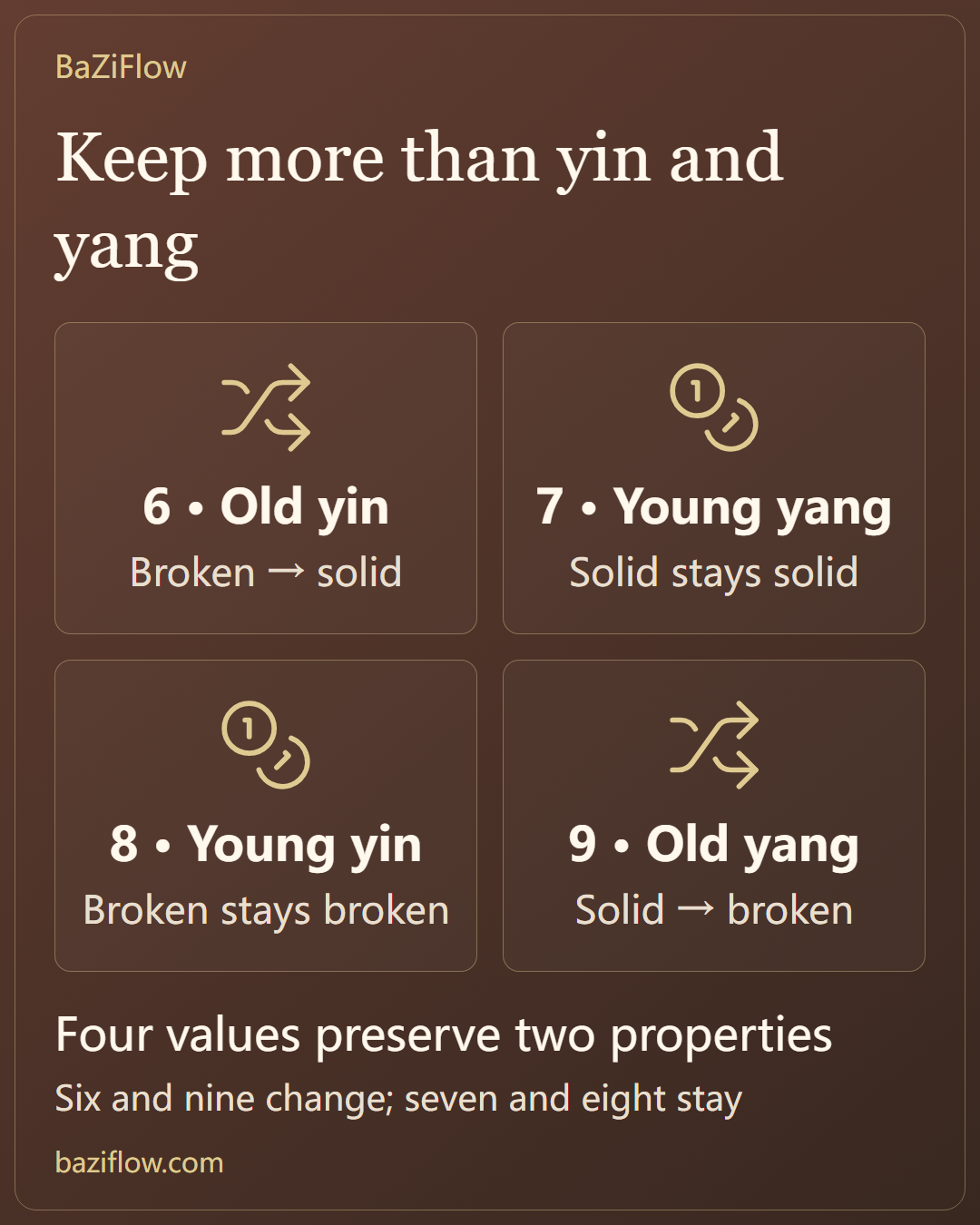
Throwing three coins together gives one line, not three. With the stated face values, their sum must be 6, 7, 8 or 9. Each sum preserves both the original yin–yang state and whether that line changes.
| Three faces | Sum | Original state | Changed state |
|---|---|---|---|
| AAA | 6 | Old yin, moving | Yang |
| One B and two A | 7 | Young yang, still | Yang retained |
| Two B and one A | 8 | Young yin, still | Yin retained |
| BBB | 9 | Old yang, moving | Yin |
The order of the three coins within one throw does not change its sum. The order of the six throws does matter. Also, 7 and 9 both begin as solid lines, but only 9 changes here; 6 and 8 both begin as broken lines, but only 6 changes. Saving only six yin–yang marks loses information needed to recover the changed figure.
The cited historical description assigns one reverse face to the single category, two to split, three to doubled and no reverse faces to crossed. Its instruction to change doubled into split and crossed into single agrees with reversing old yang and old yin. The numerical table is a way to make that correspondence easy to audit.
Moving
- 6: yin → yang
- 9: yang → yin
Still
- 7: yang → yang
- 8: yin → yin
Build upward through six results
The first throw is line 1 at the bottom. Throws 2 and 3 complete the lower trigram; throws 4–6 build the upper trigram. The cited Gujin Tushu Jicheng passage explicitly describes building from below, with three throws for the inner figure followed by three for the outer. The Liuyao workflow places this recording step before the later line assignments.
Use a supplied teaching sequence: BBB, BBA, BAA, AAA, BAA, BBA. Under the declared mapping the six sums are 9, 8, 7, 6, 7, 8. This is an invented exercise sequence, not a measured personal casting.
| Throw and upward line index | Sum | Primary line | Result after change |
|---|---|---|---|
| 1 | 9 | Yang, moving | Yin |
| 2 | 8 | Yin, still | Yin |
| 3 | 7 | Yang, still | Yang |
| 4 | 6 | Yin, moving | Yang |
| 5 | 7 | Yang, still | Yang |
| 6 | 8 | Yin, still | Yin |
Read upward: the lower three lines are yang–yin–yang, Li; the upper three are yin–yang–yin, Kan. This is Jiji. Reversing only positions 1 and 4 gives Gen below Dui, the figure Xian. The Zhouyi identifies Jiji as Li below Kan and Xian as Gen below Dui, providing independent name checks for the two structures.
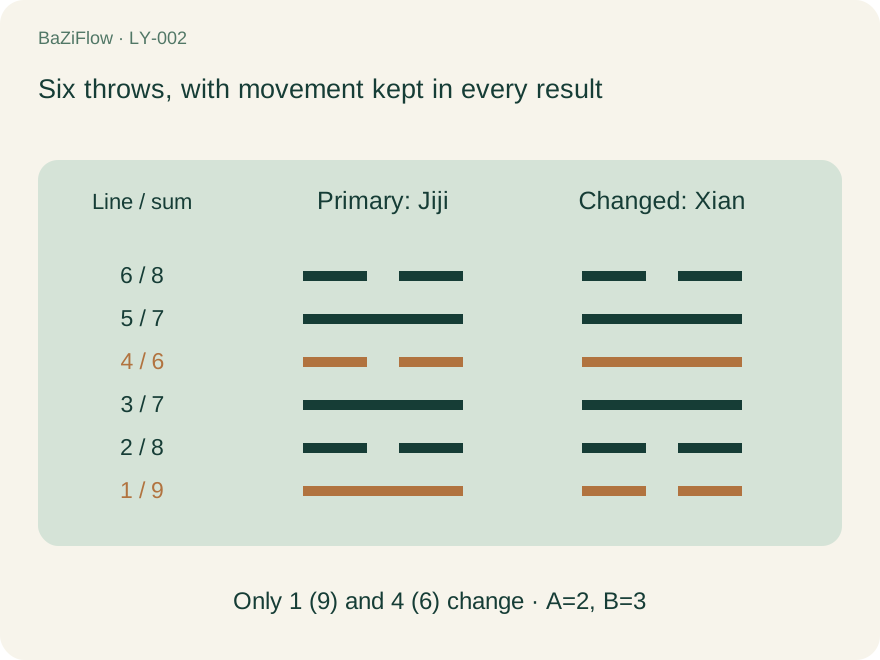
Original BaZiFlow recording exercise. A counts as 2 and B as 3; the six results are supplied teaching data, not a personal prediction.
Do not add all six sums and take a remainder to select a new moving position. In this procedure each 6 or 9 already identifies its own moving line. Replacing them with one total-based position would discard the multiple-line information actually recorded.
Jiji
Xian
Reverse Jiji positions one and four together to obtain Xian, keeping the other four lines unchanged.
Preserve the sequence when changing the layout
A written log usually puts throw 1 on its first row. A hexagram puts line 1 at the bottom. Turning the log into a diagram therefore involves a layout change, not a reversal of the line indices. Keep the indices attached to their results when copying between paper and software.
A reproducible log retains the face mapping, all six throws and their sums. Record the time and question scope separately for later charting and interpretation; those fields do not overwrite what the coins showed. If another tool uses different face names, compare its legend before importing the record. “Heads” or “front” alone is not a reliable cross-tool specification.
An edge-standing coin, an unreadable landing or a missing coin leaves that throw undetermined. State a handling convention before the exercise and record why a throw was repeated or a new sequence started. This is a modern data-recording recommendation, not a claim that the quoted source defines every such situation. An unclear face should not be completed with whichever value produces a preferred result.
The casting record is not the completed interpretation
A sequence without any 6 or 9 has no moving line under this convention; one containing several retains them all. Do not change a 9 into a 7 or erase an additional moving mark merely to obtain a more appealing changed figure. For the supplied example, a direct check is simple: exactly positions 1 and 4 differ, and the other four positions remain identical.
At this stage you have the primary figure, moving positions and changed figure. Najia branches, the six relations, six spirits and self–other markers are not directly supplied by the three-coin sum. Continue to Najia, six relations and six spirits while keeping the six original results intact.
Questions readers ask next
Why retain both seven and nine when each starts as yang?
A solid line describes an initial state without specifying its next operation. These two values carry different movement information. A format storing only yin or yang therefore needs a separate movement field to reproduce the transformation.
Does the left-to-right order of the coins affect a throw?
Under the declared sum rule, BAA, ABA and AAB all give seven. Spatial ordering within that one throw is irrelevant, but the chronological order of the six throws fixes six distinct line positions and must stay attached to the results.
Should a record with two moving lines be cast again?
The supplied exercise already contains two definite changes, so both belong in its reconstruction. Erasing one to imitate a different input procedure creates a different record and cannot reproduce the original six results.
Was this article helpful?
Part of a learning path
Liu Yao: from casting to the Useful God and movement · Step 2 of 2 available