

The Month Command: Seasonal Context Is Not an Extra Vote
Content version · · Sources & references
Two identical Wood symbols can occupy different seasonal contexts. A spring-state matrix shows what the Month Command contributes, and why seasonal support is not a complete strength judgment.
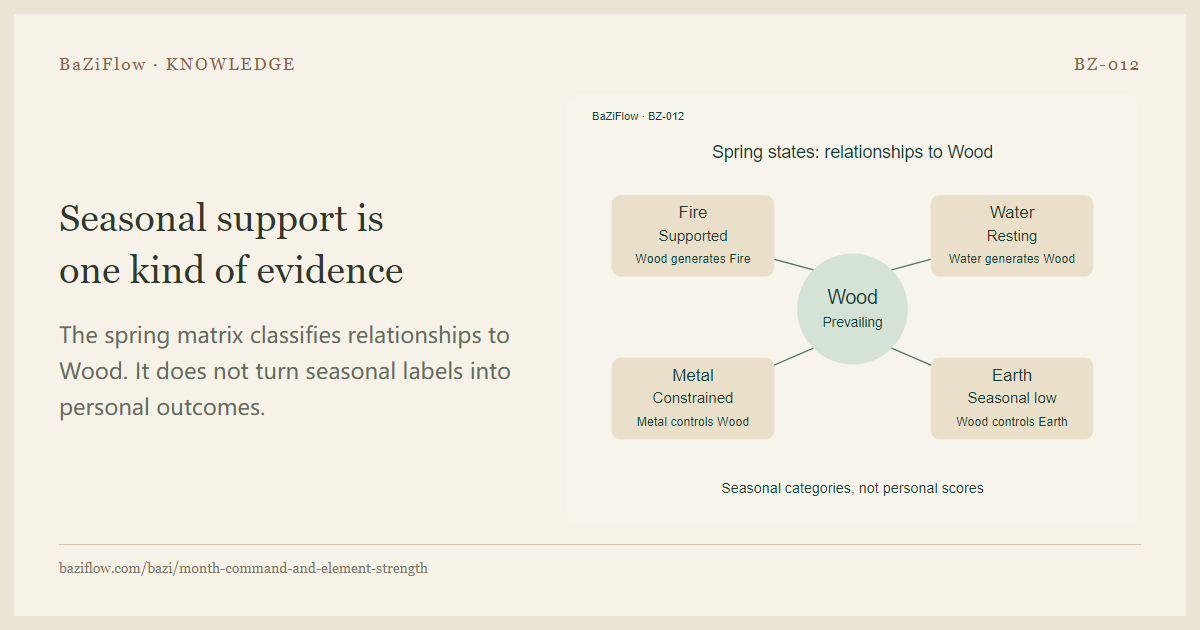
The spring matrix classifies relationships to Wood. It does not turn seasonal labels into personal outcomes.
Read first
Why BaZi months follow solar-term boundaries ↗
Five Elements cycles: learn the relationships, not just the order ↗
Hold the symbol constant; change the context
Write Yang Wood on two cards. Mark one “Tiger month” and the other “Monkey month.” The count of Wood symbols remains one on each card, yet a traditional Zi Ping reader has not been given identical conditions. Month context is precisely the information that a simple character count omits.
This is a controlled teaching comparison, not a pair of personal charts. It cannot establish a strong or weak Day Master. Its narrower purpose is to separate the question “How many symbols are present?” from “Under which seasonal conditions are they being read?” Giving the Month Branch an extra vote in a count does not capture that distinction either.
Start with a calendar coordinate
The Month Command describes seasonal authority associated with the chart's month. In ordinary Zi Ping practice the month boundary follows the twelve solar terms classed as sectional terms, rather than the first day of a civil-calendar month. The Hong Kong Observatory explains the twenty-four solar terms as successive fifteen-degree divisions of solar longitude, alternating sectional and principal terms. The article on solar terms and Month Pillars supplies the calendrical foundation.
That coordinate should not be confused with a weather reading. Actual temperature varies with location, altitude and hemisphere. A hot day does not, by itself, change a traditional Month Branch. If a school adapts the framework for a different climatic setting, the adaptation needs to be identified; silently swapping branches is not a neutral calendar conversion.
In San Ming Tong Hui, volume 2, solar terms, seasonal states and the duty of components within months are discussed in distinct sections. They belong to related but different levels of analysis. Identifying a month is not the same task as choosing a within-month duty schedule or evaluating an entire chart.
Build the spring matrix from relationships
Take Wood as the seasonally prevailing phase in spring. There are four remaining places to fill: what Wood generates, what generates Wood, what controls Wood, and what Wood controls. Following the standard generation and control cycles yields Fire, Water, Metal and Earth respectively. Each has one role, so the matrix can be checked without guessing from the emotional tone of its labels.
| Role relative to spring Wood | Phase | Traditional seasonal state |
|---|---|---|
| The prevailing phase | Wood | Prosperous |
| Generated by Wood | Fire | Supported |
| Generates Wood | Water | Resting |
| Controls Wood | Metal | Constrained |
| Controlled by Wood | Earth | At its seasonal low |
The last state is often literally translated as “dead.” In this vocabulary it is a seasonal classification, not a prediction of a person's death. Similarly, the constrained state is not a statement about imprisonment. San Ming Tong Hui explicitly resists reading every vigorous state as fortunate and every diminished state as unfortunate. Translating the terms does not license turning them into individual outcomes.
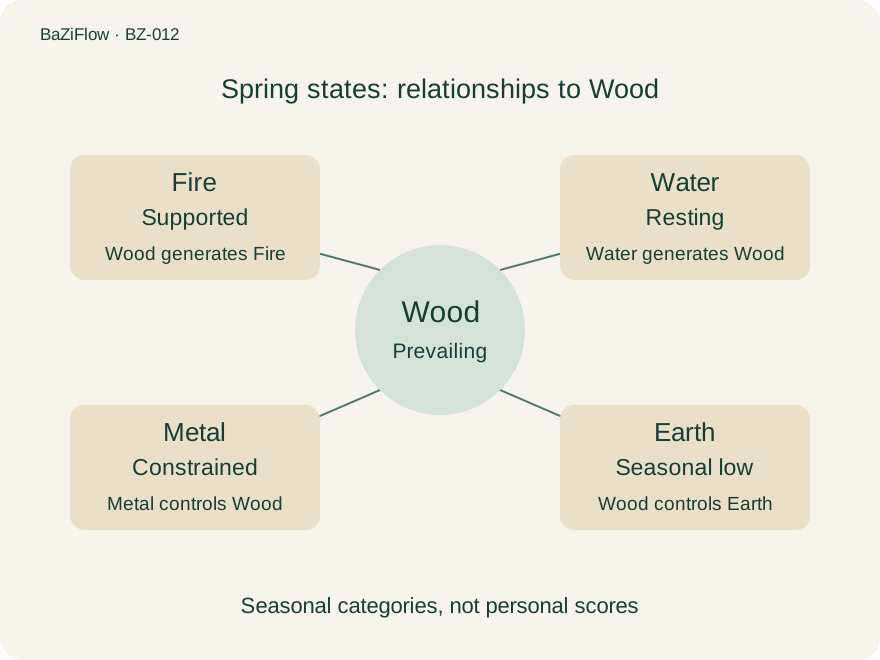
Original BaZiFlow diagram of traditional spring relationships; these states are not personal scores or predictions.
Why the matrix does not settle a chart
Seasonal support is one kind of evidence. Roots, visible stems, assistance, expenditure and control within the configuration still need to be examined. A phase outside its preferred season may have other support; a phase in season does not become immune to the rest of the structure. The comparison of rooting, emergence and seasonal support helps keep these evidence types separate.
Nor does the matrix provide a numerical model. Assigning five points to its first row and one point to its last is an additional scoring choice. A claim to calculate strength should state such choices, rather than present numbers as if they were supplied by the classical names themselves. The order of labels is not a calibrated scale of human capability.
Earth needs particular care in broader seasonal tables. Classical and later presentations may emphasise late summer or discuss Earth as distributed through seasonal transition periods associated with the four Earth branches. More detailed duty schedules also vary. This article uses the spring relation matrix to make the logic inspectable; it does not claim that every Earth month is interchangeable or that one fixed allocation of days resolves all traditions.
The two-card comparison at the beginning therefore has a deliberately limited answer. Changing Tiger month to Monkey month changes a seasonal condition. Whether the whole configuration supports a strong or weak Day Master remains a further question, requiring the omitted information and a stated interpretive framework.
A boundary in classification is not a switch in life
Crossing a solar-term boundary can change the Month Pillar under the chosen calendar rule. It does not demonstrate that ability, relationships or events change abruptly at that instant. Near a boundary, the precision and time basis of the original record matter. If the uncertain time interval crosses the boundary, the uncertainty should remain visible rather than being hidden beneath a definite reading.
The Month Command is useful because it makes the reader consider conditions before counting symbols. Keep its seasonal evidence distinct from the final judgment. Strong and weak Day Masters takes up that next question without treating one seasonal label as the whole answer.