

Fu: one yang returns, seven days and ten years
Content version · · Sources & references
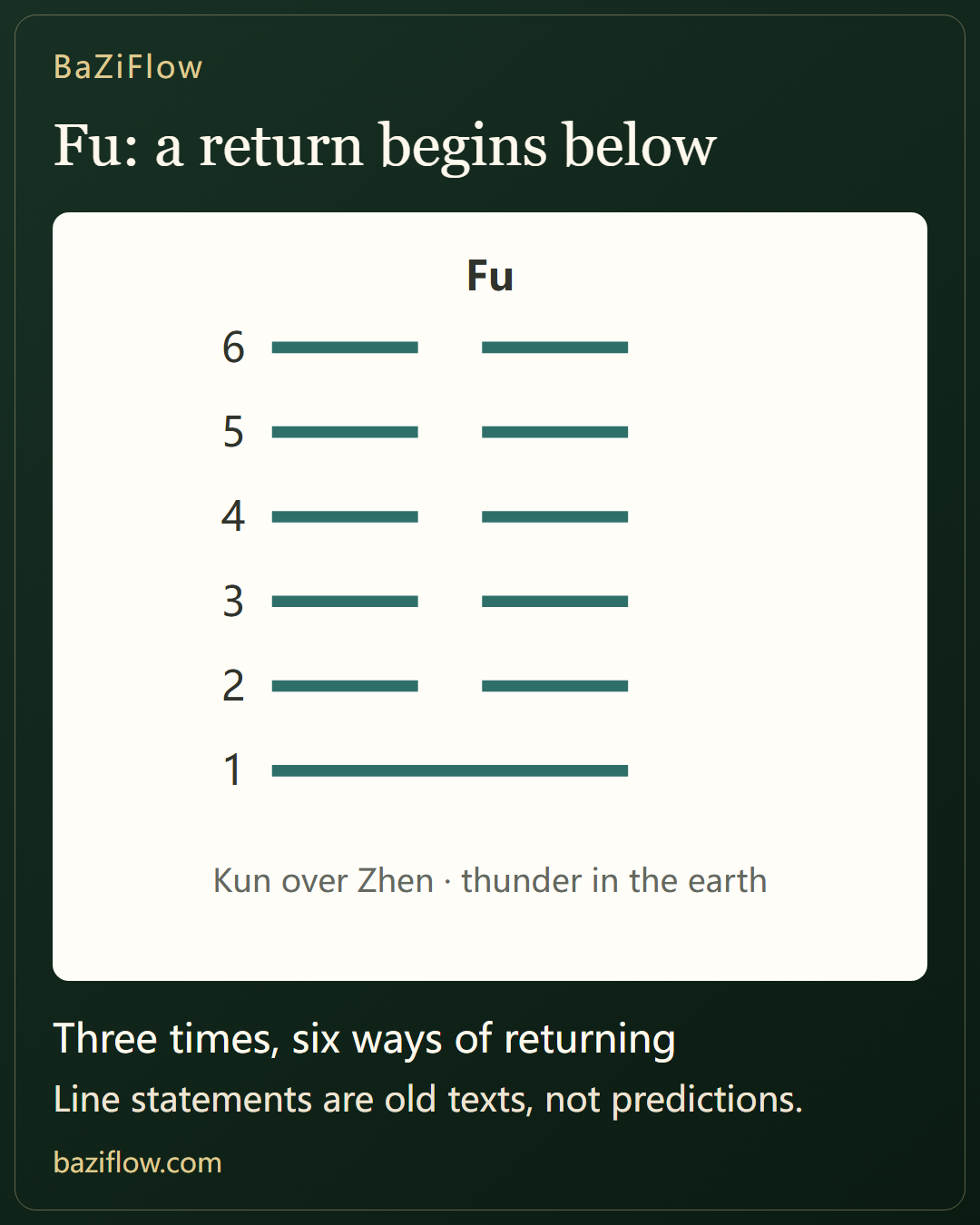
Fu (復) is the 24th hexagram: thunder within the earth, one yang line back at the bottom. Seven days, the solstice and ten years are counted, and six statements run from a near return to a lost one.
The short version8 min read
Fu literally means to come back. One yang line has come back at the bottom with five yin above; the judgment counts seven days, the Image the solstice, the top line ten years, and six statements describe six ways of returning by their distance from that yang line.
- Fu (復) stacks Kun (earth) on Zhen (thunder): one yang line has come back at the bottom, five yin lines above. The Commentary on the Judgments says "the firm returns" and "the firm grows", and the Great Image (大象) says "thunder within the earth".
- The judgment says "back and forth along its way, on the seventh day it returns"; the Commentary adds "heaven's movement" and closes with a question about the heart of heaven and earth. The Image closes the passes at the solstice.
- The six statements are: a return not far, a restful one, a repeated one, a lone one, a sincere one and a lost one, only the line farthest from line one is called lost. The top line is the longest and runs on to "for ten years it cannot campaign".
Read first
The Sixty-Four Hexagrams: How Upper and Lower Trigrams Form One Figure ↗
Judgment and Line Statements: Whole Hexagram or Single Line? ↗
Thunder within the earth: one yang line back at the bottom
Fu (復) is the 24th hexagram: Zhen (thunder) below, Kun (earth) above. The only yang line is the lowest one, line one; the five above it are yin. In the Shuo Gua Zhen is the trigram of movement and Kun that of yielding: movement below, yielding above, with the thunder still hidden in the earth.
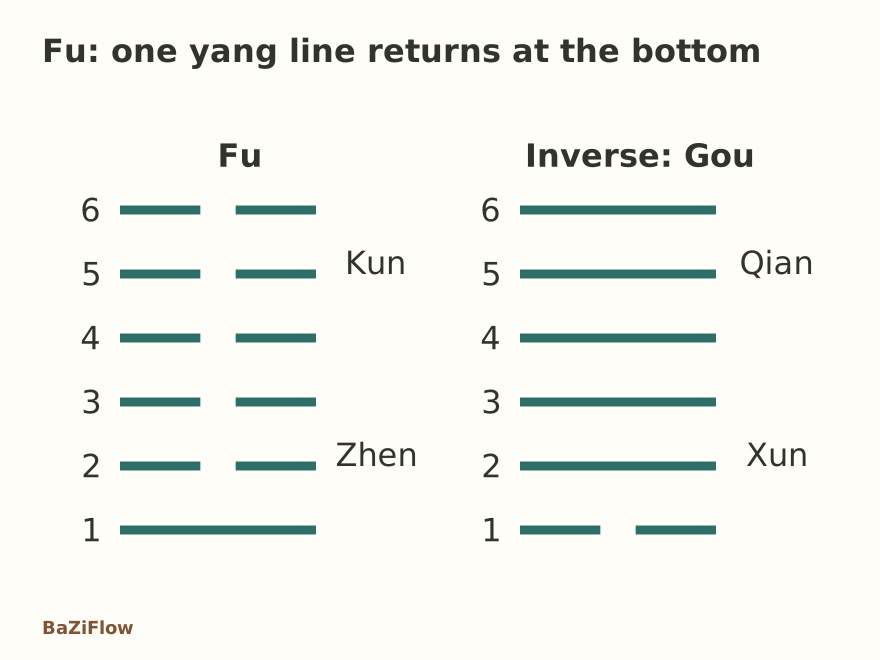
Fu beside its inverse Gou: in Fu a yang line returns at the bottom, in Gou a yin line appears there.
Enlarge diagram · scroll sideways to read
Three terms before reading Fu
- Fu
- To come back, to return. The name is a verb, and what returns is a single yang line at the bottom.
- Back and forth along its way
- Literally, going to and fro on the same road: out, and back again.
- Seven days
- The time word in the judgment. Whether it means seven days or a short cycle in general has long been read both ways.
The figure above sets Fu beside its inverse Gou. In Gou a single yin line appears at the bottom with five yang above; in Fu a single yang line returns at the bottom with five yin above. Each has just one odd line, and in both it sits at the bottom.
The judgment and the Commentary: the seventh day, the heart of heaven and earth
The judgment of Fu is longer than those of the hexagrams before it and has several short clauses:
Success. Going out and coming in without harm; friends arrive, no blame. Back and forth along its way, on the seventh day it returns. Fitting to have somewhere to go.
"Going out and coming in without harm" says nothing goes wrong on the way out or back; "friends arrive, no blame" says companions come without fault; "back and forth along its way, on the seventh day it returns" has the way traveled both ways and the return on the seventh day, and the last words are "fitting to have somewhere to go". The Commentary on the Judgments goes through them in turn:
Fu: success. The firm returns; it moves and goes forward with yielding, hence going out and coming in without harm, and friends arriving without blame. "Back and forth along its way, on the seventh day it returns": this is heaven's movement. "Fitting to have somewhere to go": the firm is growing. In Fu, may we see the heart of heaven and earth?
"The firm returns" is read off the figure: the firm, a yang line, has come back. "It moves and goes forward with yielding" is Zhen below moving and Kun above yielding. After "on the seventh day it returns" the Commentary adds only three words, "heaven's movement": this is how heaven moves; the Commentary on Bo also ends on "heaven's movement". "The firm is growing" says the yang line is rising. The last sentence is a question: "in Fu, may we see the heart of heaven and earth?" In this returning yang line, one can see the "heart" of heaven and earth.
Enlarge diagram · scroll sideways to read
The Great Image: the solstice, the ruler does not tour
The Image of Fu falls into two halves, and the second has two subjects. The first half gives the image: "thunder within the earth: Fu", Zhen under Kun, thunder still in the ground. The second half says what the ancient kings did "at the solstice", traditionally read as the winter solstice: they closed the passes, shutting the border gates, while traders and wayfarers stayed where they were. Then the subject changes, and "the ruler made no tour of the regions".
The kings closed the passes at the solstice ... the ruler did not tour the regions.
First "the ancient kings", then "the ruler": two subjects in one Image.
Enlarge diagram · scroll sideways to read
The Image of Guan says "the ancient kings accordingly toured the regions", and that of Fu says "the ruler did not tour the regions": the same act, one going out and the other not. The images differ too, wind over the earth in one and thunder within the earth in the other.
The six statements: from "a return not far" to "a lost return"
Fu appears in every one of the six statements, and the word before it keeps changing. Set the six lines in order of their distance from line one and the modifier runs from "not far" to "lost".
Enlarge diagram · scroll sideways to read
Line one is the yang line that has come back: "returning before going far", with "no great regret" and "supreme good fortune"; the Small Image says "it is a way of cultivating the self". Line two, "a restful return", sits right against line one, the word for restful being one of well-being; the Small Image says "it humbles itself before benevolence". Line three, "repeated returns", is coming back again and again: "danger, but no blame", and the Small Image says "by right there is no blame".
Line four, "walking in the middle, returning alone", walks among the five yin lines, and only this line answers line one, which tradition usually reads as why it returns "alone"; the Small Image says "it follows the Way". Line five, "a sincere return", has a word for solid and honest: "no regret", and the Small Image says "central, it examines itself". At the top line the modifier turns into "lost": "a lost return: misfortune, with calamity and error", and then the list goes on: using armies brings "in the end a great defeat"; for the ruler of the state, "misfortune"; "for as long as ten years it cannot campaign". The Small Image says "it goes against the ruler's way".
Neighbors of Fu: Bo, Gou, and the Xu Gua on a line that turns back
Turn Fu over and you have Bo (剝): the yang line that sat at the top now sits at the bottom, each hexagram being the other turned over. The inverse is Gou (姤), already set beside Fu in the first figure. The nuclear hexagram is Kun (坤); the structure of a hexagram shows how it is drawn.
When the Xu Gua explains why Fu follows Bo, one phrase carries the weight:
stripping has used up the top and turns back to the bottom
The stripping is not carried to nothing: once it reaches the top the line comes back from below, and so Fu follows. Right after Fu comes Wuwang (无妄), and the Xu Gua gives its reason: once the return has happened, there is no more reckless moving.
Enlarge diagram · scroll sideways to read
Questions readers ask next
Does "on the seventh day it returns" mean seven days?
The text does not say, and readers have long divided: some count it literally, others take it as a short cycle in general. The Commentary adds only "heaven's movement". The safest way to quote it is to give the words, "the seventh day", and not convert them into anything else.
Why does the Commentary end on a question?
The closing question reads as pointing something out: in this returning yang line one may see the "heart" of heaven and earth. In the Commentary on this hexagram it is also the only sentence that ends as a question.
Why is the top statement so long?
The top line is the longest in the hexagram: after "a lost return: misfortune, with calamity and error" it lists a great defeat in war, misfortune for the ruler and ten years without a campaign. It is also the only line whose return is called lost, and it spells out the consequences in most detail.
Was this article helpful?
Sources & references
Continue reading
Bo: a mountain on the earth, from "stripping the bed legs" to "a great fruit uneaten" ↗
The Sixty-Four Hexagrams: How Upper and Lower Trigrams Form One Figure ↗
Judgment and Line Statements: Whole Hexagram or Single Line? ↗