

The Hanged Man: a head-down moment
Content version · · Sources & references
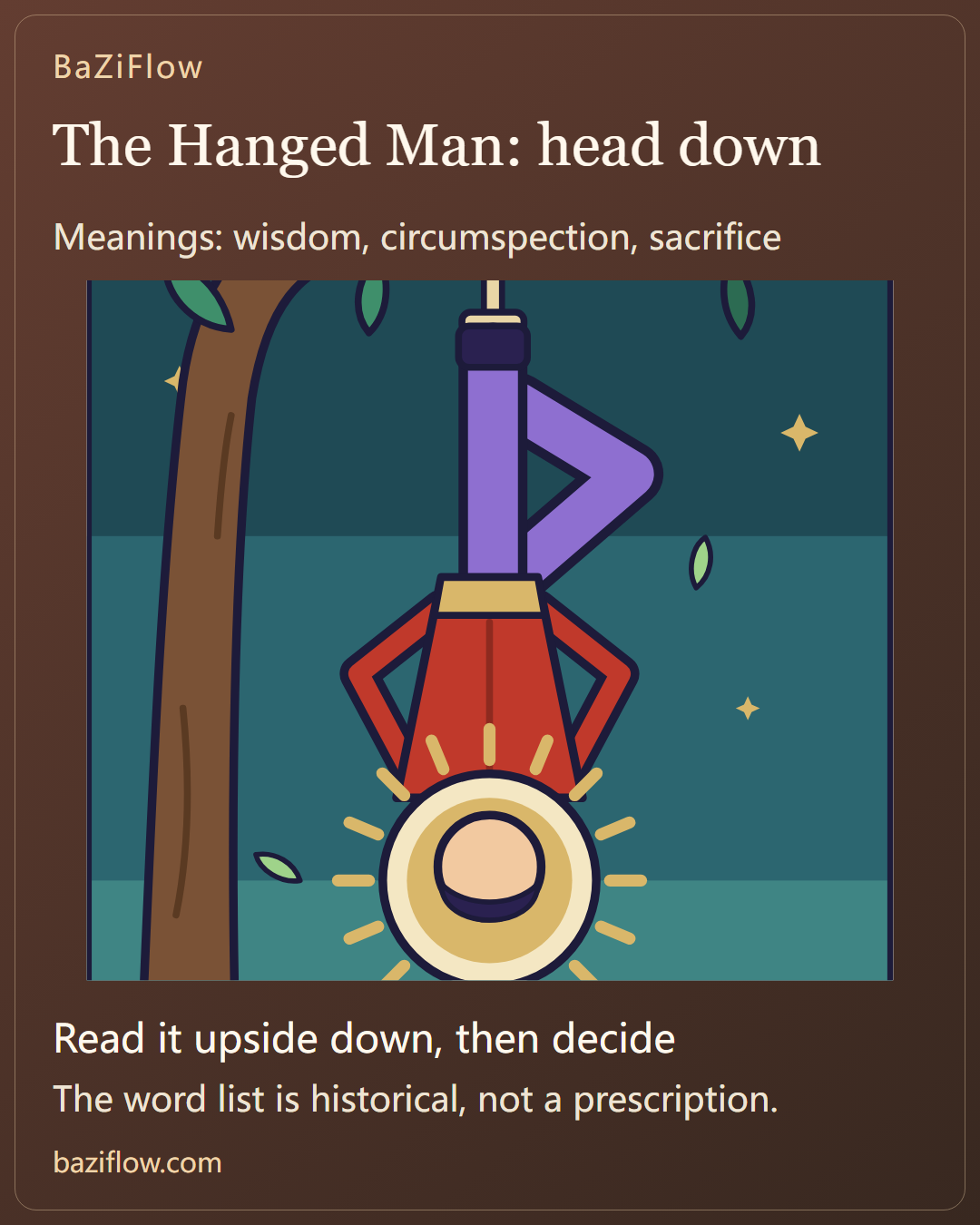
The Hanged Man shows a figure hung by one foot, a ring of light at the head. Separate the three things Waite points out, his eight-word list and his refusal of other readings, then read an agenda upside down.
The short version7 min read
The Hanged Man is a person upside down with a calm face. Waite first points to three things in the picture and then turns down the popular readings, so the first task is to tell what he wrote from what was borrowed later.
- Waite names three points: the gallows is living wood with leaves; the face shows entrancement, not suffering; the whole suggests life in suspension, life and not death.
- The divinatory list has eight words: wisdom, circumspection, discernment, trials, sacrifice, intuition, divination, prophecy. Reversed: selfishness, the crowd, body politic. "Waiting" and "pause" are not in it.
- He says calling it a card of martyrdom, prudence, the Great Work or duty is false, and gives one sentence of his own: it expresses a relation between the Divine and the Universe.
Read first
The picture: living wood, one foot, a ring of light
Waite starts with two shapes. The gallows from which he is suspended forms a Tau cross, and the figure, from the position of the legs, forms a fylfot cross. There is a nimbus about the head of the seeming martyr.
Then he asks the reader to note three things: first, that the tree of sacrifice is living wood, with leaves on it; second, that the face expresses deep entrancement, not suffering; third, that the figure as a whole suggests life in suspension, but life and not death.
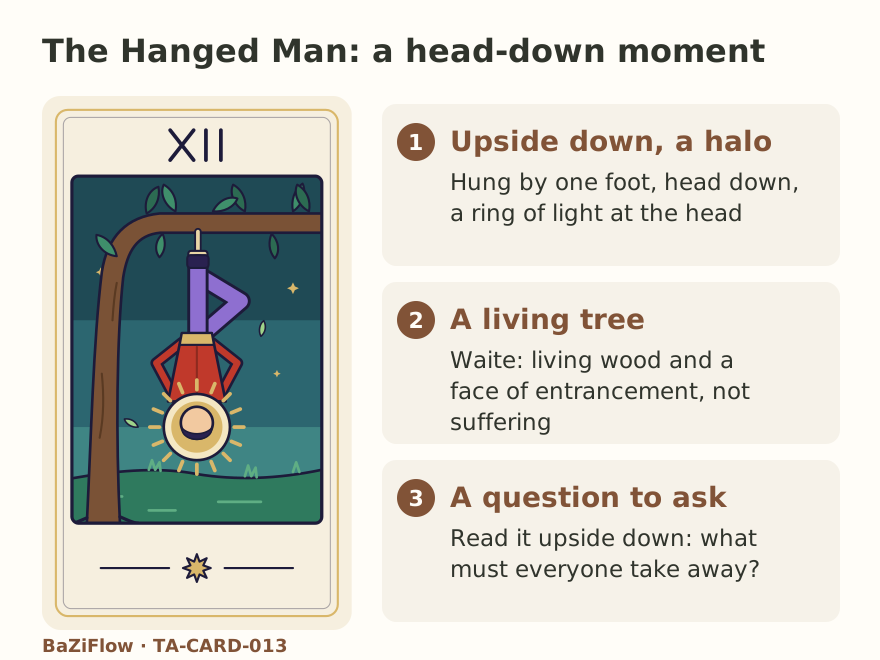
BaZiFlow's original Hanged Man with three ways to read it
On the RWS card itself, a beam runs across the top with green leaves hanging at both ends. The figure is held by one foot from the beam, that leg straight and the other bent behind it, head down, with a ring of yellow light around the head, a blue tunic and red legs.
Read the picture from top to bottom: the wood, the person, the light.
Enlarge diagram · scroll sideways to read
What Waite lists: eight words, and none of them is "waiting"
Waite's divinatory meaning is eight words:
Wisdom, circumspection, discernment, trials, sacrifice, intuition, divination, prophecy.
The eight fall into three small groups: the first three are about how to see, the middle two about what is paid, the last three about looking ahead without reasoning it out. There is no "waiting", "pause" or "letting go" in the list. The nearest source for that reading is the phrase "life in suspension" in Part II, which sits in the description of the picture and did not enter the list.
Enlarge diagram · scroll sideways to read
Tau wood, crossed legs, a nimbus: what he wrote, and what he turned down
Waite names three shapes: the Tau gallows, the cross formed by the legs, and the ring about the head. He describes the shapes without explaining what each one means.
Three shapes, each with its source
- Tau wood
- Waite: the gallows forms a Tau cross, and it is living wood with leaves on it. Tau is the Greek letter T, here a form of the cross.
- Crossed legs
- Waite: from the position of the legs, the figure forms a fylfot cross. He points out the shape and goes no further.
- Nimbus
- Waite: there is a nimbus about the head of the seeming martyr. In traditional images a halo commonly marks a holy person.
Enlarge diagram · scroll sideways to read
In the next passage Waite's tone changes. It is a card of profound significance, he says, but all the significance is veiled. One editor suggests that Éliphas Lévi did not know the meaning, which is unquestionable; nor did the editor himself.
It has been called falsely, he adds, a card of martyrdom, a card of prudence, a card of the Great Work, a card of duty, and one may exhaust all published interpretations and find only vanity. Of his own he says very simply that it expresses, in one of its aspects, the relation between the Divine and the Universe.
How to read it: hang the agenda upside down and start from the end
The picture has a plain structure: one point of attachment, the foot that holds him; a head turned down; and light about the head. Put onto a meeting agenda, it turns into three moves. It is an exercise borrowed from the picture, not from Waite.
Find the hook
Only one foot and one beam hold him. A meeting has one thing it must deliver: write it as a sentence, for example "this week's schedule is settled". Every other item hangs under it.
Head down: start from the end
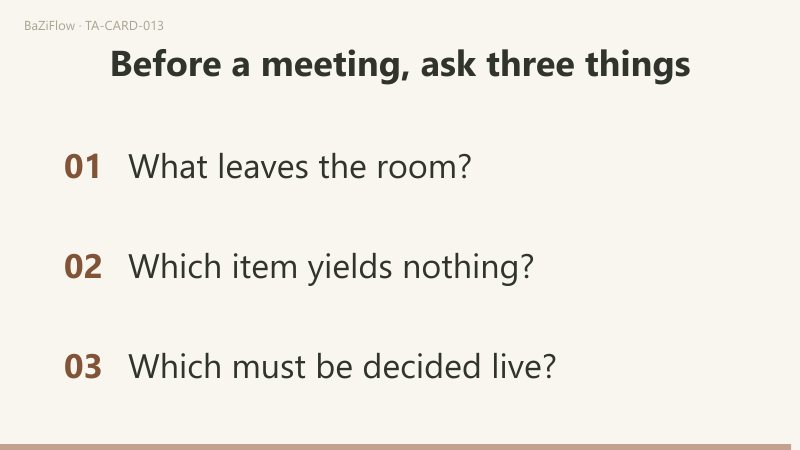
Start from "what each person takes out of the room" and go up the agenda from the bottom, asking of each item: does it yield a decision, a piece of information, or only a round of talking?
Keep what the light falls on
The light is at the head: keep in the meeting only the items that people present must decide on the spot; turn information items into a written update beforehand; cut the round-robin ones first and see whether anyone misses them.
Say a weekly meeting has three agenda items and has to shrink to forty-five minutes. Ask them from the end and the three separate by kind:
Enlarge diagram · scroll sideways to read
What is left of the agenda, read upside down
Kept in the room
- The schedule clash
- A stated yield per item
Taken out
- An item that is only a round of talk
- Numbers nobody will use
The day before
- Send the inverted agenda
- The written updates
Reversed and neighboring cards: selfishness, the crowd, and three cards about being stuck
Waite's reversed list has three words:
Selfishness, the crowd, body politic.
He does not expand on them. The first word points to the individual and the other two to a group: "the crowd" and "body politic", meaning the state or society as made up of its people. Reading it as "hung between the individual and the group" is a way of arranging the three words, not Waite's own statement.
Enlarge diagram · scroll sideways to read
Three cards that write about stopping or being held
One word, another road
The Hermit's list also contains circumspection, with prudence, and, "especially", treason, dissimulation, roguery, corruption. Waite adds that reading the card as occult isolation is a frivolous rendering.
Bound, but "temporary"
Waite describes a woman bound and hoodwinked, then adds that it is rather a card of temporary durance than of irretrievable bondage. For the Hanged Man he writes life in suspension; both keep a door open.
Looking back at this card
In the entry for Death Waite says that the suggestion of death he made at the previous card is to be understood mystically, which is not the case for Death itself.
Enlarge diagram · scroll sideways to read
Questions readers ask next
Does the Hanged Man mean "pause" or "wait"?
Neither word is in Waite's list. The nearest thing is the phrase "life in suspension" in Part II, which describes the whole picture and never entered the divinatory list. Reading the card as a pause is a later teaching borrowing.
Is the Hanged Man suffering?
Waite points out that the face expresses deep entrancement, not suffering, and that the tree is living wood with leaves. His list does include trials and sacrifice, yet he also says it is false to call the card one of martyrdom.
What is the reversed Hanged Man?
Waite's reversed list has three words: selfishness, the crowd, body politic. He does not expand on them. How individual and group words match the upright list is not stated, so say whose reading you follow.
Was this article helpful?
Sources & references
Continue reading
The Hermit: a lamp held high, while Waite's list runs from prudence to treason ↗