

Facts, symbols, inferences and advice
Content version · · Sources & references
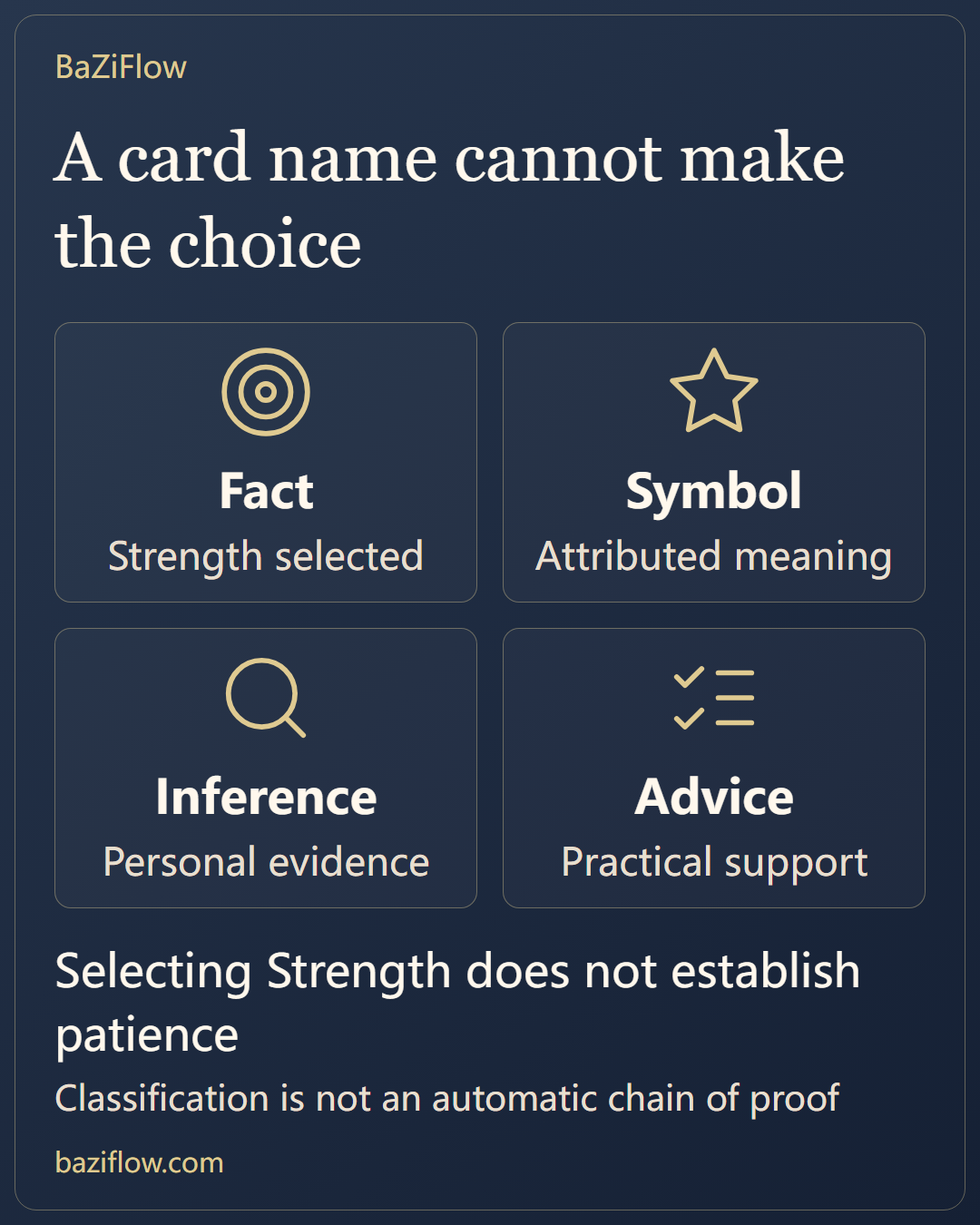
Separate four kinds of statement before judging a reading. A Strength-card example shows why a documented symbol does not establish a trait or decide an action.
The short version6 min read
An exercise can record that Strength was selected without supplying any evidence about a person’s patience. Identify the job of each sentence to locate the missing reason.
- A recorded selection identifies the card, not an established trait of a real person.
- Symbolic interpretation needs attribution; personal inference also needs relevant evidence and conditions.
- Advice requires practical goals, timing and other people’s willingness, and a sound explanation may stop before reaching advice.
Read first
Combination, Opposition and Star: Similar Words, Different Rules ↗
Give each sentence a job description
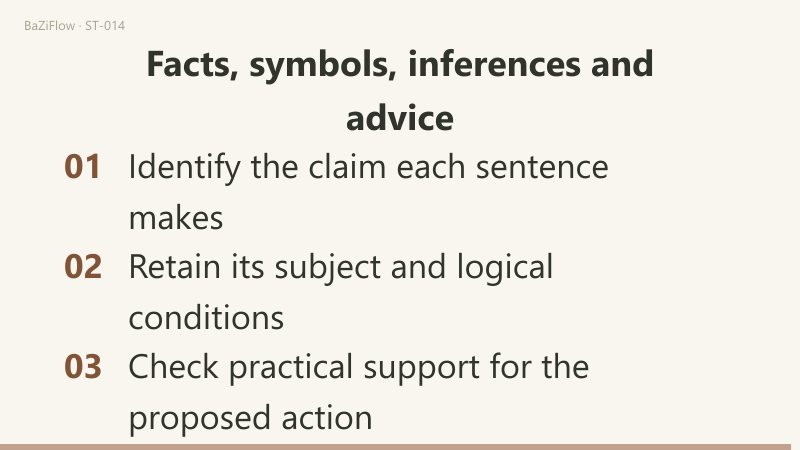
A factual statement identifies what a record contains. A symbolic statement describes an interpretive association. An inference applies reasoning to reach a further claim. Advice proposes an action in a real situation. They can appear in one paragraph, but they do not carry the same evidential responsibility.
Before deciding whether a reading is persuasive, identify which job its most important sentence is doing. A clearly recorded card or chart field is not already a measured personality trait. A possible interpretation is not already a recommendation. Keeping these distinctions visible allows a reader to use symbolic material without overstating what has been established.
| Statement type | What it needs | What it cannot silently become |
|---|---|---|
| Fact | A current source and defined scope | A claim about someone else or a different time |
| Symbol | An attributed interpretive tradition | Independent evidence of a personal trait |
| Inference | A rule and relevant conditions | A certainty after its conditions are omitted |
| Advice | Practical goals, constraints and alternatives | A result dictated by a symbol alone |
The exercise selects Strength
- Sentence role
- Recorded premise
Strength represents restraint
- Sentence role
- Attributed interpretation
This person is always patient
- Sentence role
- Personal inference
Attend immediately
- Sentence role
- Action proposal
Two claims that are easily confused
- Reflection prompt
- Invites observation without asserting that the person already has a trait.
- Personal assertion
- Makes a claim about someone and needs evidence belonging to that person.
Use the source to set a narrow factual boundary
In the second part of Waite's tarot manual, Strength is numbered VIII and Justice XI. Those headings are verifiable features of that presentation. They should not be universalised to every tarot system. The Strength discussion describes the woman and lion and develops symbolic meanings; Waite also identifies some deeper meanings as matters of inference rather than obvious surface content.
This offers a teaching example without inventing a person's reading. Suppose an exercise selects Strength. The factual statement is that the exercise selected that card. A statement about restraint or impulse belongs to interpretation. A claim that a particular person has always been patient would require information about that person, which the exercise does not supply.
There is no need to reproduce a modern copyrighted card image or pretend that a draw occurred. The source's numbering and its distinction between visible design and inference are enough for this exercise. Our figure therefore depicts reading layers, not a card face.
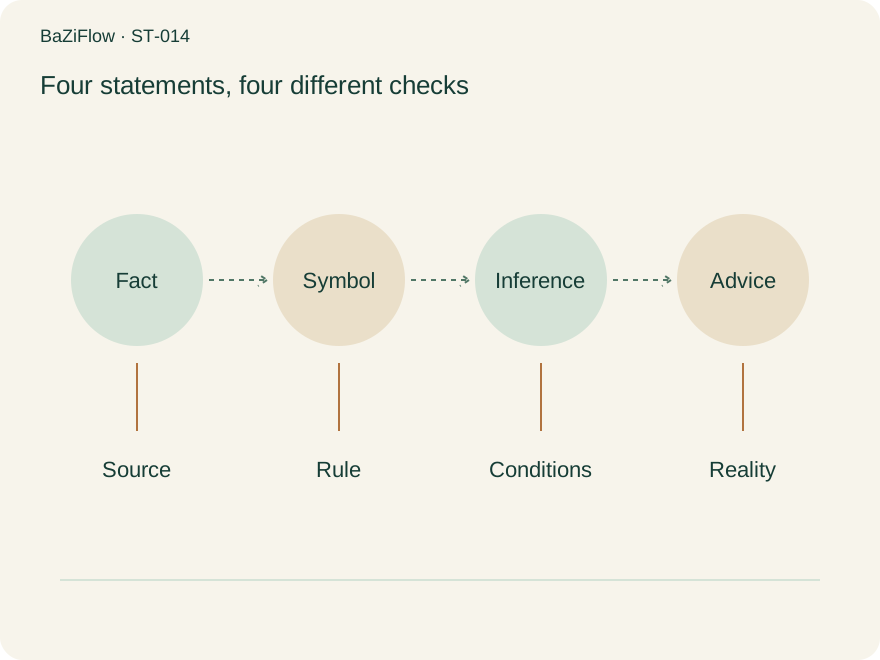
Original BaZiFlow reading-layer diagram. Connections require reasons; a recorded fact does not automatically determine an action.
The broken connections mark places where explanation is needed. The diagram is not a mandatory four-section writing template, and its arrows do not certify a causal chain.
This presentation
- Strength VIII
- Justice XI
Not established by numbering
- Every deck agrees
- A person has the trait
A reflection prompt and a trait assertion are different claims
“Consider how restraint operates in this situation” offers a possible direction for observation. “This proves you are consistently restrained” asserts something about a person's behaviour. The second statement is stronger and needs support beyond the symbolic image. Improving its tone does not supply that missing support.
Preserve the subject, time layer and logical conditions when moving between sentences. A hypothetical future circumstance must not become a natal fact in the next paragraph. A partner's chart, a quotation and a teaching example retain their own provenance. Repeated terminology does not merge them into the current person's data.
Ordinary prose is also not a substitute for an authoritative record: an everyday word that merely resembles a technical term cannot establish a chart entity. Extracting a phrase from generated explanation and then using it to justify that explanation creates a circular support structure. Return to the actual record instead.
If time is available
- Condition to retain
- Availability is still unknown
A partner’s chart field
- Condition to retain
- It belongs to the partner
A future-window interpretation
- Condition to retain
- It is not a current natal record
Action needs information outside the symbolic framework
A proposal to attend an event depends on its content, schedule, availability and the person's goals. A card name does not verify those conditions. Even a well-attributed interpretation cannot remove a scheduling conflict or establish what another person has agreed to do.
Advice should remain distinguishable from observation. “Could consider” proposes an option; “has occurred” describes an event. Changing the grammatical mood does not allow the author to borrow the certainty of a fact for a recommendation. If the real context is missing, a clarifying question or a narrower suggestion may be more appropriate than a complete-looking action list.
Different authors can use the same symbol differently. A classical explanation, a modern psychological reading and a personal analogy should retain their attributions. They do not belong inside one quotation presented as a single historical rule. Classical texts and modern explanations explores that source distinction.
Event condition
- Places are available
Personal condition
- Another commitment overlaps
Stop at the layer the evidence supports
A knowledge article can explain facts and symbols without inferring anything about a person. A data check can stop after reporting a field discrepancy. A reflection note can explore possibilities without issuing advice. Completeness means that the statements are honestly identified, not that every piece of writing fills all four levels.
For a practical reading exercise, choose the strongest conclusion and follow it backwards. What real-world condition makes the proposed action relevant? Which rule links the inference to the symbol? Which current record supports the starting fact? A missing connection calls for a smaller claim or an explicit unknown, not more specialist vocabulary.
This also makes personalisation easier to assess. An individual conclusion should change for a reason when its relevant input changes; it should not merely acquire a different name. Evidence-based personal readings develops that comparison. Keeping the layers visible leaves readers room to decide how much weight each part deserves.
Verify a selected card
- Supported stopping point
- Fact
Explain a writer’s association
- Supported stopping point
- Fact and symbol
Personal goals are missing
- Supported stopping point
- No action recommendation
Record both conditions
The event has places, but the person has an overlapping commitment.
Inspect the recommendation
“Attend immediately” omits the conflict; the selected symbol does not resolve it.
Name a limited next check
Ask whether another session exists. Until confirmed, feasibility remains open rather than guaranteed.
Questions readers ask next
Does selecting Strength establish patience?
A selection records which card the exercise uses. An attributed symbolic interpretation and a claim about a real person require different support.
How does a reflection prompt differ from an assertion?
Asking what someone notices about restraint leaves the answer open. Describing that person as habitually patient asserts a pattern, which calls for observations of their behaviour rather than the card alone.
Must an explanation end with advice?
No. It may stop at verified facts or an attributed interpretation. Practical goals, timing and other people’s willingness must be checked before proposing a specific action.
Was this article helpful?
Theme: Wealth & resources
Part of a learning path
Across systems: compare methods, not stitched conclusions · Step 5 of 5 available