

The seventh house: the Descendant and the party across
Content version · · Sources & references
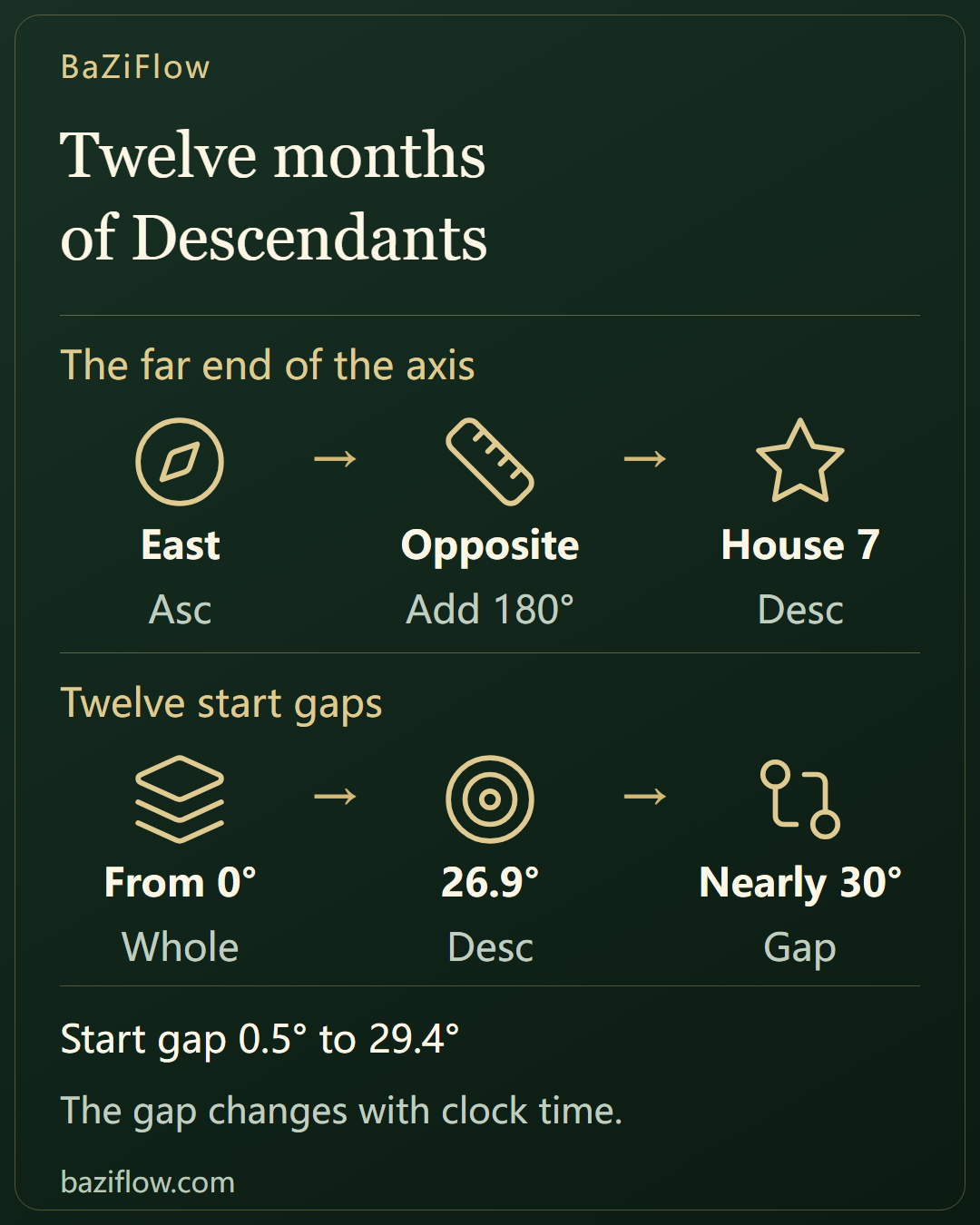
House 7 is the angular house exactly opposite the Ascendant. Lilly’s entries for it, then twelve Descendants at 18:00 in Cape Town: how far apart the two systems start house 7, and why the cusp sign matches.
The short version6 min read
The seventh house is angular and begins at the Descendant, the point exactly opposite the Ascendant. Lilly’s entries for it all concern the party across: a spouse, open enemies, the other side in a lawsuit, and even the astrologer; both systems begin it in the same sign.
- In Placidus the house-7 cusp is the Descendant, always the Ascendant plus 180 degrees. In whole sign, house 7 is the entire sign containing the Descendant, beginning at that sign’s 0 degrees.
- In Cape Town at 18:00 on the 15th of each month of 2026, the Descendant stood anywhere from 0.5 to 29.4 degrees into its sign, and that number is exactly the gap between the two house-7 starts. Libra held the cusp only once in twelve.
- Lilly files marriage, open enemies, the opposing party in a lawsuit or a war, the astrologer and the physician under this house, and says that for a matter judged from it, the lord of the sign on the cusp is the significator.
Read first
The far end of the axis
The seventh house is the third of the four angular houses, the one in the west. It begins at the Descendant, which you reach by counting 180 degrees across from the Ascendant, and Lilly calls it the "Angle of the West."
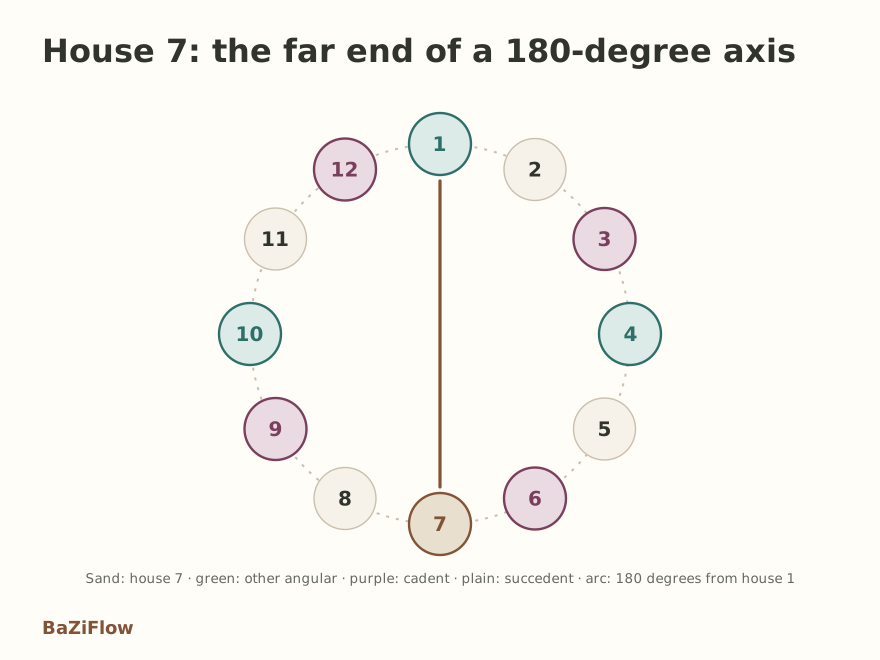
Position sketch: the arc joins house 1, which holds the Ascendant, to house 7 directly opposite; colors mark the class of position, not the size of a house.
In the picture the sand-colored house 7 hangs on an arc of 180 degrees from house 1. Green marks the three other angular houses, purple the cadent ones, and plain circles are succedent. In Placidus, the cusp of house 7 is the Descendant itself, always the Ascendant plus 180 degrees. In whole sign, house 7 is the entire sign that contains the Descendant, and it starts at that sign’s 0 degrees.
What the book files under the seventh house
Lilly’s entry for house 7 has no single field of life at its center. Its center is the other person:
The book says it judges marriage and describes the person inquired after, man or woman; all love questions; "publique enemies"; the defendant in a lawsuit and the opposing party in war; "all quarrels, Duels, Law-suits"; the astrologer himself in astrology and the physician in physic; thieves and thefts; fugitives and banished men.
Read together, the items share one feature: an opposing side facing the person who asks. An adversary, a defendant, someone being sought, someone being consulted.
Enlarge diagram · scroll sideways to read
At the end of the entry the book names Libra and the Moon as co-significators and adds that Saturn or Mars placed here are bad for marriage. That verdict belongs to the book’s own century, and this site’s readings do not cite it.
In a question, the astrologer also sits here
In Lilly’s horary work the querent is the first house, and the seventh across the chart is both the thing or person asked about and the astrologer himself. His cautions before judgment put it this way:
Enlarge diagram · scroll sideways to read
The only reason the book gives is one sentence: the seventh house "generally hath signification of the Artist." For how the horary and electional branch works, see horary and electional astrology.
One clock time, twelve Descendants in a year
The simplest way to watch two house systems divide house 7 is to fix the place and the clock time and let the sky turn for a year. Take Cape Town (33.92°S, 18.42°E, UTC+2 all year), 18:00 on the 15th of each month, and let the engine give both house-7 starts. At a fixed clock time the Ascendant moves forward 24 to 46 degrees a month and completes one circle a year.
Enlarge diagram · scroll sideways to read
The gap is simply the Descendant’s degree within its sign, and all twelve samples read as follows:
Enlarge diagram · scroll sideways to read
On 15 December the gap is only 0.5 degrees and the two systems nearly coincide; on 15 June it is 29.4 degrees, almost a whole sign. Where whole-sign house 7 starts is fixed by the rising sign alone, while where Placidus starts it depends on the Descendant of that moment, and that is the whole reason the two answers can sit this far apart.
The sign agrees, so the sign’s lord agrees
In every row the two systems put house 7 in the same sign. Placidus places its cusp at the Ascendant plus 180 degrees, which lies in the sign opposite the rising one, and that is the very sign whole sign takes. Lilly says that for a matter judged from the seventh house, "the Lord of that sign descending on the cusp is Significator." That lord is therefore one planet in both systems:
Enlarge diagram · scroll sideways to read
Lilly’s "Libra and the Moon" is a correspondence of natural signs, not a promise that house 7 sits in Libra: across the twelve clock times the Descendant fell in Libra only on 15 October (10°38′), while Sagittarius came up twice (January and December).
Two exercises
Cape Town, 15 June, 18:00: a body stands at Gemini 10°. Which house is it in, in each system?
Whole-sign house 7 is all of Gemini, so house 7. Placidus house 7 starts at Gemini 29°22′, and 10° comes before it, so house 6.
On 15 January at the same clock time, a body stands at Sagittarius 28°?
28° is past the Descendant (Sagittarius 26°53′), so both systems say house 7. Within Sagittarius, the two answers split only in the stretch before the Descendant.
The other end of this axis is the first house. Where the Descendant and its three sister points come from is told in the four angles, and what separates the two ways of cutting houses in house systems.
Questions readers ask next
Is the seventh house simply the "marriage house"?
Lilly’s entry runs on the idea of the party across; marriage is one item, next to open enemies, the defendant in a lawsuit, duels, thieves and runaways. "Marriage house" is a later shorthand. A chart supplies only a position and cannot tell anyone’s love life.
Are the Descendant and the sign of house 7 the same thing?
The sign is the same; the degree need not be. The Descendant is one degree, where Placidus starts house 7. Whole sign takes the entire sign containing it, from 0 degrees. In Cape Town on 15 June the Descendant is at Gemini 29°22′ while whole-sign house 7 starts at Gemini 0°.
Why is the astrologer counted in the seventh house?
It is a rule of 17th-century horary: the querent is the first house and the astrologer, sitting across, the seventh. Lilly warns that if the seventh cusp is afflicted and the question is unrelated to it, the judgment will not please the querent. Natal chart reading has no such rule.
Was this article helpful?
Sources & references
Continue reading
The Sixth House: Cadent, Lilly’s "No Aspect", and Mars’s Two Windows in London ↗
The Eighth House: Lilly’s Estate and Dowry, and Why It Is as Wide as the Second ↗