

Keep the original Sukuyō condition
Content version · · Sources & references
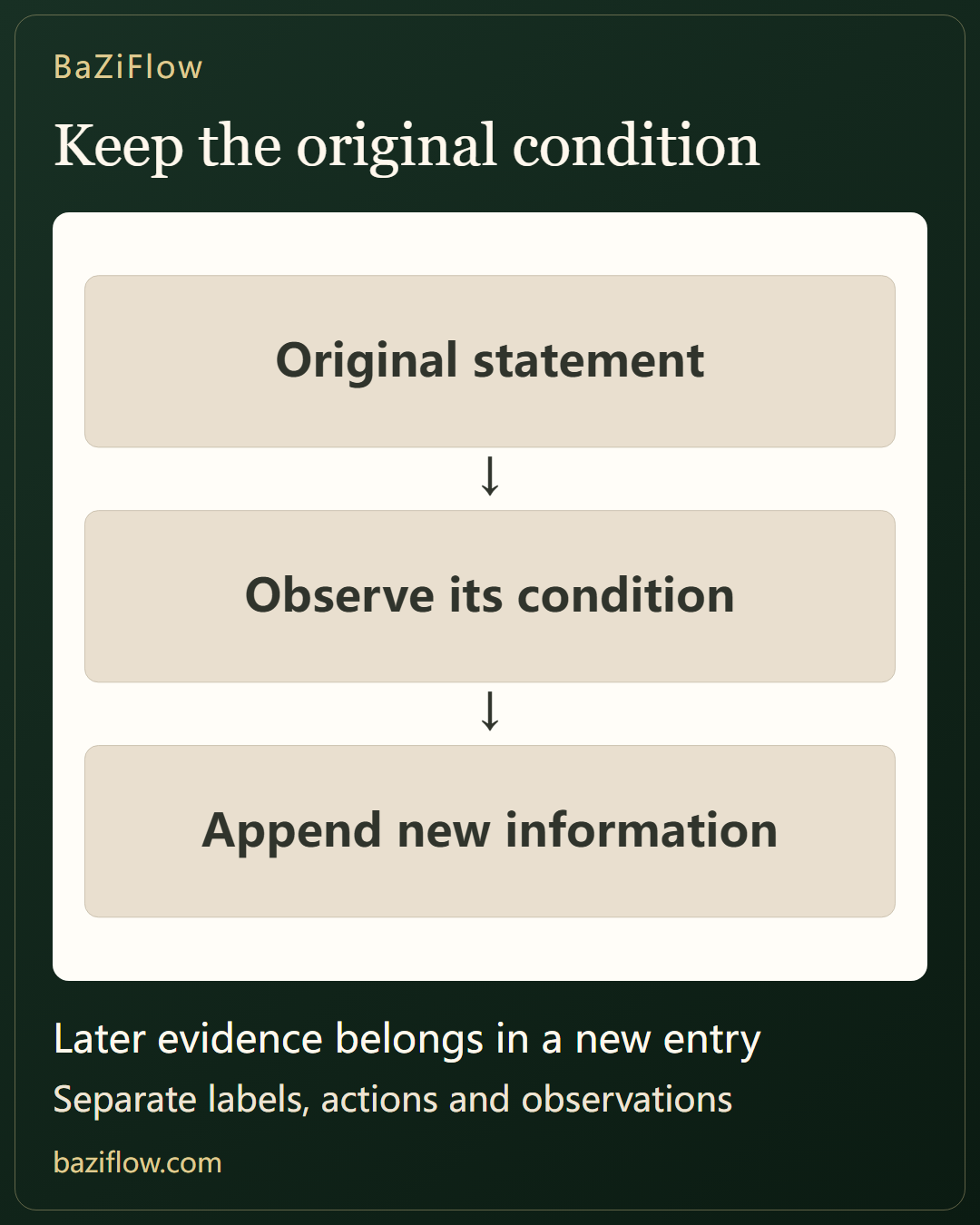
Follow a walk invitation through a Wednesday deadline, distinguish partial confirmation from the original condition, and preserve actions and revisions.
The short version6 min read
A useful Sukuyō case record preserves its comparison, original sentence, intervening actions and observation at the deadline. A reply may leave a detail unconfirmed, and an extension creates a new arrangement. Follow a fictional walk invitation to see how later information can extend a record without changing its original condition.
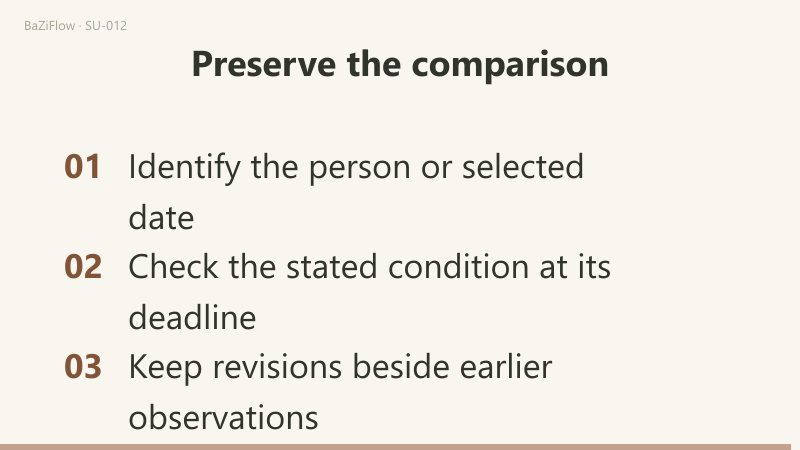
- Two birth references and a birth reference against a daily mansion may produce the same label while comparing different targets; identify the person or selected date.
- When both people must confirm the place and time, one uncertain time leaves the condition unmet. Receiving two replies is a different criterion.
- Append new deadlines, actions and results while retaining the earlier observation. Not yet due, unmet and unobservable are separate record states.
Read first
Decide whether an entry can be judged before counting it
A personal reading log may contain a precise expectation, a broad impression, an unfinished event and a sentence written after the outcome. Those entries do not become comparable merely because each has a mansion label beside it. Before counting apparent matches, determine what each entry actually claimed and whether there was an opportunity to observe it.
Keep not-yet-due entries distinct from missed conditions, and distinguish ambiguous wording from a clearly observed result. A log can improve the honesty of recollection without becoming a study of predictive validity. This article offers a recording practice, not a validated scoring system for Sukuyō.
Preserve the input and the original sentence
Store the method used to obtain the mansion labels and identify the comparison: two people's birth references, or one birth reference against a selected day's mansion. T1299's three-nine discussions distinguish these subjects. That textual distinction helps prevent a later review from quietly replacing one comparison with another.
Preserve the sentence written at the time, its date, scope and intended deadline. Put later explanations in new entries rather than editing them into the original. If the first note simply said that cooperation would improve, a later detailed account of a specific event should not be presented as though the detail was predicted in advance.
The US National Archives' document-analysis method asks readers to consider creator, audience, time, purpose and supporting material. We adapt those general questions to a personal record. The institution has not supplied a Sukuyō experiment here, and its worksheet does not certify the conclusions of a diary.
Consider Bi as the reference. In the cited three-nine order, Zui and Shen intervene before Jing, making Jing inclusive position four, An. If Jing is another person’s birth mansion, the target is that person. If Jing is the mansion assigned to a selected day, the target is that date. The label An matches, but the target field does not. One observation of a conversation cannot silently be used to assess both comparisons.
Jing: a birth mansion
- Target: another person
Jing: a daily mansion
- Target: a selected date
Follow one invitation through a deadline
Imagine two people planning a neighborhood walk. Before sending an invitation, the recorder writes: “By Wednesday evening, both participants will have confirmed the meeting place and starting time.” This is an invented, observable expectation, not a forecast calculated from actual birth data.
The recorder then sends a proposal. One participant confirms both details. The other agrees to the location but says the starting time is still uncertain. At the Wednesday deadline, the original condition has not been met. A reply is not the same as confirmation of both specified details.
| Moment | What the record preserves | What should not be rewritten |
|---|---|---|
| Before the invitation | The original Wednesday condition | A later, easier success criterion |
| During planning | Proposal sent and partial replies received | The recorder's actions as if nothing intervened |
| Wednesday evening | Place accepted, one time confirmation missing | “Both replied” substituted for “both confirmed” |
| Later revision | A new time or deadline agreed | The original deadline erased |
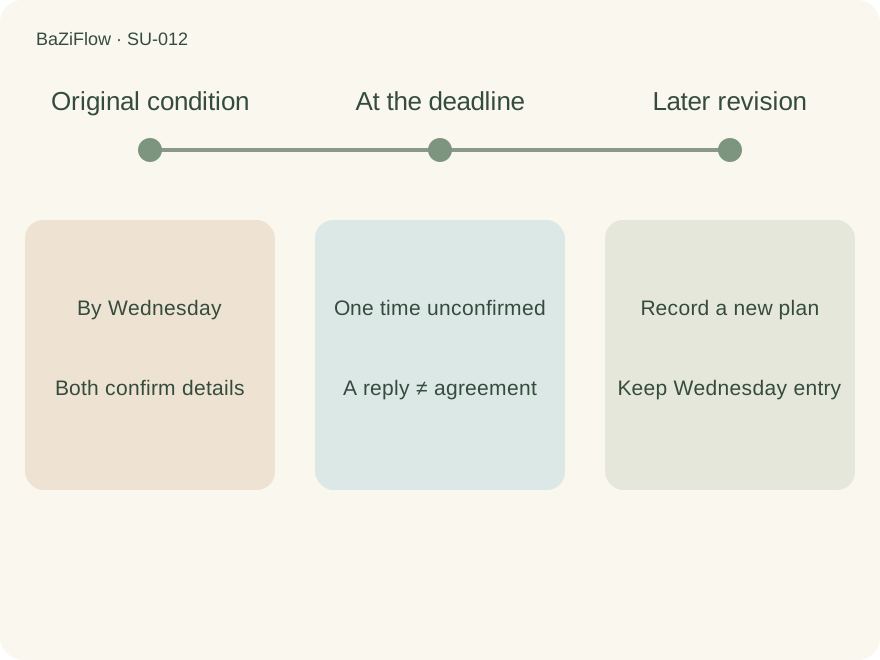
Original planning-log example, not a measured prediction or a real participant record.
If the second participant confirms on Thursday, add that event with its date. It may be a successful resolution of the plan, but it does not retroactively meet the Wednesday condition. The distinction is not punitive. It protects the meaning of the original sentence so that it can be reviewed fairly.
Now change only the criterion. Criterion A is “both people replied”; criterion B is “both confirmed the place and time.” One complete confirmation and one reply with an uncertain time meet A but not B. The record must use the criterion written before the invitation, rather than selecting the easier sentence after the replies arrive.
Both replied
- This case: met
Both confirmed details
- This case: unmet
Your actions belong in the outcome record too
Sending a clear proposal, offering an alternative time or following up may make agreement more likely. If those actions occurred, they are part of the process that produced the result. A later agreement cannot simply be credited entirely to the reading while the practical work disappears from the log.
The opposite outcome also needs context. Perhaps the plan was canceled for a reason outside the recorded question, or the participants never had a chance to respond. That may affect whether the original claim can be evaluated, but the explanation should be documented rather than selected after the fact to preserve a preferred conclusion.
You can record that a reading prompted useful reflection or helped you organize a question. That is a claim about its role in your activity. It is different from showing that it accurately predicted an external event. Keep those possible benefits and claims in separate fields instead of forcing them into one accuracy score.
The reading
Preserve its wording
Your intervention
Propose, remind, negotiate
Observed outcome
Record at the deadline
Keep the full sequence available for later comparison
Do not retain only the most striking apparent matches. Keep unresolved entries and observations that did not fit, with enough context to understand their status. Nor should every unobservable case be marked wrong simply to make a spreadsheet complete. A meaningful review starts by preserving the limits of each record.
This exercise specifies no sampling frame, control group or statistical test, so it reports no percentage of effectiveness. Its narrower purpose is to expose changed wording, missing observations and selective recollection. For comparisons across different practical situations, see same group, different dynamics.
When discussing real cases with others, separate the shareable method notes from unnecessary identifying details. Use participant codes where possible, keep sensitive birth inputs separately if they are needed for recalculation, and do not publish private messages merely to make the case vivid. If details are omitted, label the omission rather than replacing them with invented facts.
A final status can remain open: “Wednesday condition not met; one time confirmation missing; revised arrangement awaiting reply.” That is a usable record, not an unfinished piece of storytelling that needs a reassuring ending. For documenting the source and calculation version behind a log, see checking Sukuyō sources.
Not yet due
Review time has not arrived
Condition unmet
Evidence contradicts completion
Unobservable
Necessary observation is missing
Questions readers ask next
Can two comparisons both labeled An share one record?
Not merely because the label matches. Comparing Bi with another person’s Jing birth mansion differs from comparing Bi with Jing assigned to a selected date. Preserve the target and method so subsequent observations belong to the right claim.
Does completing an extended plan fulfill the original deadline?
The revised plan may succeed, but its success does not alter the earlier observation. In this exercise, one time remained unconfirmed on Wednesday. Confirmation on Thursday is a later event, not evidence that both details had been agreed by Wednesday.
How does not yet due differ from unobservable?
Not yet due means the specified review time has not arrived. Unobservable means the information needed to assess the condition is unavailable. Neither is the same as observing at the deadline that a clear condition was not met.
Was this article helpful?
Sources & references
Continue reading
An–Huai readings: keep labels separate from behavior ↗