

How upper and lower trigrams form one hexagram
Content version · · Sources & references
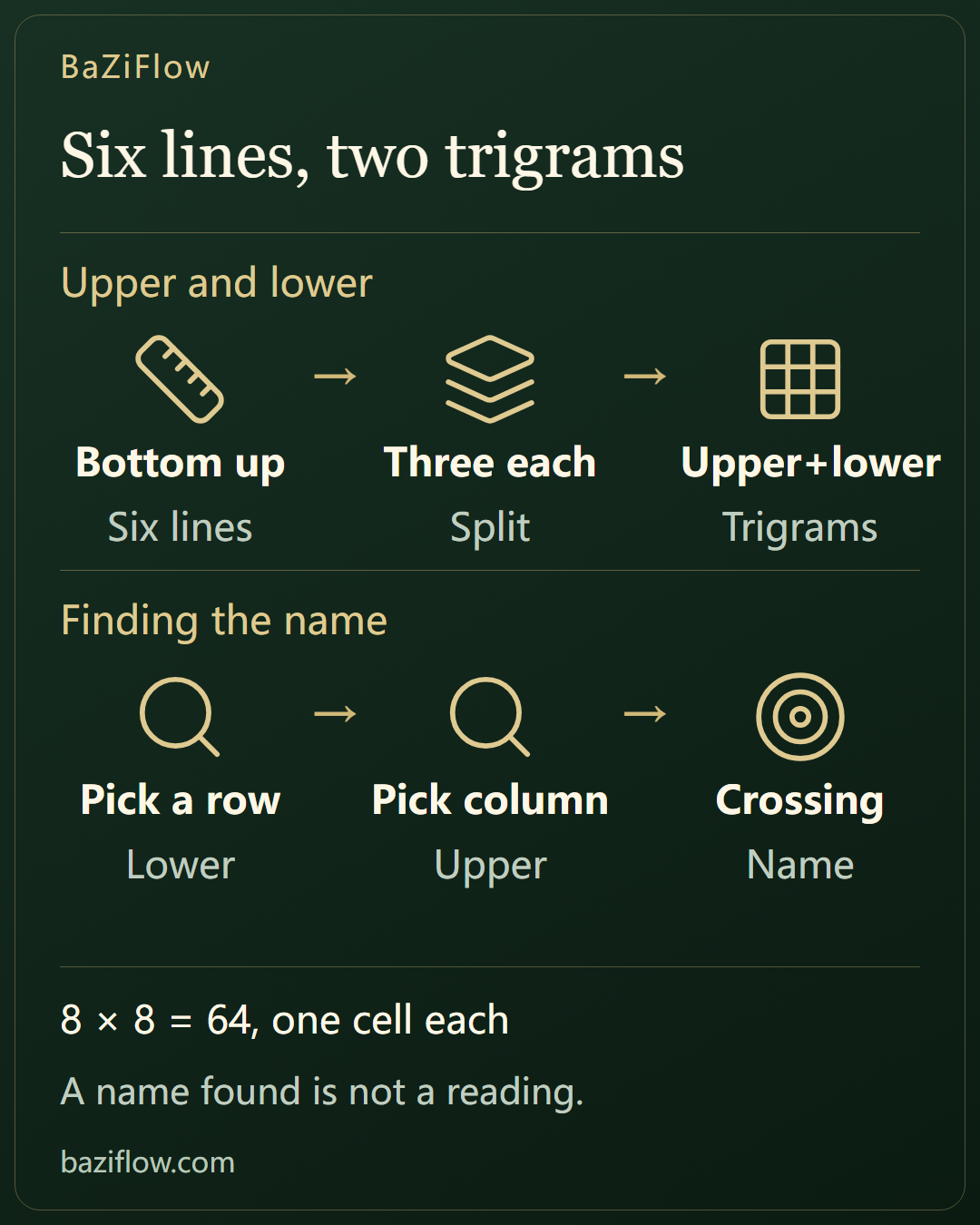
The sixty-four hexagrams are an 8 × 8 set of combinations, one trigram stacked on another. A lookup table, a Zhun, Jie and Meng comparison and two exercises show how to count lines, split them and find the name.
The short version8 min read
A hexagram is one trigram pressed onto another. Split it apart, look up the two halves, and the name follows.
- There are eight possible upper trigrams and eight lower ones, so 8 × 8 = 64 hexagrams; two different trigrams with their places exchanged make a different figure.
- Counting starts at the bottom line. Lines one to three form the lower (inner) trigram, lines four to six the upper (outer) one; identify each half, then look up the cell.
- One hexagram may be called just Zhun or written Water over Thunder, Zhun. Exchanging the halves, turning the figure upside down and the transmitted sequence number are three separate things.
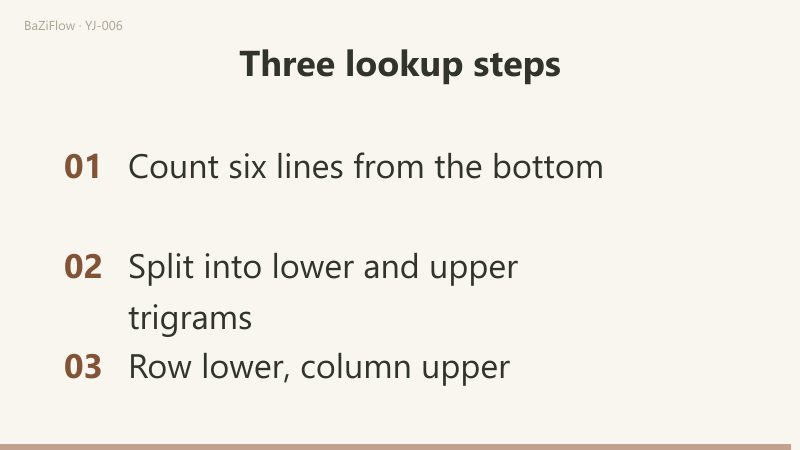
Read first
Yin and Yang Lines: Two Strokes, Six Places, Read from the Bottom ↗
Eight Trigrams: Three-Line Structure and Basic Images, Read Through the Shuo Gua ↗
One trigram on top of another
Every hexagram is one trigram placed on another: the lower one first, then the upper one, six lines in all. There are eight choices for each half, so the set is an 8 × 8 table, not a ready-made list. For another way of counting to sixty-four, see yin and yang lines.
Enlarge diagram · scroll sideways to read
A six-line figure built this way is called a doubled hexagram, and its building blocks are single trigrams (three-line figures). Lay the upper trigrams along one side and the lower trigrams along the other, and each crossing cell is one hexagram.
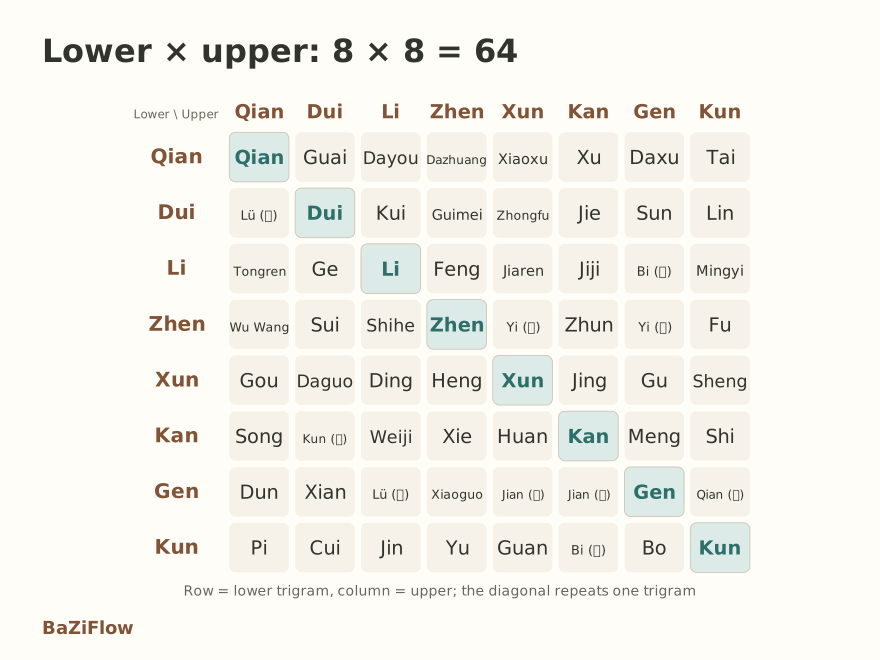
Lookup sketch: row = lower trigram, column = upper trigram. A combination table, not a sequence and not a table of outcomes.
Use the table by finding the row first, then the column. Hexagrams whose plain spelling would repeat are told apart by the Chinese in brackets: Qian (谦) is a hexagram, not the trigram Qian, and likewise Kun (困), Bi (比) and Bi (贲), Yi (益) and Yi (颐), Jian (蹇) and Jian (渐), Lü (履) and Lü (旅). The eight tinted cells lie on the diagonal; each has the same trigram above and below, and their names are written differently, as the fourth section shows.
Lower below, upper above: how positions are counted
The six lines are counted from the bottom: first, second, third, fourth, fifth and top. The first three form the lower trigram, also called the inner trigram; the last three form the upper trigram, also called the outer one. What each position means is the topic of line positions; here we only count.
Enlarge diagram · scroll sideways to read
The lower three lines of Zhun are yang, yin, yin, which is Zhen; the upper three are yin, yang, yin, which is Kan. Exchange them and you get Jie: yin, yang, yin below and yang, yin, yin above. Both use the same two trigrams, but their places differ, so they are not one hexagram. From trigrams to hexagrams in Meihua draws the same contrast with Tai and Pi, with more attention to casting.
The Commentary on the Images (象传) describes above and below in the same way: for Jiji it reads “water above fire: Jiji”. Water is the upper trigram Kan and fire is the lower trigram Li, and the upper one is named first.
Water above fire: Jiji.
From six lines to a name in three steps
There is no need to memorise sixty-four pictures. Split the figure into two trigrams, name each, then find the crossing cell.
Enlarge diagram · scroll sideways to read
The eight trigrams (bottom up, yang 1, yin 0)
Reference
Rows and columns follow the same trigram order, which is why every figure with identical halves sits on the diagonal. For the line shapes and images of the trigrams themselves, see the eight trigrams.
Write the six lines from the bottom
Mark a yang line 1 and a yin line 0, starting with the lowest line, never from the top of the picture.
Split into halves of three
Lines one to three are the lower trigram and four to six the upper; name each half from the reference chips.
Row for lower, column for upper
Find the lower trigram’s row and the upper trigram’s column in the table; the crossing cell gives the name.
Two exercises
Lines from the bottom: 0 1 1 1 0 1
The lower three, 0 1 1, are Xun; the upper three, 1 0 1, are Li. The Xun row meets the Li column at Ding.
Lines from the bottom: 1 1 0 0 0 1
The lower three, 1 1 0, are Dui; the upper three, 0 0 1, are Gen. The Dui row meets the Gen column at Sun.
Two ways to write a hexagram name
One hexagram is commonly written in two forms. In the Zhou Yi text each figure has a single name such as Zhun, Jiji or Tai. Later tables, and Liuyao and Meihua material, often put the images of the two trigrams in front: Water over Thunder, Zhun (水雷屯), Water over Fire, Jiji (水火既济) or Earth over Heaven, Tai (地天泰).
Enlarge diagram · scroll sideways to read
Read “Water over Thunder, Zhun” as follows: water is the upper trigram Kan, thunder is the lower trigram Zhen, and Zhun is the name, which matches the 1 0 0 0 1 0 of the second section. The eight figures with the same trigram on both sides are known together as the eight pure hexagrams (八纯卦); the table below gives their names.
| Trigram | Qian | Kun | Kan | Li | Zhen | Gen | Xun | Dui |
|---|---|---|---|---|---|---|---|---|
| Written as | Qian as Heaven | Kun as Earth | Kan as Water | Li as Fire | Zhen as Thunder | Gen as Mountain | Xun as Wind | Dui as Lake |
After the lookup: three easily confused things
A name found only tells you which hexagram this is. Three operations look alike and are easy to mix up.
Enlarge diagram · scroll sideways to read
Three different things
Swap the two trigrams
Zhun’s upper Kan and lower Zhen traded places give Jie, as shown in the second section.
Turn the whole figure over
Zhun’s six lines in reverse order give Meng. When both trigrams read the same backwards (Qian, Kun, Kan and Li), exchanging the halves and turning the figure over must give the same result, as with Tai and Pi; if either one does not (Zhen, Xun, Gen or Dui), the two operations differ.
The transmitted sequence
A cell’s place in the table is not a sequence number. In the transmitted order Zhun is hexagram 3, Meng is 4 and Jie is 40; the sequence has its own explanation, so do not read the order of cells as numbers.
For how each hexagram’s Judgment and line statements are read, see hexagram and line statements.
Questions readers ask next
Why is the total exactly 8 × 8?
Each of a trigram’s three positions is yin or yang, giving 2 × 2 × 2 = 8 trigrams. The upper half and the lower half are chosen independently, so eight times eight gives sixty-four. Equivalently, six lines with two states each give 2 to the sixth power.
Are inner and outer trigrams the same as lower and upper?
Yes, they are two names for the same halves: the inner trigram is the lower one and the outer trigram is the upper one. Remembering “inner below, outer above” tells you which three lines a text means when it says one or the other.
Are “Water over Thunder, Zhun” and “Zhun” two different hexagrams?
No. They are one hexagram. The Zhou Yi text gives this figure only the name Zhun; the images of its upper trigram Kan (water) and lower trigram Zhen (thunder) are what later tables put in front of it.
Was this article helpful?
Part of a learning path
Sources & references
Continue reading
Eight Trigrams: Three-Line Structure and Basic Images, Read Through the Shuo Gua ↗
Judgment and Line Statements: Whole Hexagram or Single Line? ↗