

Zhen: thunder near and far, and what stays in hand
Content version · · Sources & references
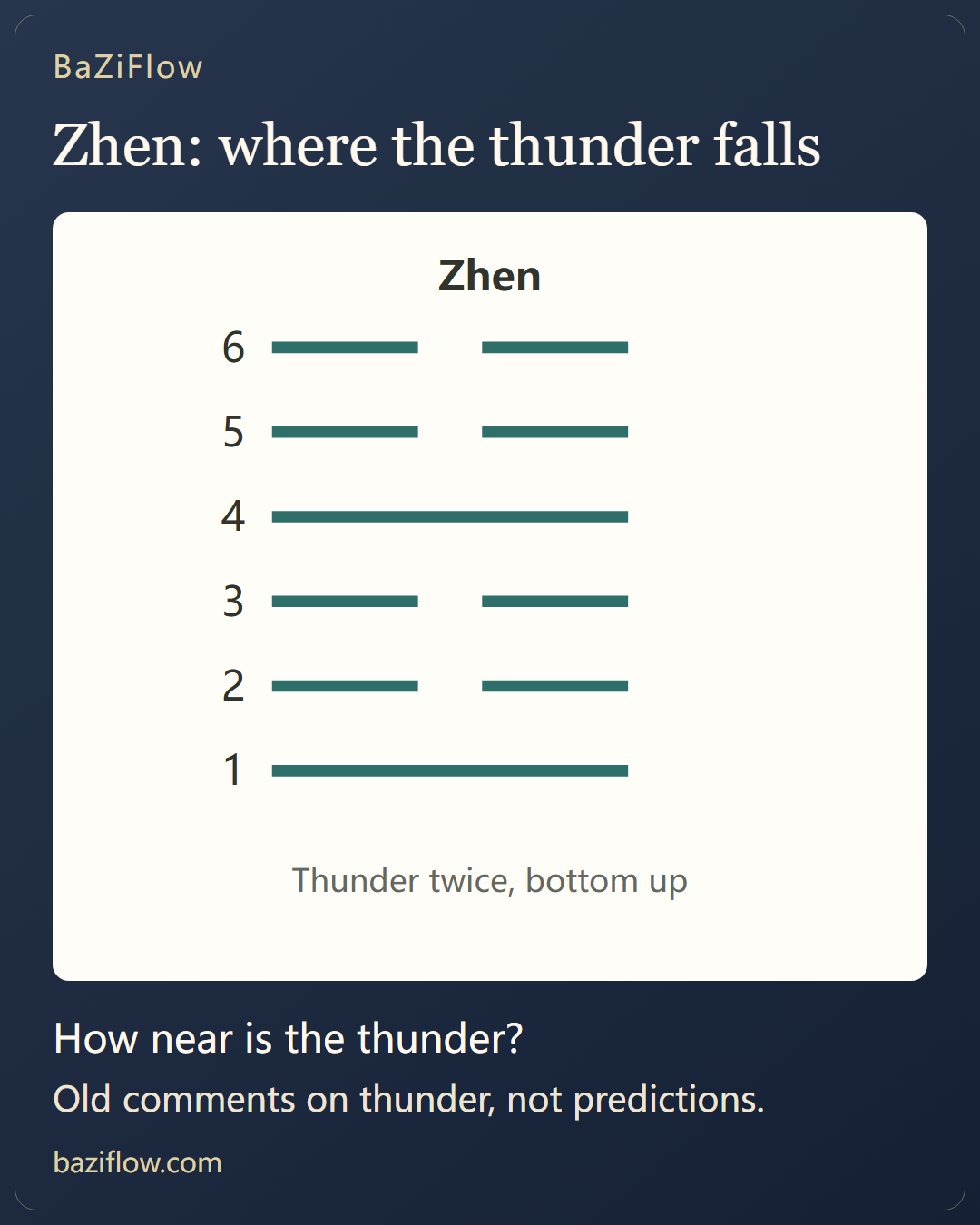
Zhen is the 51st hexagram, thunder doubled. Read the judgment’s dread followed by laughter, the Commentary’s “startles the far, frightens the near”, and six lines that set the thunder at different distances.
The short version8 min read
Every thunderclap in Zhen comes with a distance: just arriving, a hundred li, the neighbor’s house. The text also keeps asking one more thing: what is lost in the noise, and what is still held in the hand.
- Zhen stacks Zhen on Zhen. Each trigram has one yang line under two yin lines, so the whole figure has only two yang lines, the first and the fourth. The Shuo Gua says “Zhen is moving”, and the Great Image calls it repeated thunder.
- The judgment puts dread first and laughter second; the Commentary reads them as “fear brings good fortune” and “afterward there is a rule”.
- In the judgment and line statements the character for losing (丧) turns up three times: the ladle and wine are not dropped, cowries are lost, and nothing is lost. The six lines set the thunder at different distances: just arriving, the nine hills, the neighbor.
Read first
The Sixty-Four Hexagrams: How Upper and Lower Trigrams Form One Figure ↗
Judgment and Line Statements: Whole Hexagram or Single Line? ↗
Thunder on thunder: the same trigram twice
Zhen (震) is the 51st hexagram of the Zhouyi, with Zhen as both the upper and the lower trigram. Each trigram is a yang line under two yin lines, so of the six lines only two are yang: line 1 and line 4, one at the base of each trigram. The Shuo Gua says “Zhen is moving”, adds that nothing moves the myriad things faster than thunder, and calls Zhen the eldest son.
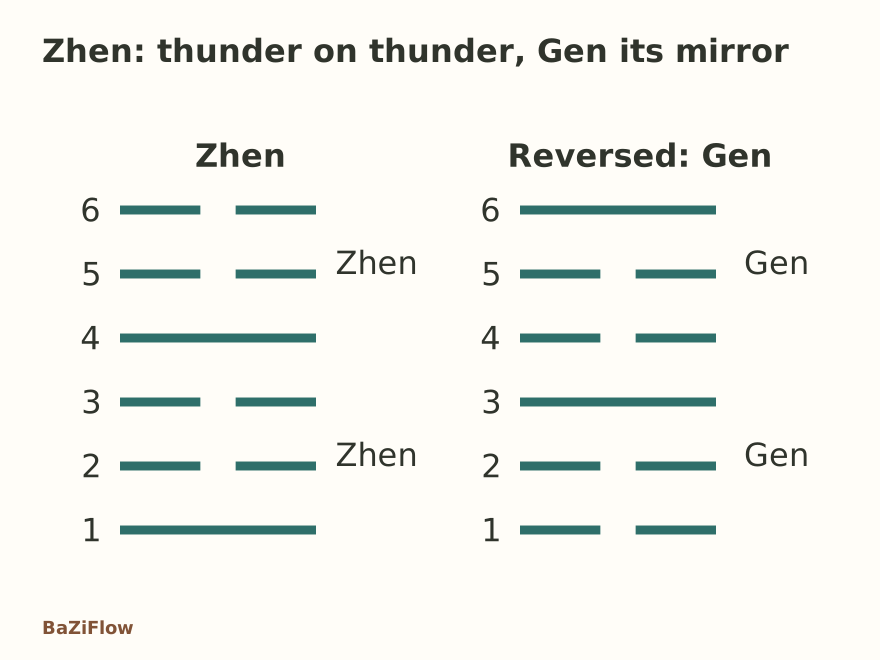
Zhen and its reversed hexagram Gen: turn Zhen upside down and you have Gen, so the mirror of thunder (moving) is mountain (stopping).
Enlarge diagram · scroll sideways to read
Four words to know first
- Dread
- The judgment’s first word for the thunder’s arrival is a word of fright. The Commentary glosses it as “fear”, so it means just that.
- Laughter
- The judgment says “laughing talk”, and the Commentary reads it as “afterward there is a rule”.
- Ladle and wine
- The ladle scoops the offering and the wine is the fragrant liquor of the rite. “Not dropping” them means that neither is let go of.
- Repeated
- The Great Image speaks of thunder “repeated”: one clap right after another.
The judgment and the Commentary: dread, then laughter, a hundred li
The judgment of Zhen reads: success; thunder comes with dread, then laughing talk; the thunder startles a hundred li, but the ladle and the fragrant wine are not dropped. The Commentary on the Judgments repeats the first three clauses one by one and puts one explanation after each.
Zhen: success. “Thunder comes with dread”: fear brings good fortune. “Laughing talk”: afterward there is a rule. “It startles a hundred li”: it startles the far and makes the near afraid. One who goes out can guard the ancestral temple and the altars of the land, and serve as master of the sacrifice.
Enlarge diagram · scroll sideways to read
The first clause, “fear brings good fortune”, puts the fear first. The second, “afterward there is a rule”, puts the laughter after it, and the word rule means a pattern or a norm. The third has a small distinction: those far away are “startled” and those near are “afraid”. One thunderclap, and the response depends on the distance.
The Commentary does not explain “the ladle and the wine are not dropped” by itself. It only adds, at the very end, “master of the sacrifice”. Ladle and wine belong to the rite, so both phrases point at one occasion: however loud the thunder, the one presiding does not let anything fall.
The Great Image: repeated thunder, fear and self-examination
Repeated thunder: Zhen. The noble person, in fear and dread, puts himself in order and examines himself.
Enlarge diagram · scroll sideways to read
“Repeated” means layered: thunder follows thunder, and there is no gap in which to breathe out. What the noble person does is spelled out in a short run of verbs: to be afraid, then to put oneself in order, then to examine oneself.
That fear can be read alongside the judgment’s “dread”. The judgment, as the Commentary glosses it, says that fear brings good fortune; the Image follows the fear with two acts. One speaks of what fear leads to, the other of what one does with it.
Six lines: where the thunder falls, and what is lost
In the six statements the thunder falls in different places, and each statement pays attention to one thing: what a person still has in hand in that place.
Enlarge diagram · scroll sideways to read
Line 1 is closest to the judgment: “thunder comes with dread; afterward, laughing talk: good fortune”, adding “afterward” and, at the end, the verdict “good fortune”. Its Small Image copies the Commentary’s two glosses word for word: “fear brings good fortune; afterward there is a rule”. So the same pair of sentences appears four times, in the judgment, the Commentary, line 1 and its Small Image.
In line 2 the thunder already brings danger: “thunder comes, danger”. Cowries are lost (the word before “lost” is read in more than one way in the tradition), and the person climbs the nine hills; “do not chase them: in seven days they are regained”. The Small Image explains with the figure: “it rides on the firm”, since line 2 is yin and sits right on top of the yang first line. Line 3 says “thunder, in a daze”, traditionally read as being unsettled, then “if one moves with the thunder, no mishap”. Its Small Image says “the position is not fitting”: line 3 is yin yet stands at the third position, which counts as a yang place.
Line 4 is the only yang line of the upper trigram, so it is the start of a second clap, and its statement is just three characters: “thunder sinks into the mud”. The Small Image comments “not yet bright”.
Line 5, “thunder goes and comes: danger”, still has “nothing is lost; there is a matter in hand”. The Small Image says first “moving in peril”, then adds “its matter lies in the middle: great, with nothing lost”. In line 6 the thunder for the first time does not strike oneself: “thunder not on one’s own body but on the neighbor: no blame”. The person still trembles and looks about wildly, which tradition reads as terror, and setting out is misfortune, but the Small Image ends: “warned by the neighbor”, taking a warning from the neighbor’s thunder.
Now count the character for losing (丧): the judgment has “the ladle and wine are not dropped”, line 2 has “cowries are lost”, line 5 has “nothing is lost”. The cowries come back after seven days. What the judgment keeps hold of is the ladle and the wine.
Gen, Xun and Jian: neighbors of Zhen, and its place after Ding
Flip Zhen over and it becomes Gen (艮), which makes Gen the reversed hexagram (综卦) of Zhen; the figure at the top shows both. Zhen is “moving” and Gen is “stopping”, and the Za Gua packs the two into a single line: Zhen rises, Gen halts. The inverse hexagram (错卦) is Xun (巽). The nuclear hexagram (互卦) is Jian (蹇). To get it, take lines 2 to 4 of Zhen as a lower trigram (yin, yin, yang: Gen) and lines 3 to 5 as an upper one (yin, yang, yin: Kan).
Enlarge diagram · scroll sideways to read
The Xu Gua says that Zhen follows Ding because there is no one better than the eldest son to manage the vessels. Ding supplies the vessel and Zhen supplies the person: the eldest son in the Shuo Gua, and in the last line of the Commentary the master of the sacrifice. After Zhen, the Xu Gua says, things cannot go on moving forever and must be stopped, so Gen comes next.
Questions readers ask next
Is Zhen about the danger of thunderstorms?
On the surface it is thunder, since the Shuo Gua takes thunder as the image of Zhen. But the text keeps asking what a person does after the thunder: dread, laughter, hiding, sinking, looking at the neighbor.
What does “the ladle and the fragrant wine are not dropped” mean?
The ladle is used to scoop the offering and the wine is the fragrant liquor of the rite. The thunder startles a hundred li, and the one presiding keeps hold of both. The Commentary does not gloss the phrase word by word; it adds only “master of the sacrifice” at the end.
Why is the fourth line only three characters long?
It is the shortest line statement in the hexagram: thunder sinks into the mud, and the Small Image comments “not yet bright”. The text gives no further detail. Tradition usually reads it as being unable to stir, and nothing beyond that can be filled in.
Was this article helpful?
Sources & references
Continue reading
Ding: fire over wood, read from the upturned feet to the jade carrying bar ↗
Gen: where in the body the stopping happens, from the toes to the jaw ↗
The Sixty-Four Hexagrams: How Upper and Lower Trigrams Form One Figure ↗
Judgment and Line Statements: Whole Hexagram or Single Line? ↗