

Fate: the slot counted as offset 0
Content version · · Sources & references
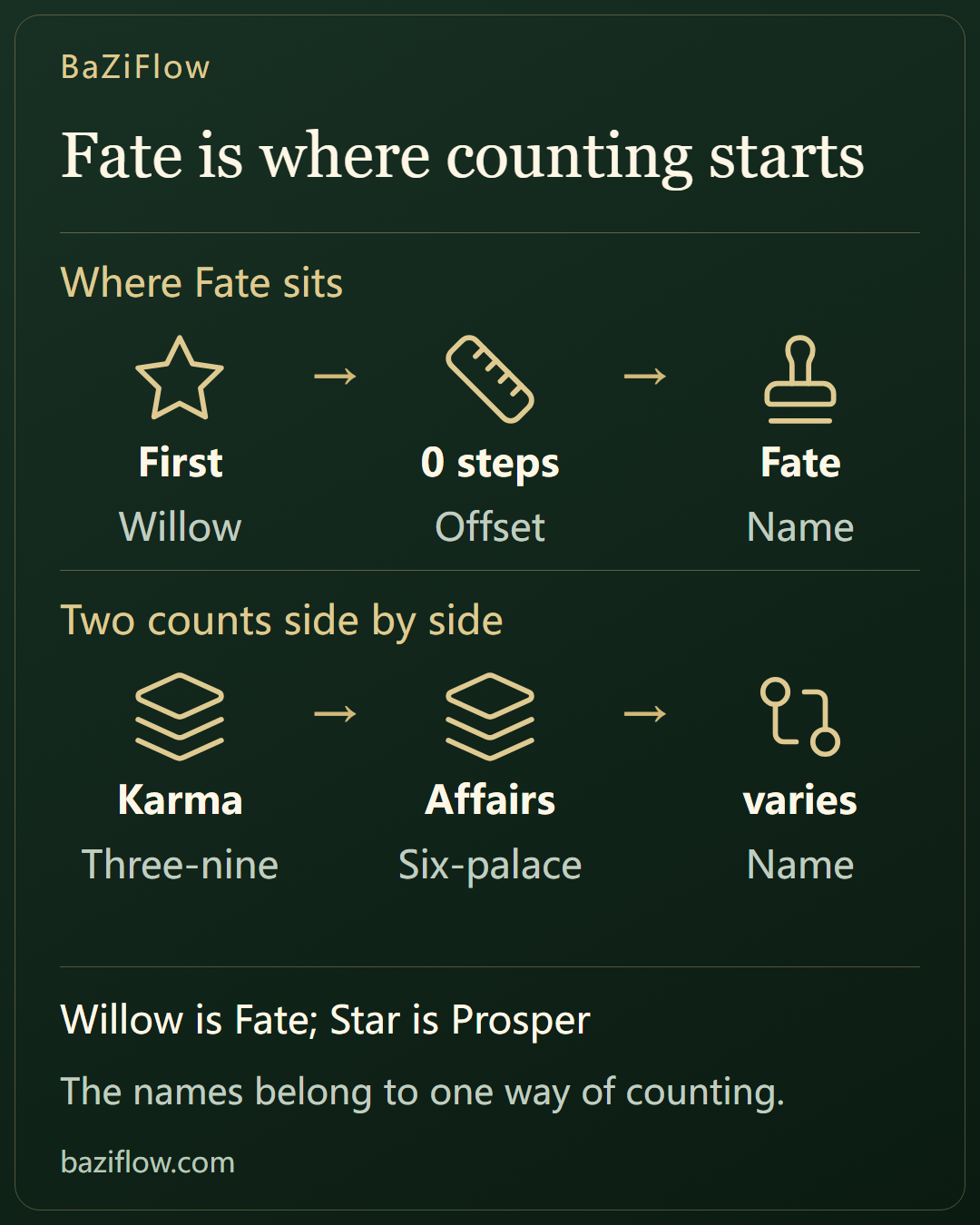
Fate is the zero-offset slot of the three-nine count: your own birth mansion is the start and is called Fate. A ring, a nine-by-three table, a same-mansion check and the six palaces show how the word is used.
The short version7 min read
Fate is the first slot of the three-nine count: your own birth mansion is both the starting point and the one called Fate. Its offset is 0 in both directions, so two people with the same mansion see each other as Fate.
- The sutra writes one row as Fate, Prosper, Decline, Ease, Peril, Attain, Break, Friend and Kin, with Karma and Womb heading the second and third rows. The site’s mansion order, counted from Net, matches the sutra’s whole line in all 27 places.
- Fate is offset 0, and the reverse is 0 as well: it is the only one of the six groups that uses a single word for both directions, and from any starting mansion it is one place out of 27.
- The same position gets different names under different counts: place 10 is Karma in the three-nine and Affairs (事) in the six palaces. Say which count is meant before talking about names.
Read first
The first slot, and the place where counting starts
In plain words first: Sukuyō (宿曜) puts a person's own birth mansion at position 1 and calls it Fate (命), then counts onward one place at a time. Every mansion reached gets a name, and Fate is the starting point itself.
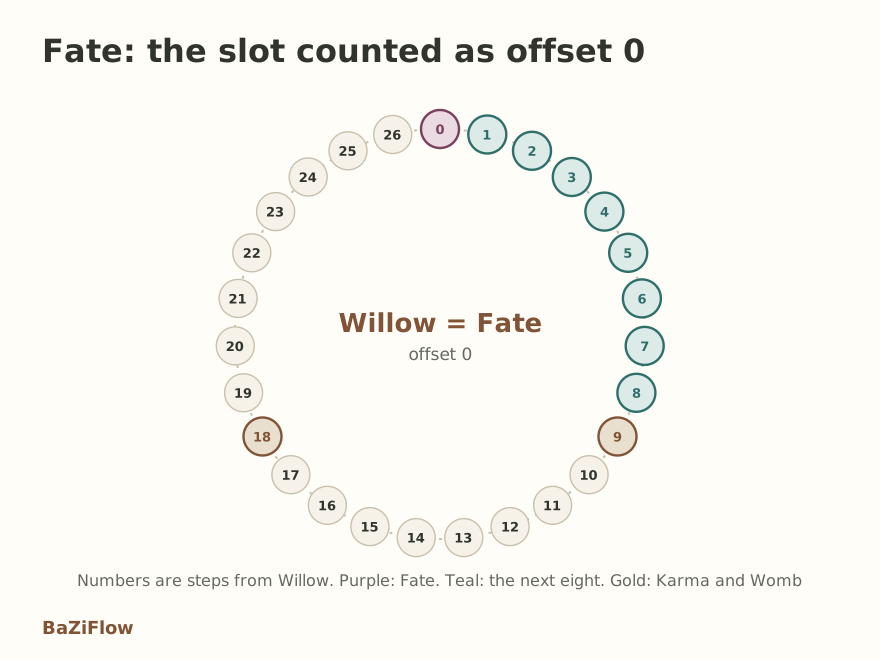
Sketch: the ring of 27 mansions starts at Willow; the offset counts the start as place 1. The mansion order is the site’s ring, and the order of names matches the sutra’s three-nine table.
The ring is the 27 mansions in a circle, with Willow (柳) placed at the top as the start. Purple is Fate, teal marks the eight places that follow in the same row, and the two gold slots head the second and third rows. The starting point takes no step, so its offset is 0. Prosper is offset 1, Karma offset 9 and Womb offset 18.
The three-nine count: nine places from your own mansion, then twice more
The sutra’s second fascicle states the rule of the count plainly in its "secret method" passage (三必秘要法; the Taishō text reads "three-must", the Ming-dynasty edition "three-nine", which matches the passage itself):
The three-nine method always takes the mansion one belongs to as the first nine. First is the Fate mansion; next, second, is the Prosper mansion; third is Decline ...
"The mansion one belongs to" is the person's own birth mansion. When nine places are full the row ends, and the text goes on: the tenth mansion heads the "second nine" as Karma, and the nineteenth heads the "third nine" as Womb. So Fate occurs once on the circle, Karma and Womb head the second and third rows, and the eight names after each head repeat. The table lists all 27 places with Willow as Fate:
Enlarge diagram · scroll sideways to read
The sutra also works one full row through with Net as the start; see Net. I counted from Net through the site's mansion order (Hairy Head, Net, Turtle Beak, Three Stars ... Stomach) and compared all 27 places with the sutra’s three-nine line one by one: every name matches. With Willow as the start the rule is unchanged. How a birthday turns into a birth mansion is a separate question, and different methods give different answers; see why calculation methods differ.
When two people share a mansion
For a first meeting, the sutra gives this order of checking:
First look at which of my mansions that person’s Fate mansion falls on; then look at which of theirs my Fate mansion falls on.
The verb in the original (押) can be read as "falls upon": first find where the other person's mansion lands in my sequence, then where mine lands in theirs. When both have the same mansion, both lookups land on place 1, and both answers are Fate.
Enlarge diagram · scroll sideways to read
Among the 27 possible partners exactly one shares your own mansion, so from any starting mansion Fate is one place in 27. Each of the other ten names has a different word for its reverse. Fate is the only group whose two directions use the same word.
Three places where the book writes "Fate"
One and the same word appears in the sutra in three settings, and each compares something different.
Enlarge diagram · scroll sideways to read
The book says, of the day when a Fate mansion is on duty:
When a Fate or Womb mansion is on duty for the day, no undertaking is suitable.
The first setting compares two people, the second compares "today's mansion" with "my mansion", and the third watches where the stars in the sky are. The second fascicle words the day rule as "on a Fate-mansion day or a Womb-mansion day, no undertaking is suitable" and then adds "another view" that lists the Fate, Womb, Peril and Break days together.
A second count that starts at Fate: the six palaces
The sutra also has a count that starts at Fate in a different way, in the chapter on secret miscellaneous divination (秘密杂占品第五). It is called the six palace mansions and is used to see where the Sun, Moon and planets have gone:
Counting from Fate, the tenth is the Affairs mansion, the fourth the Intent mansion, the sixteenth the Gathering mansion, the twentieth the Sameness mansion and the thirteenth the Conquest mansion.
The note's example is Bond (娄): counting forward, the fourth is Net, the Intent mansion; the tenth is Star, the Affairs mansion; the thirteenth is Chariot, the Conquest mansion. The table works out all six positions, again with the site's mansion order:
Enlarge diagram · scroll sideways to read
One position carries two names. Place 10 is the Affairs mansion (事宿) in the six palaces and Karma in the three-nine; place 4 is Intent (意宿) in the six palaces and Ease in the three-nine. The names belong to the count, and a different count brings different names, so before saying what relationship a mansion has, say whether the three-nine or the six palaces is meant. This series is about the three-nine.
For how two directions combine into one group, see the six relationship types; for how a gap is sorted into bands, see near, middle and far distances; Fate's neighbors Prosper and Kin are in Prosper–Kin.
Questions readers ask next
Does "Fate" mean my own birth mansion is called Fate?
Fate is a position name given from one person’s point of view: your birth mansion is first in your own sequence, so it is called Fate there. The same mansion in another person’s sequence may be Prosper, Karma or something else. A mansion name such as Net or Well is a different kind of name.
If two people share a birth mansion, are they alike?
The table only answers whether they fall in the same slot. One mansion matches many different dates, and experiences, choices and agreements sit outside the label, so likeness cannot be read off it.
Is the Fate of Sukuyō the same as the Life palace in Zi Wei or astrology?
No. Here Fate is the first place of the three-nine sequence, a name for a relative position. The Life palace in Zi Wei and the ascendant house in astrology are places worked out from a birth moment. The words look alike but the systems and calculations differ, so one cannot stand in for the other.
Was this article helpful?
Sources & references
Continue reading
Prosper–Kin (栄親): six landing offsets and how they pair up ↗