

House systems: change the boundaries, not the planets
Content version · · Sources & references
Use a simple degree example to distinguish Whole Sign, equal houses from the Ascendant and a quadrant method, then compare charts fairly.
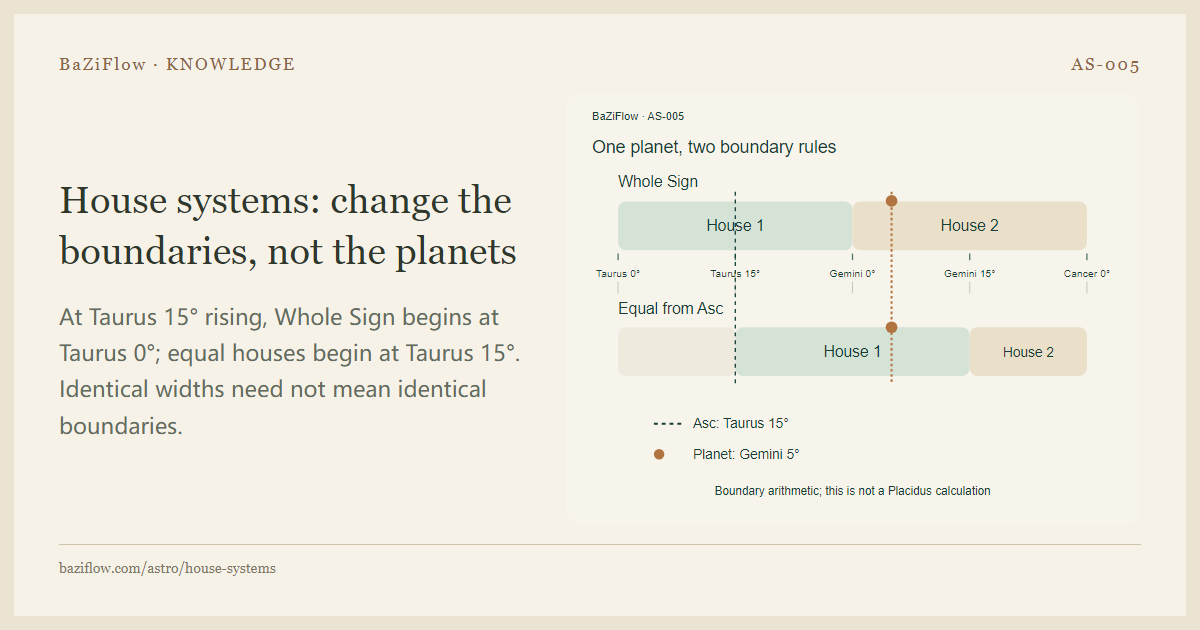
At Taurus 15° rising, Whole Sign begins at Taurus 0°; equal houses begin at Taurus 15°. Identical widths need not mean identical boundaries.
Read first
Start with a ruler experiment
Imagine an Ascendant at 15° Taurus and a hypothetical planet at 5° Gemini. No birth date is needed for this boundary exercise. In Whole Sign houses, Taurus is the entire first house and Gemini the second. In equal houses measured from the Ascendant, house one runs from 15° Taurus to 15° Gemini. The same planet therefore belongs to house two in the first method and house one in the second.
The planet has not moved. The starting point of the partition has. Nor has the Ascendant been reset to 0° Taurus: that is the first boundary in Whole Sign, while the Ascendant retains its actual degree. Keep this distinction before interpreting either placement.
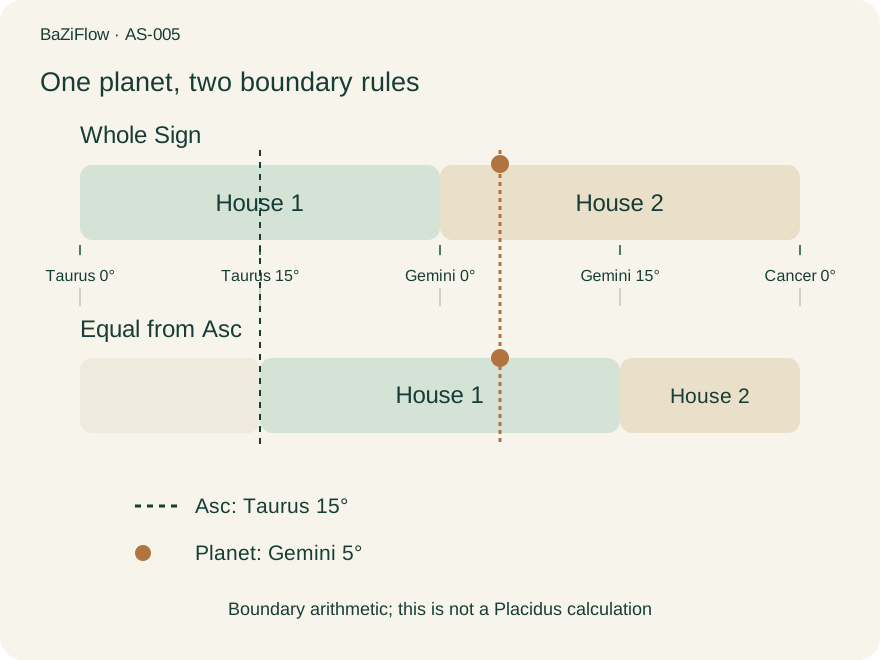
Original BaZiFlow teaching diagram; schematic, not a personal chart.
A third method needs more information
Placidus derives intermediate cusps through divisions of diurnal and nocturnal arcs. It is not a simple trisection of each quadrant's zodiac longitude. Our two-position boundary exercise lacks the time and place needed to supply its cusps, so it would be misleading to add a made-up “Placidus” row of uneven boxes.
Swiss Ephemeris documents these different constructions. In Whole Sign and the Ascendant-based equal system discussed here, the Midheaven need not coincide with the tenth-house cusp. Display the MC as its own point rather than shifting it to make an interpretive label look tidy. House division is also separate from a tropical or sidereal zodiac setting.
Audit a disagreement in the right order
When two programs disagree, first compare the inputs: birth date, converted UTC, coordinates, zodiac framework and planetary-position settings. Time and place explains the two input paths. Then compare planetary longitudes. Only after those match is a house-system switch a controlled explanation of different house assignments. If the basic components are unfamiliar, review planets, signs, houses and aspects.
A useful comparison sheet holds the fixed inputs in one column and the house cusps, planet-to-house assignments and MC relationship in another. Change one setting at a time. A difference created by a time-zone error is not a philosophical disagreement between house systems.
Expect three kinds of outcome
A planet far from the relevant boundaries may keep the same house; report that stability. A planet near a boundary may change house; preserve the rule-dependent alternatives. At high latitudes, certain algorithms can encounter limitations, and a program may report failure or use a fallback. Inspect the actual message and method used rather than trusting an unchanged label.
These cases call for different notes. They do not require inventing a different life story for every setting. Record the common ground and focus the comparison on the house assignments that actually change.
Choose a coherent practice, not a flattering result
The geometry can be checked against its definition. That is different from proving that one interpretive school is objectively the best predictor of a life. A practical learning choice is a method with a clearly stated procedure and a consistent body of teaching. Finish a reading in that method before comparing only the parts that actually change. Switching whenever a description is unwelcome makes the comparison impossible to assess.
For a wider contrast, continue to Zi Wei palaces and Western houses. Their shared count of twelve does not imply the same construction, contents or topic boundaries.
Sources & references
Continue reading
Sun, Moon and rising: what the “Big Three” leaves out ↗
Twelve palaces, twelve houses: compare the questions, not the labels ↗