

What are Sukuyō astrology and the birth mansion?
Content version · · Sources & references
Distinguish a measured Moon position from a calendar-assigned birth mansion. Compare named sources, a month-table example and the settings needed to reproduce a result.
A calendar-based birth mansion depends on a date rule. It is distinct from measured lunar longitude, a sun sign and a BaZi Day Pillar.
“Birth mansion” does not necessarily mean a measured Moon position
A Sukuyō result may give a name such as Bō (昴) or Shitsu (室). In the calendar-based method discussed here, that name is assigned to a birth date by a rule. It should not automatically be read as the Moon's measured longitude at the instant of birth. A table lookup and an astronomical position calculation can both be internally correct while answering different questions.
The first task is therefore to identify the method. Keep the original date, the calendar conversion, the table or astronomical reference used, and any intercalary-month convention. A label without those details is hard to reproduce. Why calculation methods differ examines the comparison in more detail.
Three familiar labels that answer different questions
A sun sign describes the Sun's position in the chosen zodiac. A BaZi Day Pillar belongs to a continuous sixty-pair day count. A calendar-based birth mansion is a name assigned through the chosen mansion table. All three can use birth dates, but one label does not uniquely determine the other two.
Calling all three a zodiac obscures this difference. Nor does the word natal turn a single mansion into an entire birth chart. A comparison should ask which data and reference frame each method uses before transferring any interpretation; see similar terms across systems.
What the circular diagram can—and cannot—show
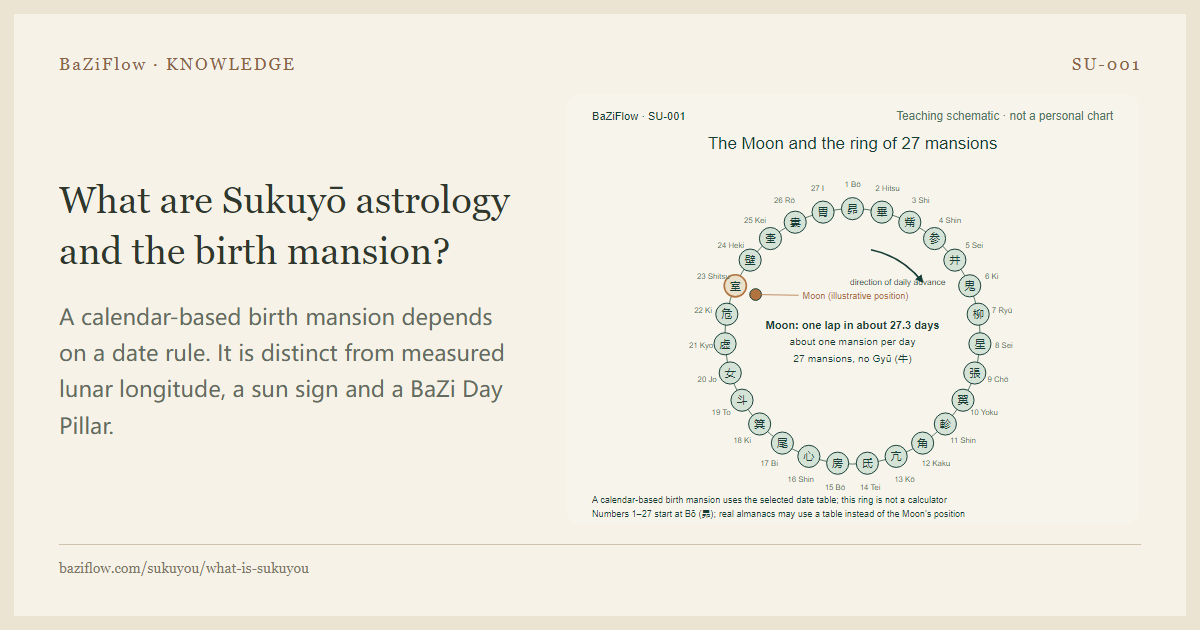
The Moon returns relative to the stars in roughly 27.3 days. In an equal-longitude scheme, dividing a full circle by twenty-seven gives 13°20′ per sector. About one sector per day is an average illustration, not a constant daily speed or a proof of the scheme's historical origin.
Chinese twenty-eight-mansion astronomy uses a different, equatorial reference with unequal intervals. Borrowed Chinese names do not ensure identical star groups or boundaries. Our evenly spaced ring is an ordering diagram, not a sky map or a personal chart.
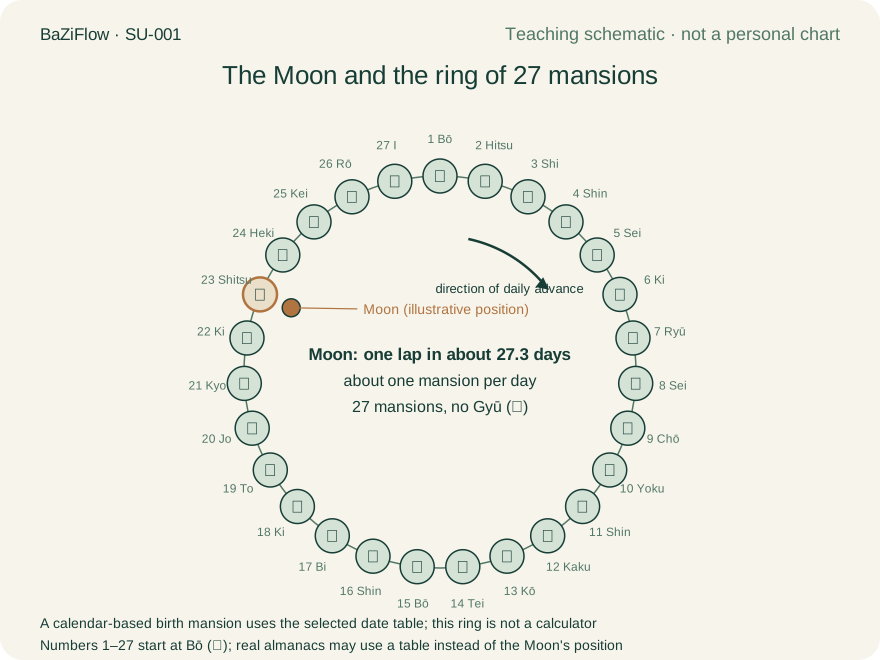
Original BaZiFlow teaching diagram; it shows only the ring order of the Moon and the 27 mansions, not a personal chart.
The marker at Shitsu is illustrative. It belongs to no real date. A calendar that assigns a new starting mansion at each lunar month needs its own month-start rule; the ring alone cannot tell you how to continue across that boundary.
Work a table example before interpreting a name
The twenty-seven-mansion calendar table described by Japan's National Astronomical Observatory sets a starting name for each month and advances daily, omitting the Ox mansion. In that specified table, month eight begins at Kaku (角), reaching Rō (婁) on day fifteen; month nine begins at Tei (氐), reaching Rō on day thirteen. Different dates can therefore receive the same mansion.
These are checks within the table, not calculated birth readings. They leave Gregorian conversion and intercalary months unresolved. If another tool differs, investigate whether its inputs, conventions or implementation differ. Do not assume every disagreement is an arithmetic error, or that none is; there is no justified universal one-mansion error limit.
The sutra is a collection of material, not one unnamed algorithm
The cited T1299 text credits Amoghavajra with translation and Yang Jingfeng with revision. Its opening material includes mansions, twelve signs and seven luminaries, and later sections include calendar tables and the three-nine framework. A modern birth-mansion lookup is not a complete account of that work.
There is a concrete reason to name the exact table: the Tang month table in volume one contains the Ox mansion, whereas the common twenty-seven-name calendar lookup omits it. A citation to the sutra's title alone cannot establish that every passage implements one modern twenty-seven-mansion rule. Record the section and edition, and read twenty-seven versus twenty-eight mansions before combining lists.
Calculation and interpretation need separate checks
A reproducible assignment tells you which name a method gives the date. It does not validate the traditional temperament or fortune statements attached to that name. This article explains the structure without inferring anyone's character, relationships or future from a mansion.
When continuing, separate the birth mansion from the daily mansion, retain unknown settings rather than guessing, and compare specified methods on the same dates. That leaves a useful record even when the final interpretation remains uncertain.
Part of a learning path
Sources & references
Continue reading
27 or 28 lunar mansions: what is the difference? ↗