

The second house: succedent and its width
Content version · · Sources & references
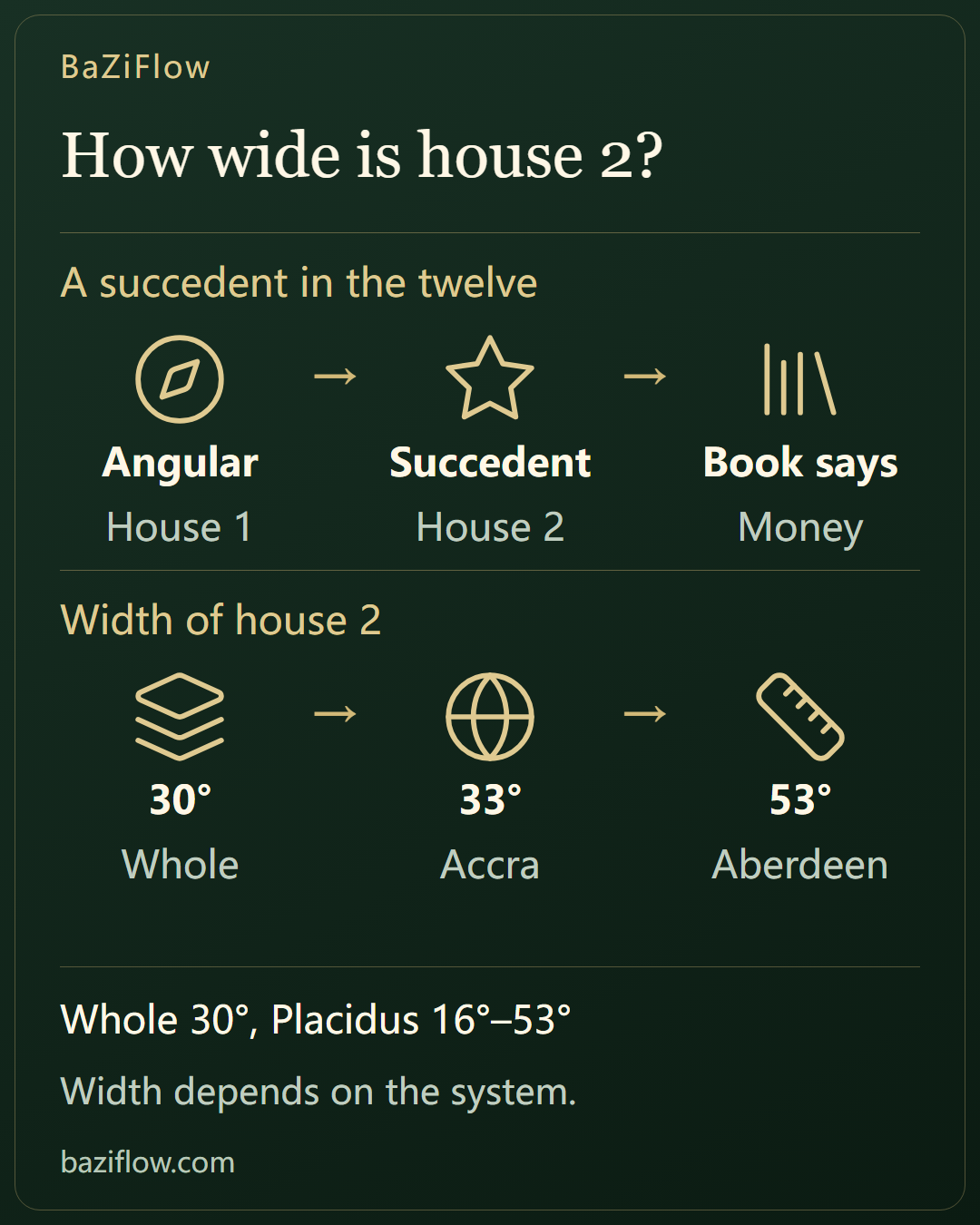
House 2 is the succedent house that follows house 1. Lilly’s entries for it, then three cities at one moment on 5 Dec 2026: whole sign is always 30 degrees, while the Placidus second house can be narrow or wide.
The short version6 min read
The second house is succedent, right behind the first. Lilly lists goods, money lent, gain and loss, and friends and assistants in lawsuits; in whole sign it is 30 degrees everywhere, while its Placidus width moves with time and latitude.
- "Succedent" literally means following: houses 2, 5, 8 and 11 each come right behind an angular house. Lilly says angles have the most force, and succedents come next.
- At 09:00 UTC on 5 Dec 2026 the second house is 33.0 degrees wide in Accra, 47.7 in London and 53.4 in Aberdeen; on 10 Mar at noon the same cities give 28.0, 18.6 and 16.3. In whole sign every one of them is 30.
- One Pluto (3°39′ of Aquarius) is whole-sign house 3 and Placidus house 2 in Aberdeen, 3 and 1 in London, 2 and 1 in Accra. One body, three pairs of numbers, so a house number needs its system and place.
Read first
Second because it sits right behind the first
Why is house 2 called succedent? The word means following: the house comes right after an angle.
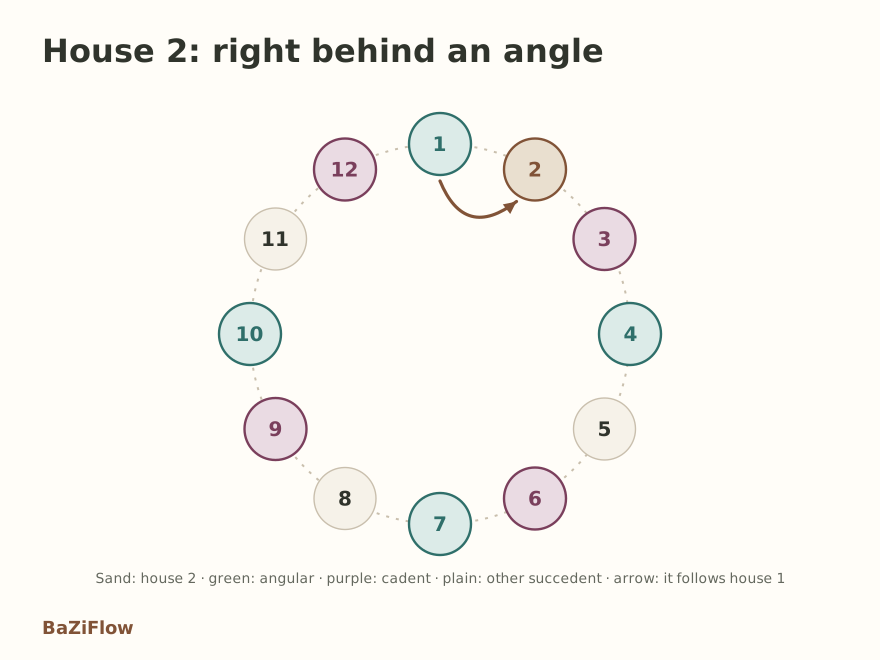
Position sketch: twelve houses around a ring, with an arrow showing that house 2 comes right after house 1; colors mark the class of position, not the size of a house.
In the picture house 2 is sand-colored, with an arrow from house 1. The green houses 1, 4, 7 and 10 are angular, and each angle has a succedent house behind it: houses 2, 5, 8 and 11. The purple houses 3, 6, 9 and 12 are cadent and come after the succedents. When William Lilly’s Christian Astrology (1647) reaches this house it adds that some Latin authors call it Anaphora; on the strength of the three classes he says the angles are most powerful and the succedents are "next in vertue".
The book puts money and helpers in this house
The second-house entry in Christian Astrology opens with the circumstances of the person asking:
The book says: his estate, his wealth or poverty, all removable goods, money lent, "profit or game, loss or damage".
Then it turns to lawsuits and duels, and the entries become people: in a lawsuit the house signifies a man’s friends and assistants, and in a private duel the querent’s "second", the helper at his side.
Enlarge diagram · scroll sideways to read
One house covering both money and helpers shows that a house in this book is a set of matters belonging together: whatever sits in the asker’s own hands or at his side is looked at here. Lilly adds cosignificators, Jupiter and Taurus, and treats Jupiter in this house, or ruling it, as an argument for an estate. That is a 17th-century author’s judgment, and this site draws no conclusion from it for any chart.
One moment, three cities, three second houses
In whole sign the second house is always one whole sign, 30 degrees. Placidus differs: its cusps come from dividing time, so at the very same moment a change of place changes the width of house 2. Take 09:00 UTC on 5 December 2026. The engine gives the Placidus second house for three cities; width means the degrees from cusp 2 to cusp 3:
Enlarge diagram · scroll sideways to read
At 12:00 UTC on 10 March 2027 the same three cities give 28.0, 18.6 and 16.3 degrees. The higher the latitude, the bigger the swing: Aberdeen goes from 53.4 down to 16.3, while Accra moves only between 33 and 28. The start of house 2 also separates the two systems: in London at that December moment whole sign starts it at 0 degrees of Capricorn and Placidus at 11°04′ of Aquarius, 41 degrees apart.
Why the width varies: a quadrant is being divided
Placidus takes the stretch of ecliptic from the Ascendant to the lower heaven, houses 1 to 3, and divides it into three by time. That whole stretch changes size from moment to moment:
Enlarge diagram · scroll sideways to read
In London on 5 December the stretch is 124.8 degrees, split as 44.7, 47.7 and 32.5; on 10 March it is only 59.4, split as 15.7, 18.6 and 25.1. The three parts are not equal, because time is being divided, not degrees, so "each house is a third of the quadrant" is not accurate. Whole sign ignores the size of the stretch and cuts by sign, always 30.
Fix the inputs
Write down the UTC moment, the coordinates and the house system; none may be missing.
Take two cusps
Read the longitudes of cusp 2 and cusp 3.
Subtract
Cusp 3 minus cusp 2; if the result is negative, add 360 degrees.
One body, three pairs of house numbers
Back to 09:00 UTC on 5 December 2026. Pluto is at 3°39′ of Aquarius, ecliptic longitude 303.65, and the three places give these house numbers:
Enlarge diagram · scroll sideways to read
Aberdeen’s Placidus second house starts at 2°30′ of Aquarius, so Pluto has just entered it, 1.15 degrees in, while the whole-sign second house is Capricorn and Pluto is not in it. Each calculation is right by its own rule. When you write "second house", add the system and the place so others can check it.
Two exercises
In whole sign with Sagittarius rising, which sign is the second house?
Sagittarius is house 1, so the next sign, Capricorn, is house 2.
London, 5 Dec, 09:00 UTC: where does the Placidus second house start?
At 11°04′ of Aquarius, 47.7 degrees wide, ending at 28°44′ of Pisces.
Continue with the third house to see how a cadent house falls away after a succedent; the two systems and their boundaries are in house systems, and the whole division of labor is in the twelve-house overview.
Questions readers ask next
Is the second house the "money house"?
Lilly’s entries name concrete matters: movable goods, money lent, profit and loss. "Money luck" is a later summary. The chart supplies a position only; how much money anyone has depends on real accounts, which no house can give.
Are succedent houses weaker than angular ones?
Lilly writes that angles are most powerful, succedents next and cadents poor, which is his own statement of strength. He also lists a separate order for the twelve houses, in which the second stands ninth. This site scores no house on that basis; it only records that the second belongs to the succedent class.
Why does the book mention the second house in duels?
There "second" is the helper who stands beside a duelist, not an ordinal. Lilly gives the second house to the querent’s helper, and in lawsuits to friends and assistants: the same idea of a helper in both places.
Was this article helpful?
Sources & references
Continue reading
The First House: Counting from the Horizon, the Sunrise Minutes and Lilly’s Ascendant ↗
The Third House: Cadent, Lilly’s Near-at-Hand Entries, and Three Hours of the Moon in Oslo ↗