

Tropical and sidereal zodiacs: compare the origins
Content version · · Sources & references
Compare zodiac starting points with a worked circular-coordinate example, distinguish signs from constellations, and learn which settings make two charts reproducible.
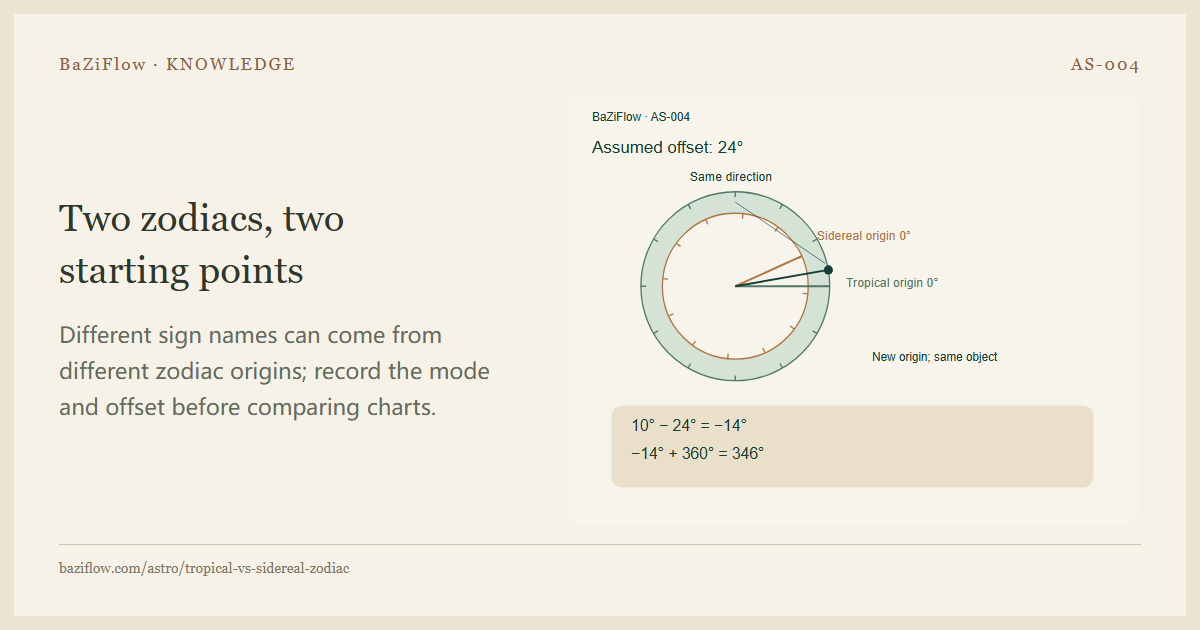
Different sign names can come from different zodiac origins; record the mode and offset before comparing charts.
Read first
Run a controlled comparison before reading the labels
Open a chart calculation twice, keeping the instant and every setting identical. In the second copy, change only the zodiac mode. Write down the full longitudes of two objects before reading their sign names or descriptions. This is a small software-comparison exercise: it asks what changed in the calculation, not which personality paragraph feels more convincing.
A record with just a date and a screenshot may not be sufficient. For a sidereal calculation, preserve the named reference convention as well as the word sidereal. Keep the software version, calculation time and coordinate settings. If you also switch house systems or correct the time zone, you no longer have a one-variable comparison. The change may be legitimate, but the before-and-after image cannot isolate its cause.
For readers who are still sorting out the vocabulary, the four components of a chart explains why a sign label, a house number and an aspect are different fields. Here we will inspect those fields in that order only when the evidence calls for it.
The pair of numbers that should stay apart
Suppose the first calculation gives longitudes of 40 and 100 degrees. Their separation is 60 degrees. In a deliberately simplified exercise, subtract the same 24-degree offset from both: the results are 16 and 76 degrees. Their separation is still 60 degrees. A common rotation of the origin changes each coordinate while preserving this separation.
That invariant is more informative than counting how many sign names changed. If a comparison also produces a different aspect list, investigate the selected objects, allowed orbs and reference conventions. Do not attribute every difference to the word sidereal. The sixty-degree separation here is an arithmetic result; it does not establish any interpretation of a sixty-degree aspect.
The exercise has a useful counterexample to a popular shortcut. An original longitude of 29 degrees becomes 5 degrees after subtracting 24. Both are inside the Aries sector. Therefore “move everything back one sign” is not the transformation. Whether a boundary is crossed depends on the initial position within the sector.
A negative angle is a place on a circle
Now use one position near zero. Start at 10 degrees and apply the same assumed offset: 10 minus 24 equals minus 14. Add a full circle to express it as 346 degrees. The sector beginning at 330 degrees is Pisces, and 346 minus 330 is 16. That is how a label of Aries 10 degrees can become Pisces 16 degrees without any object moving.
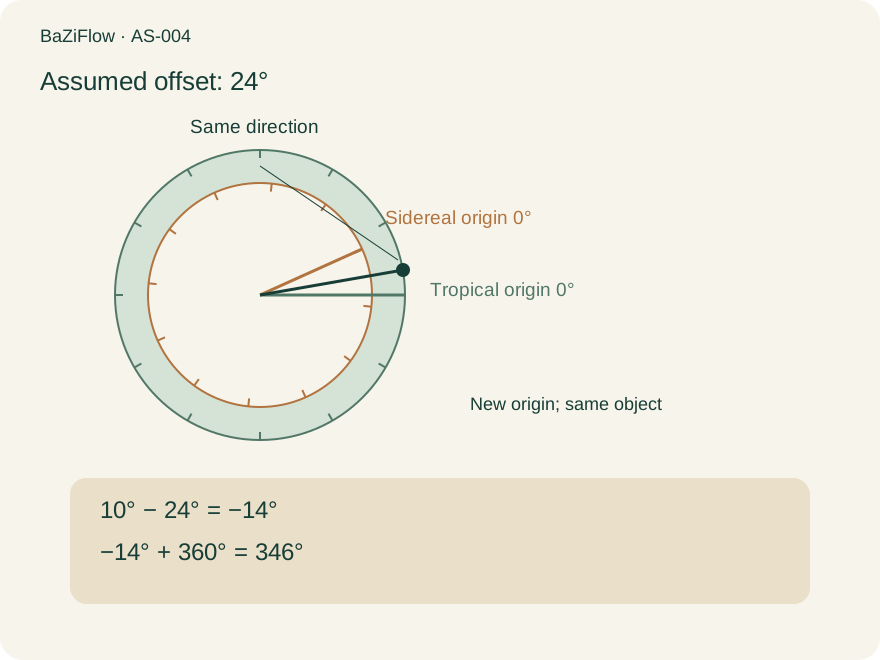
Original BaZiFlow teaching diagram; 24° is an assumed offset, not an ephemeris value for a date.
In this illustration the offset is invented for easy arithmetic. It is not a measured value for a particular date or an instruction to configure a chart tool to 24 degrees. Real calculations need a date-dependent reference and consistent precision options. Swiss Ephemeris recommends its dedicated sidereal functions instead of casually combining separately calculated outputs. The diagram explains the idea; it is not a replacement ephemeris algorithm.
Why the origins have names
Tropical longitude begins at the vernal equinox. Sidereal longitude uses a stellar reference, and precession changes the relationship of that reference to the equinox over time. The offset is called an ayanamsha. Different choices, including Lahiri and Fagan/Bradley, are explicitly distinguished in the Swiss Ephemeris documentation. A named convention is therefore part of the input, not an optional decorative label on the result.
The usual equal-sign versions of both zodiacs divide the circle into twelve 30-degree sectors. Astronomical constellations are not twelve equal sectors. As the OpenStax astronomy discussion helps clarify, sharing names does not make the two kinds of region interchangeable. A sidereal chart is not automatically a plot of modern constellation boundaries.
These distinctions explain what the numerical exercise means. They do not show that one system's personal interpretation is valid. An ephemeris manual can establish how a coordinate was calculated; an astronomy textbook can clarify a reference frame. Neither function turns a recognisable description into independent evidence of predictive accuracy.
Use discrepancies as questions, not verdicts
A productive comparison ends with a short account of which settings explain which differences. This table is a diagnostic guide rather than a list of interpretations:
| Observation | What it warrants checking | What it does not establish |
|---|---|---|
| Sign names differ but a common offset explains the positions | Zodiac origin and named ayanamsha | That the object physically moved |
| The aspect list differs too | Objects included, orbs and coordinate options | That changed sign names alone changed all angles |
| House placements differ | The actual house method and its settings | A house move inferred solely from the subtraction |
| Results agree after settings match | Reproducibility of those calculations | Accuracy of a personal prediction |
Whole-sign houses use sign sectors to organise houses; other house methods have different definitions. That is why the house row needs its own investigation. Comparing house systems develops this separate question rather than folding it into a zodiac choice.
Keep birth-data uncertainty in another part of the record. An uncertain clock time and a deliberately selected origin are different kinds of information: one limits what can be known, the other specifies what is being calculated. A reader should be able to see both without guessing.
With those records in place, two printouts can be compared without choosing whichever description sounds more appealing. You can identify a coordinate difference, leave an unexplained software discrepancy open, or discover that more than one setting changed. If the remaining disagreement concerns a boundary in time, checking a birth near a sign cusp takes the investigation from a rough calendar label to an explicit instant.