

Root: the middle, miswritten and repeated
Content version · · Sources & references
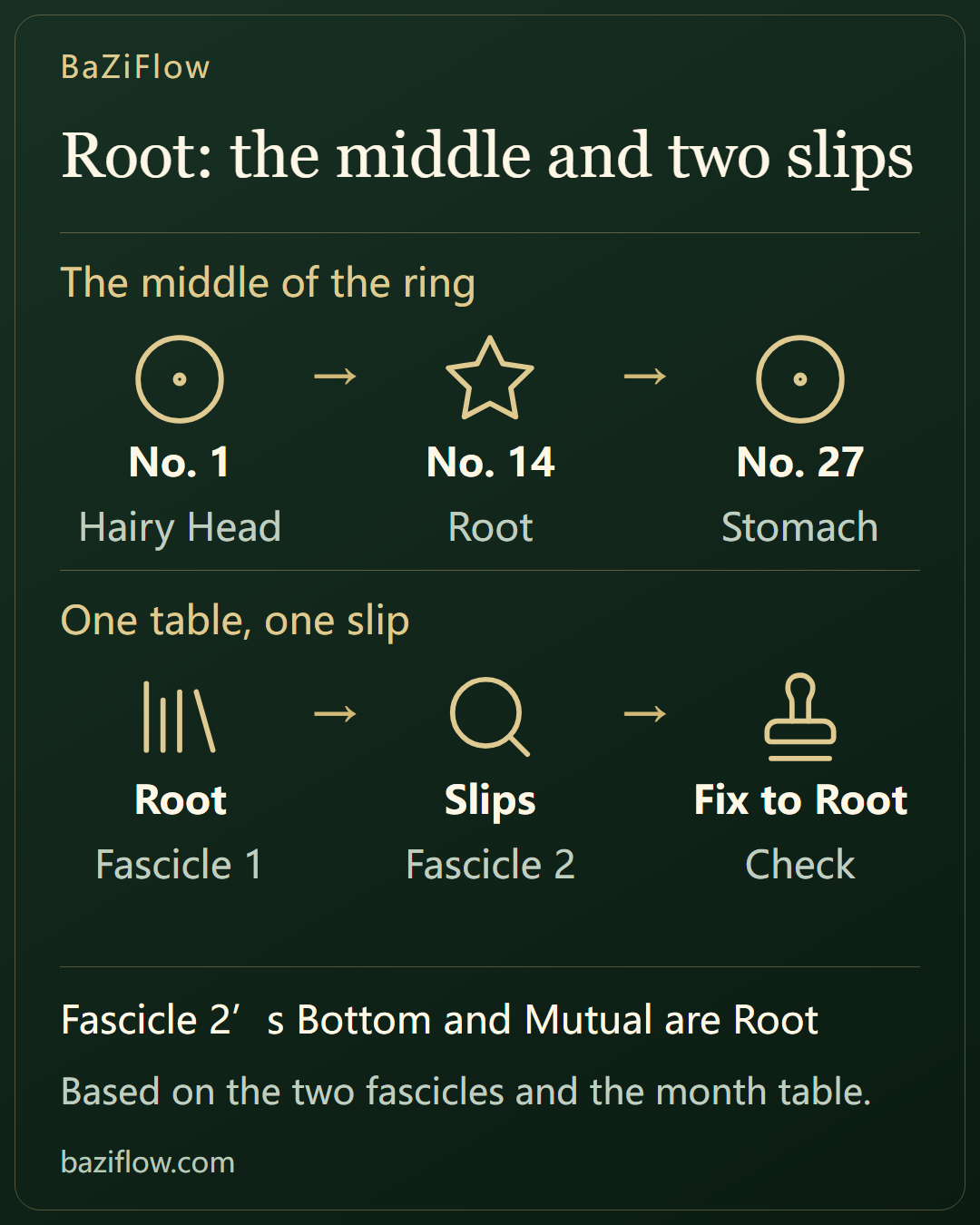
Root (氐) is position 14 on the site’s 27-mansion ring, exactly in the middle. Four stars in both text and note, two miswritten characters in fascicle 2, and the two consecutive Root days when month 8 has 30 days.
The short version7 min read
Root (氐) is position 14 on the site’s 27-mansion ring, with 13 mansions before it and 13 after, exactly in the middle. In fascicle 2’s second copy of one table, Root has been written as two other characters.
- Root is 14th, with 13 mansions on each side; the farthest are Hairy Head and Stomach. The sutra’s picture and the note both give it four stars, one of only two mansions among the seven from Star to Root whose counts agree.
- Fascicle 2 copies out the Rakshasa-day table and the house-day list a second time and writes Root as Bottom (底) and Mutual (互), and Stomach as Risk (冒); fascicle 1 shows the original characters at the same places.
- In the Japanese old calendar (new moon fixed by Tokyo time), Root is the first-day mansion of month 9. When month 8 has 30 days, its day 30 and day 1 of month 9 are both Root: October 10 and 11, 2026, but not in 2025, when month 8 had only 29 days.
Read first
What is Sukuyō astrology? How a birth mansion is found ↗
Sukuyō 27 mansions vs the 28 lunar mansions: what is the difference? ↗
Position 14 on the ring, the middle of 27 places
The copies do not always write Root (氐) with the same character: fascicle 2 of the Sukuyō Sutra once copies it as the character for “bottom” and once as a character meaning “mutual”. Counting the 27 mansions from Hairy Head, Root comes 14th, with Neck (亢) just before it and Room (房) just after.
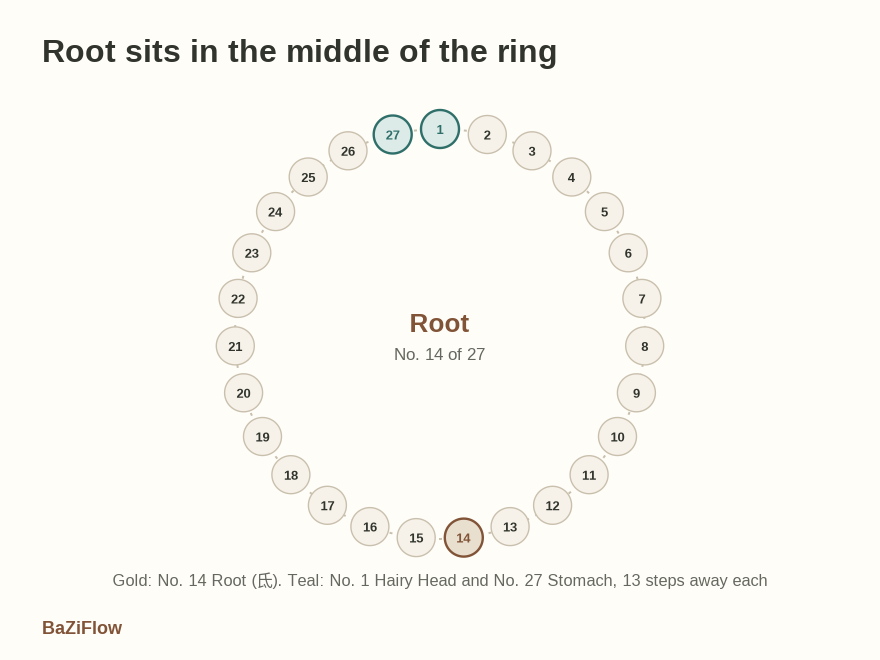
Gold Root has 13 mansions on each side; teal Hairy Head and Stomach are farthest from it, 13 steps each way.
Twenty-seven is odd, so one place must sit exactly in the middle, and that is position 14: 13 mansions come before it and 13 after. The teal ones in the picture, Hairy Head (昴) and Stomach (胃), are the two farthest from Root, each 13 steps away. On an odd ring there is no mansion exactly opposite, and these are the farthest there are.
One character, Root: not Clan, Bottom or Low
First get the character straight. It is read dī, and the site’s page for it takes the root sense, foundation. In the sutra’s second chapter the Root picture opens with:
Root has four stars, shaped like a cow’s horn.
Four stars make the shape of a horn. After the picture Jingfeng’s note gives the Chinese count, also four, with charge of encroachment and harm and a place in the east. Text and note count alike here, though other entries on the same page differ widely; Extended Net sets those numbers out in a table.
Enlarge diagram · scroll sideways to read
Root and Low sound the same, Root and Clan differ by one stroke, and Bottom looks like Root as well. In copying and typing they are the easiest to write for one another, and the next section shows exactly that kind of slip.
One table copied twice, and Root becomes “bottom” and “mutual”
Some of the sutra’s tables appear once in fascicle 1 and once in fascicle 2. Set side by side, they show that fascicle 2 has copied Root out as other characters:
Enlarge diagram · scroll sideways to read
The Rakshasa days are one of the three weekday-and-mansion tables (see Extended Net). When fascicle 2 copies it, the line reads:
… Mercury day, the Moon with Three Stars. Jupiter day, the Moon with Bottom (底). Venus day, the Moon with Legs. …
The “Bottom” has to be Root: fascicle 1 writes the same pair as “Root on Jupiter day”, and the order of the seven pairs matches throughout. The “Risk” (冒) at the head of the same line is also a slip, for Stomach. The other place is the house list: fascicle 2’s passage that names mansions by house writes the Scorpion house as “take the Mutual (互), Room and Heart days”, and set against fascicle 1’s house table, “Root 1 foot, Room 4, Heart 4”, the “Mutual” can only be Root.
One more point: Root has 3 feet in the Scales house and 1 in the Scorpion house, yet the day list by house in fascicle 2 sends Root to the Scorpion house, and the Scales entry names only Horn and Neck. The side with more feet does not always win.
Day 30 of month 8 and day 1 of month 9 are both Root
Here “old calendar” means the Japanese old calendar, with each new moon fixed by Tokyo time, and that is how the site’s month table is laid out. On that table Root is the first-day mansion of month 9, so day 1 of month 9 is Root, and after a full 27-step lap day 28 is Root again. The full Moon of month 3 (the Root month in the sutra) is Root as well, in line with the month name.
Root has one more feature that depends on month length. Month 8 begins at Horn, and counting to its day 30 lands exactly on Root, while the first-day mansion of month 9 is also Root. If month 8 has 30 days the two days join up as a repeat.
Enlarge diagram · scroll sideways to read
October 10, 2026 is Japanese old-calendar month 8, day 30, and the 11th is month 9, day 1: both are Root. In 2025 month 8 had only 29 days, so October 20 (month 8 day 29) is Neck and the next day, month 9 day 1, is Root, with no repeat. Of the fifteen years 2018 to 2032, seven have a 30-day month 8 and Root twice in a row (2019, 2020, 2022, 2023, 2024, 2026 and 2029).
The Chinese lunar calendar differs in that one year. The new moon fell at 23:50 Beijing time on October 10, which was already 00:50 on the 11th in Tokyo, so in the Chinese calendar October 10 is the first of month 9 (Root), the 11th is day 2 (Room), and month 8 has only 29 days. Of the fifteen years, 2026 is the only one where the two calendars disagree here; in the other six, month 8 has 30 days in both.
Two small exercises
Which mansions are old-calendar month 8 day 30 and month 9 day 1?
Month 8 begins at Horn and 29 steps on is Root; month 9 begins at Root already. Both days are Root.
What mansion falls on month 3, day 15, and what is the month called in the sutra?
Month 3 begins at Stomach and 14 steps on is Root; the sutra calls month 3 the Root month, named for the mansion holding the full Moon.
Before Root is Neck and after it Room. For month names and month tables see Sukuyō and birth mansions, and for checking different copies of one source see checking Sukuyō sources.
Questions readers ask next
Are Root (氐), Clan (氏), Bottom (底) and Low (低) the same character?
No. The mansion character is read dī and means a foundation or root; the other three are different characters. Because they look and sound alike, they are easy to miswrite when copying, and the e-text of the Sukuyō Sutra has places where Root appears as Bottom (底) or Mutual (互). Only a second copy of the same table reveals it.
Why are two days in a row Root in October 2026?
The site’s table follows the Japanese old calendar (new moon fixed by Tokyo time) and restarts its count every month. In 2026 month 8 has 30 days, and day 30 reaches Root; month 9 begins at Root too, so October 10 and 11 repeat. In a year when month 8 has 29 days it ends on Neck, and nothing repeats. In the Chinese lunar calendar, month 9 already begins on October 10, so that repeat does not appear there.
If the sutra’s count and the note’s count agree, is that entry especially reliable?
Agreement only shows that the two layers of text count the same number. It says nothing about the rest of the entry. Among the seven mansions from Star to Root only Horn and Root agree, and each of the others differs by its own amount. Reliability comes from checking entry by entry against the text.
Was this article helpful?
Sources & references
Continue reading
Neck (亢): One-Star Fire Pearl, Three Runs of Nine from Neck, and a Leap Month ↗
Room (房), Mansion No. 15: the Tent Picture, Four Feet and the Friday Pairing ↗