

Cross the middle boundary, exchange the roles
Content version · · Sources & references
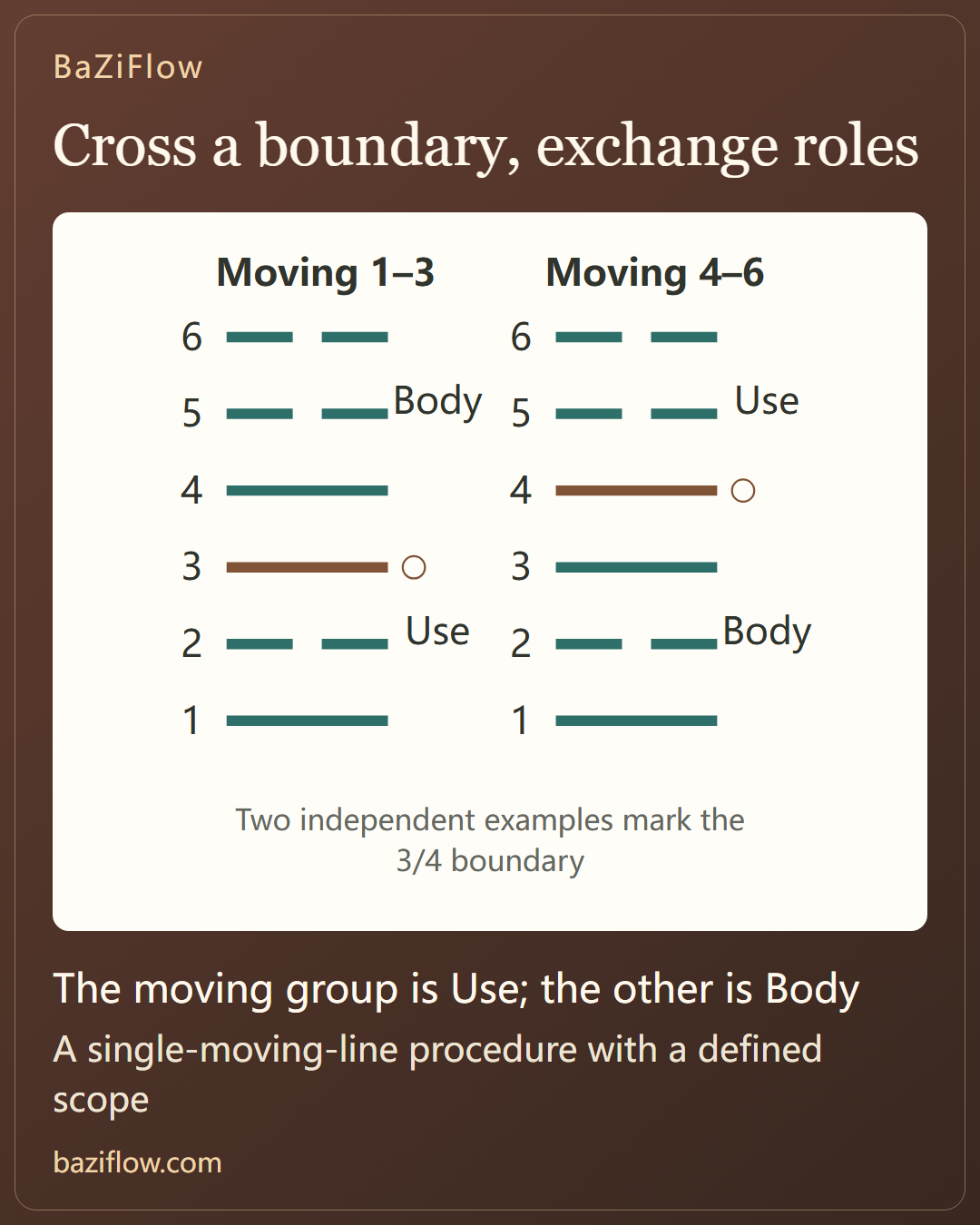
Use two independent Feng exercises to distinguish upper and lower placement from body and use, then separate the primary use trigram from broader influences.
The short version6 min read
Keep Feng with upper Zhen and lower Li, but change the stipulated moving position from three to four in separate exercises. Body and Use exchange because the trigram containing the moving line is Use. Wood still generates fire; the roles attached to that direction change.
- Body and Use initially name the two component trigrams inside the primary figure, not the complete primary and changed hexagrams.
- Positions one through three are lower; four through six are upper. The group containing the single moving line is Use.
- In Feng, moving line three makes Zhen Body and Li Use; moving line four reverses those roles without reversing wood generating fire.
Read first
Determining a moving line: position first, then the change ↗
Primary, nuclear and changed hexagrams: trace each operation ↗
“Body” is a reference role, not a physical body
In Meihua, ti and yong are often translated as body and use. Those English words can mislead: body does not automatically mean health, and use does not mean a useful or favorable result. In the initial assignment considered here, each label belongs to one of the two three-line trigrams within the primary hexagram. Body supplies the reference role; use is the responding matter considered in relation to it.
Volume two of the Meihua Yishu explains the terms through the contrast between host and guest, or stillness and movement. Volume three makes the moving-versus-still assignment explicit. This article follows the common single-moving-line procedure: the trigram containing that line is use, and the other trigram is body. “Moving” refers to the line selected by the casting procedure. It is not inferred from which person seems active, which symbol suggests motion, or which side of a diagram attracts attention.
Inside the primary
- Upper / lower trigrams
Complete figures
- Primary / changed
A useful boundary test: line three versus line four
Number the six positions upward. Lines 1–3 belong to the lower trigram, and lines 4–6 to the upper trigram. A moving line in the lower half therefore assigns use below and body above. A moving line in the upper half assigns use above and body below. The top trigram has no permanent entitlement to the body role.
Consider a supplied Feng figure with Zhen above Li. Run two independent exercises, returning to the original figure before the second. First stipulate moving line 3, which lies in the lower Li. Then stipulate moving line 4, which lies in the upper Zhen. These are alternative teaching conditions, not two moving lines in one casting.
| Given condition | Body | Use | Direction of wood generating fire |
|---|---|---|---|
| Feng, line 3 moves | Upper Zhen: wood | Lower Li: fire | Body generates use |
| Feng, line 4 moves | Lower Li: fire | Upper Zhen: wood | Use generates body |
Volume two's house-divination example involving Feng changing to Zhen explicitly identifies Zhen as body and Li as use. It supports the first row's allocation. The second row is a separately declared exercise. We do not borrow the narrative's predictions about buildings or treat its account as evidence of predictive accuracy.
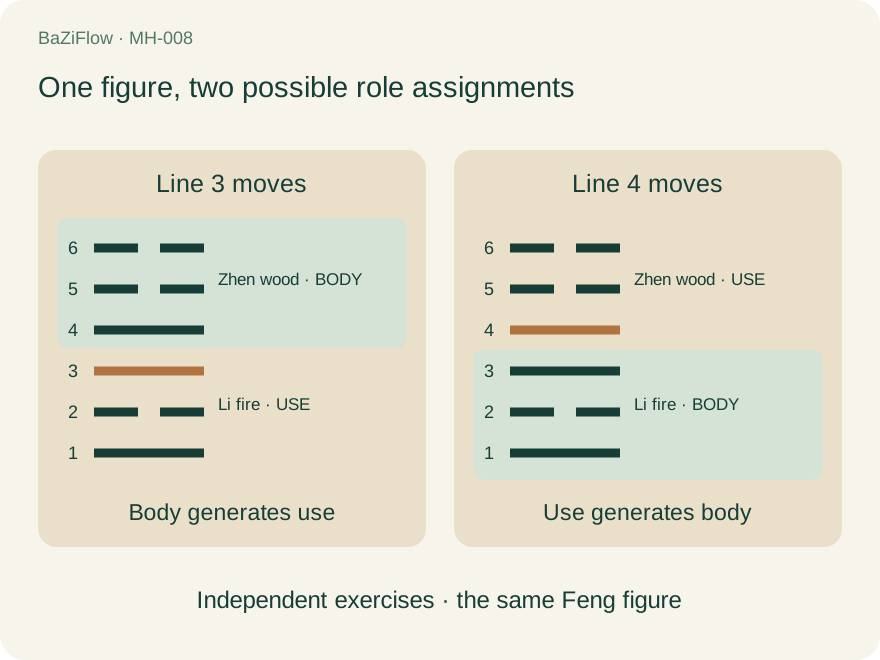
Original BaZiFlow comparison. Lines 3 and 4 are alternative teaching conditions, not two moving lines in one casting.
Wood still generates fire in both rows. What changes is the role attached to each end of that relationship. Reversing body and use is not the same as reversing the elemental relation. If both rows are recorded as body generating use, the roles have been attached permanently to the trigram names instead of assigned from the moving position.
Feng
Feng
Two independent Feng exercises mark line three or four, assigning Use to lower Li or upper Zhen respectively.
Preserve the original before making the change
Assign the initial roles on the primary figure, before replacing a line. The use trigram is the original three-line group containing the moving position. After the replacement, the corresponding trigram may have a different name. That later identity should not overwrite the name of the original use trigram.
A clear worksheet therefore records the original upper and lower trigrams, the moving position, and the role assigned to each. The changed figure is kept alongside them as a subsequent structural result. For the distinction between whole figures and their component trigrams, consult primary, nuclear and changed hexagrams.
If a moving position has not been established, a hexagram name alone cannot complete this allocation. Nor should a method producing several moving lines be silently reduced to one in order to fit this procedure. The problem is a mismatch of assumptions, not a blank cell that must be filled somehow. Check how a moving line is selected before assigning roles.
Moving 1–3
- Use below / Body above
Moving 4–6
- Use above / Body below
Why “use” sometimes refers to more than one thing
The initial body–use pair is only one level of the discussion. Volume two's section titled Body and Use also treats nuclear structures, changed structures and external responses as influences considered relative to body. Its phrase about one body and many uses broadens the scope of comparison. It does not turn the initial use trigram into several different original trigrams.
Keep those levels explicit. A column for the primary use trigram can be followed by separate notes for nuclear and changed relationships. Each comparison needs an identified reference. If every new figure is allowed to redefine body without explanation, statements such as “generates body” can switch their target halfway through the reading.
The identity of the person or matter being considered also comes from the question, not from the label alone. When someone asks on another person's behalf, the operator is not automatically the subject of every statement about body. Likewise, a traditional family association attached to a trigram is not evidence that a particular relative is involved. The record should distinguish a symbolic association from an identified subject.
For a manually entered figure without a moving line, this tool assigns neither Body nor Use and gives no relationship verdict. Once a single moving line is supplied, its half determines the roles. Nuclear and changed figures remain supporting comparisons against the original Body; they neither redefine it nor form a predictive score.
Apply a declared procedure, not an unlimited rule
The same volume's weather-divination section explicitly takes a different approach, considering the figures without dividing body and use. That exception matters: the text itself does not require every topic to use the initial allocation taught here. This article concerns a stated single-moving-line exercise, not a universal instruction for all forms of object or weather divination.
An accurately completed table establishes the roles and the direction of a traditional relationship. It does not establish that an event will succeed, assign a numerical probability, or replace the remaining interpretive conditions. Seasonal strength and the other figures have not yet been considered in this exercise.
For a reproducible reading, retain the question's subject, the original pair of trigrams, the selected moving position and the resulting role assignment. Then the next stage can explain what else is being added, rather than quietly changing the starting point. Continue with generation, control and strength to examine those additional conditions.
Questions readers ask next
Does the upper trigram always take the Body role?
No. Under this single-moving-line procedure it is Body when the moving line is below, and Use when the moving line is above. Separate Feng exercises at positions three and four cross exactly that boundary.
Can a changed trigram replace the recorded original Use trigram?
No. Assign the initial roles before changing any line. The original group containing the moving position is Use. A different trigram produced by changing that line belongs to the changed structure and needs its own record.
Does one Body and many Uses allow Body to change repeatedly?
The expression broadens the influences considered relative to Body, including nuclear and changed structures and external responses. It does not remove the need for a fixed reference. Keep each level and comparison target explicit.
Was this article helpful?
Part of a learning path
Meihua: from trigrams to Body and Use and review · Step 5 of 5 available