

Building a learning log
Content version · · Sources & references
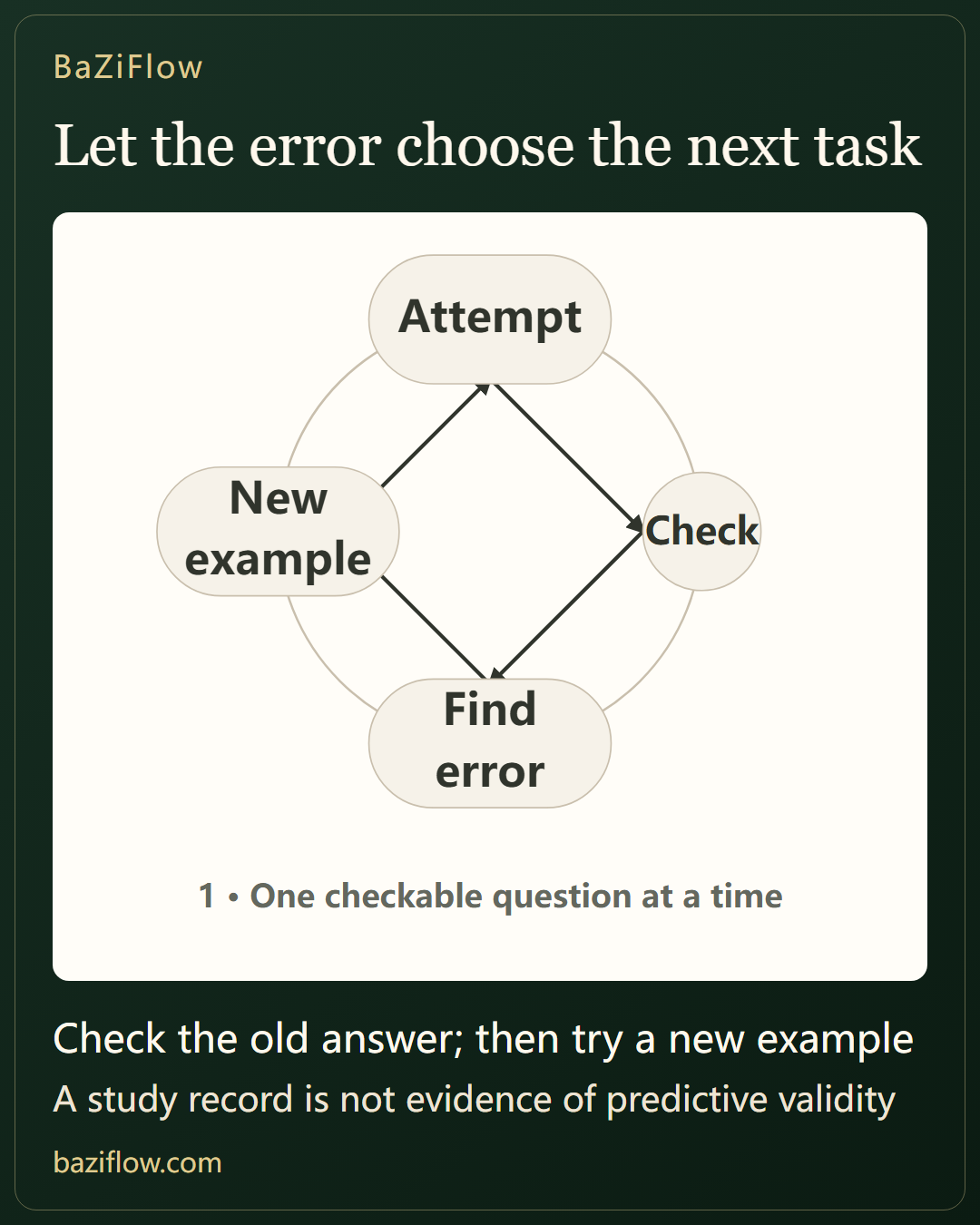
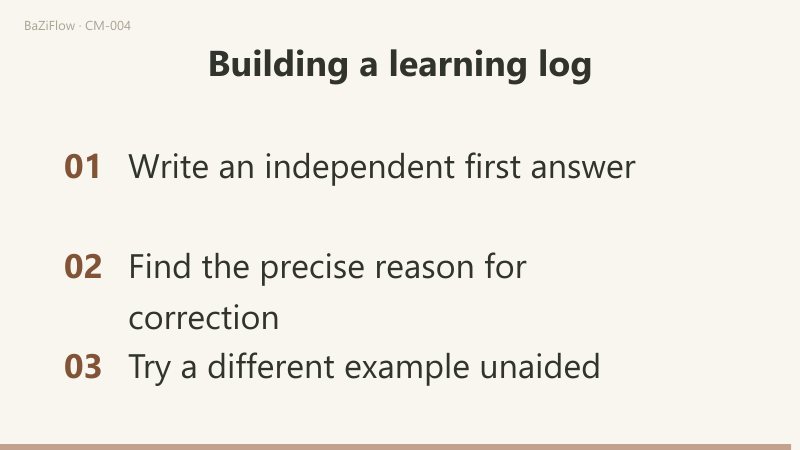
Build short entries around a question, an unaided attempt, a check and a different follow-up example. Separate learning terminology from applying a convention or evaluating a prediction.
The short version6 min read
A polished page of notes can feel like mastery. A useful learning log also records what you decided before looking, why you changed it and how a different example will test that change.
- Choose one question that can be answered before consulting the solution.
- Keep the initial reasoning and locate the error in a term, step or scope.
- Transfer to a new example tests learning; fluent calculation alone does not establish prediction.
Read first
What will you do differently at the next session?
That question gives a learning log a purpose beyond documenting effort. A record of pages read can be useful for scheduling, but it does not show which distinction you can now make. Try ending an entry with a small, specific next attempt: identify the source of an explanation in a different passage, or list the settings required by a different example before inspecting its result.
If no next attempt follows from the entry, look for the missing link. Perhaps the question was too broad, the check was only a feeling of familiarity, or the correction was copied without explaining why it mattered. You do not need to write more. You need to make the relationship between this attempt and the next one clearer.
Keep the first answer and the reason for change
- Error explanation
- The point where the reasoning used a definition, step or scope incorrectly.
- Transfer
- Selecting and applying the appropriate method in a different example.
Three learning goals that should not share one score
Knowing a term, applying a stated convention and evaluating a prediction are separate achievements. Correctly naming a card's number tests knowledge of a deck. Reproducing selected chart fields tests an operation under specified conditions. Neither task, by itself, demonstrates that a reading predicts events.
Name the goal before choosing a check. For a terminology exercise, consult the relevant source. For a calculation exercise, fix the inputs and convention. A claim about prediction requires a different kind of evidence and cannot be settled by a few memorable matches in a notebook. Do not let success in the easier task silently count as success in the harder one.
NIST's discussion of experimental design connects the choice of design with the objective and factors under investigation. The modest lesson here is to match the check to the question. A personal study log does not become an experiment merely by containing a table, and no accuracy rate is established by the workflow below.
Term knowledge
- Suitable check
- Explain it and distinguish a counterexample
Rule execution
- Suitable check
- Recalculate from stated inputs
Predictive claim
- Suitable check
- Use a suitable evidence design
Keep the answer you gave before checking
Suppose you assumed that a tool's default setting was a rule shared by every school. After reading the documentation, you discover it was a choice made by that tool. If you replace your first answer with the correct setting name, you lose the useful part of the lesson: you confused a local choice with a universal convention.
Preserve the initial answer and its reason. Add the correction beside it, with a location in the material that prompted the change. Then choose a follow-up example where the same confusion could occur in a different form. You might inspect another tool's explanation before deciding whether its different result is an error.
| Entry component | What it contributes |
|---|---|
| A narrow question | A target that can actually be checked |
| Your first attempt | The reasoning before the answer was visible |
| The check | A correction, its basis and any remaining gap |
| A next example | A chance to apply the distinction elsewhere |
For more on preserving sources without erasing earlier versions, see saving evidence and uncertainty. The log can link to that evidence rather than duplicating an entire archive inside each entry.
Initial answer
- Default means universal
Evidence found
- A choice made by this tool
Revised action
- Read the next tool’s method
Use the cycle to organize attention
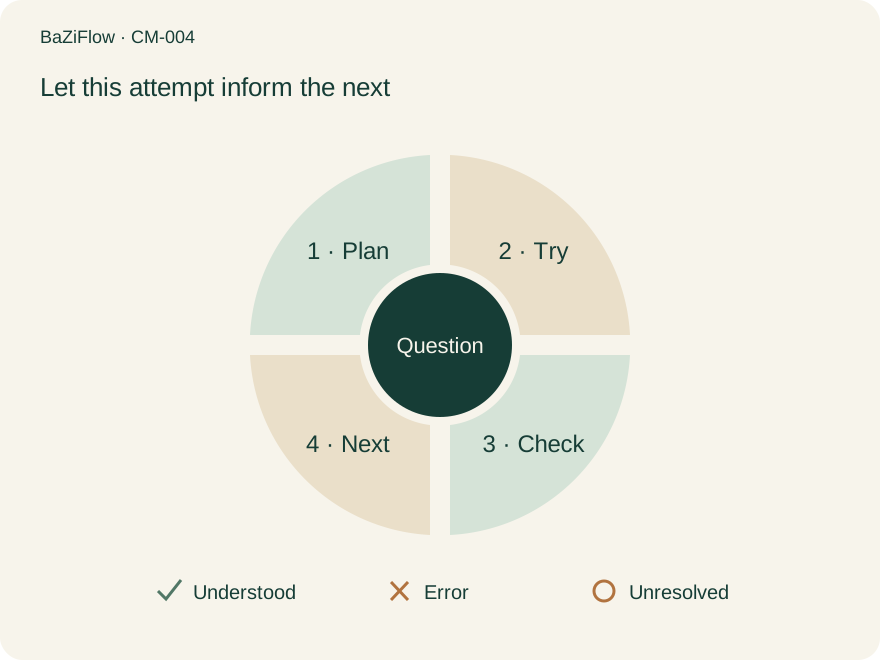
Original BaZiFlow learning-cycle diagram. Organizing revision does not establish predictive validity.
The diagram keeps a small question at the center and gives each part of the session a place: plan, try, check and choose the next attempt. The distinct marks separate an understood item, an error and an unresolved question. An unresolved item is a legitimate stopping point when the necessary material is unavailable.
The Education Endowment Foundation's guidance on metacognition describes planning, monitoring and evaluating learning in a school context. It informs the organization of this exercise, not a claim that this particular notebook has been tested for astrology or that education research validates divination. Keep the scope of the reference as clear as the scope of your own progress.
Try answering before looking back at your notes. Then change the example rather than merely repeating the same page. If you learned to distinguish a source passage from a modern explanation, work with another author or another annotation. The aim is to discover whether the distinction travels beyond the layout you recognize.
1
- Question
- Attempt
- Evidence
- Next attempt
One question per cycle
Let errors determine the next task
When the second attempt fails, ask where the difficulty occurred. An unfamiliar term calls for prerequisite learning. A missing source location calls for better reference tracking. Treating an inference as an observed fact calls for another sentence-classification exercise. More reading is not a specific remedy until you know what it should address.
The guide to classical texts and modern explanations provides one possible subject for this kind of practice. It is an example of a limited learning target, not a mandatory route through every tradition. Choose material that matches the question you are working on.
Keep successful, unsuccessful and unresolved examples. Saving only satisfying entries can exaggerate your competence; saving only failures can hide what has become stable. The comparison is useful because it changes your plan, not because it produces a flattering total score.
Finally, keep the routine small enough to finish. A few questions and one concrete next step are often sufficient. If the same error returns across several sessions, change the sequence, break down the question or seek a different explanation. A useful log shows where your reasoning changed and what would let you check that change. It is not a polished record pretending you never needed correction.
Same page again
- May test visual familiarity
Different method
- Requires checking scope again
Keep the first claim
Record “the default is universal” and why it seemed reasonable before checking.
Locate the convention
Find the tool’s method note and record which choice it actually makes.
Test a different tool
Identify its settings first; do not carry over the previous tool’s default.
Questions readers ask next
Why retain an incorrect answer?
It preserves the reasoning that needs to change. A corrected answer alone cannot show whether the learner misunderstood a term, skipped a step or applied a local convention too broadly.
How long should a session last?
Set a small endpoint, such as explaining one counterexample or locating a missing source. A question can remain explicitly unresolved when no new evidence is available.
Does a detailed log validate predictions?
It documents learning and procedures. Predictive validity requires a separate question, outcomes, comparisons and an appropriate evidence design; the number of notes cannot supply those conditions.
Was this article helpful?
Theme: Reflection & emotions
Sources & references
Continue reading
A Classical Citation Does Not Cover Every Modern Claim ↗
Facts, Symbols, Inferences and Advice Have Different Jobs ↗
Personalization Needs a Reason That Changes with the Input ↗