

Xun Four: the Wood palace in the southeast corner
Content version · · Sources & references
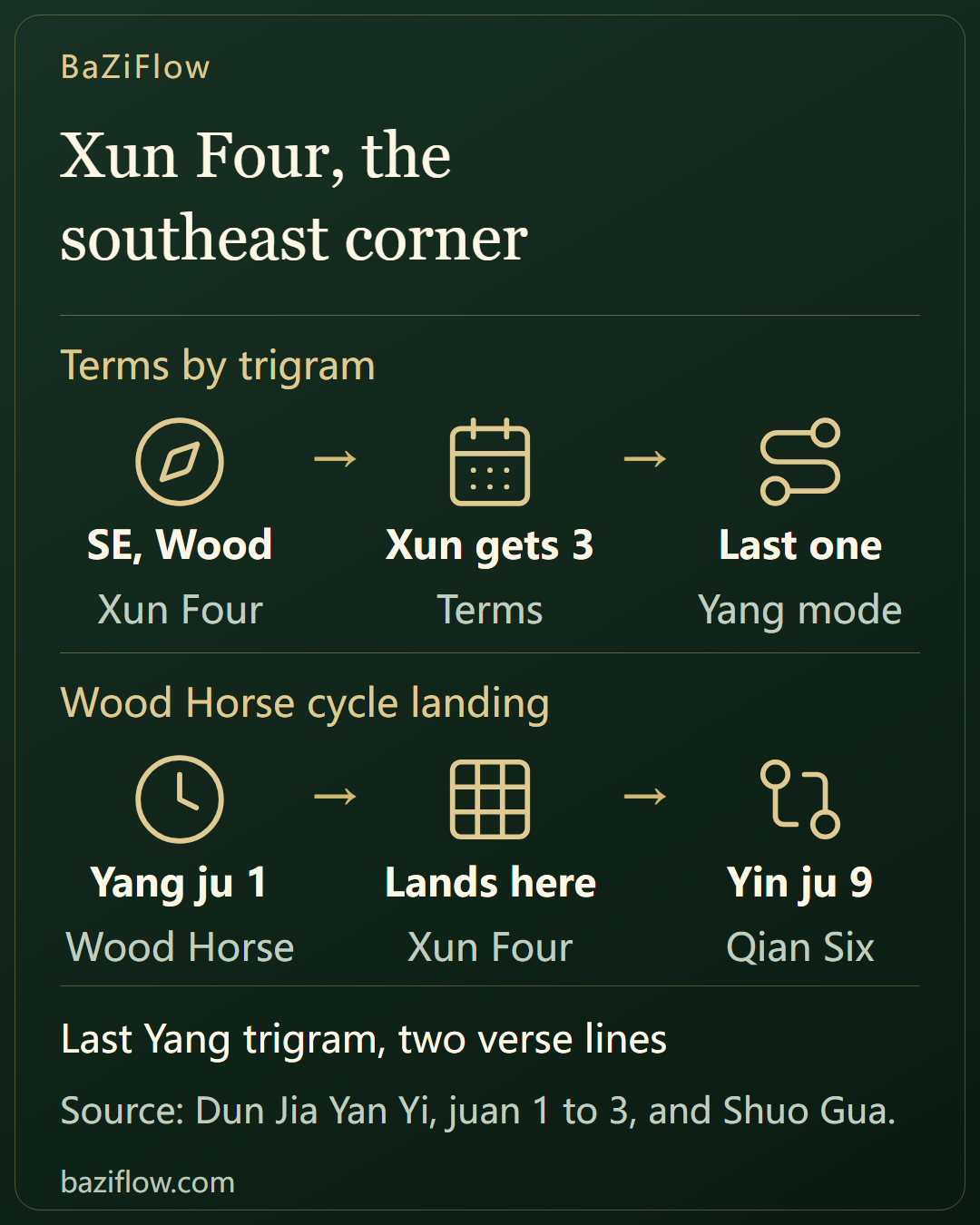
Xun Four is the southeast corner of the nine palaces: number 4, trigram Xun, Wood. The term grouping, the Yang Wood Horse cycle and the Wind escape verse in Dun Jia Yan Yi show what the palace covers.
The short version7 min read
Start of Summer, Grain Buds and Grain in Ear belong to Xun Four, the southeast corner with Luoshu number 4, the Xun trigram and Wood, so the twelve Yang-mode terms end in this box. Of the five lines on the Wind escape in Dun Jia Yan Yi, only two name the Xun palace.
- Xun Four is one of the four corner palaces, at the upper left of a south-up grid and diagonally across from Qian Six; its terms are Start of Summer, Grain Buds and Grain in Ear, and the daily Rest Gate's three spells there all open on a You day.
- The book gives Start of Summer, Grain Buds and Grain in Ear to Xun. Reading its list from the Winter Solstice, the Yang-mode trigrams are Kan, Gen, Zhen and Xun, so Xun comes last; the Summer Solstice after it belongs to Li.
- Of the five verse lines under the Wind escape only the first two name the Xun palace, three name stems on the earth plate, and one more line at the end of the entry falls in Kun; when "Xun" appears, first tell which line is meant.
Read first
Southeast, Wood, Xun, four: the box in the upper left corner
Xun Four (巽四) holds the southeast corner of the nine palaces. Its number is 4, its trigram is Xun and its element is Wood. On a south-up, east-left grid, look at the upper left corner first and you have found it.
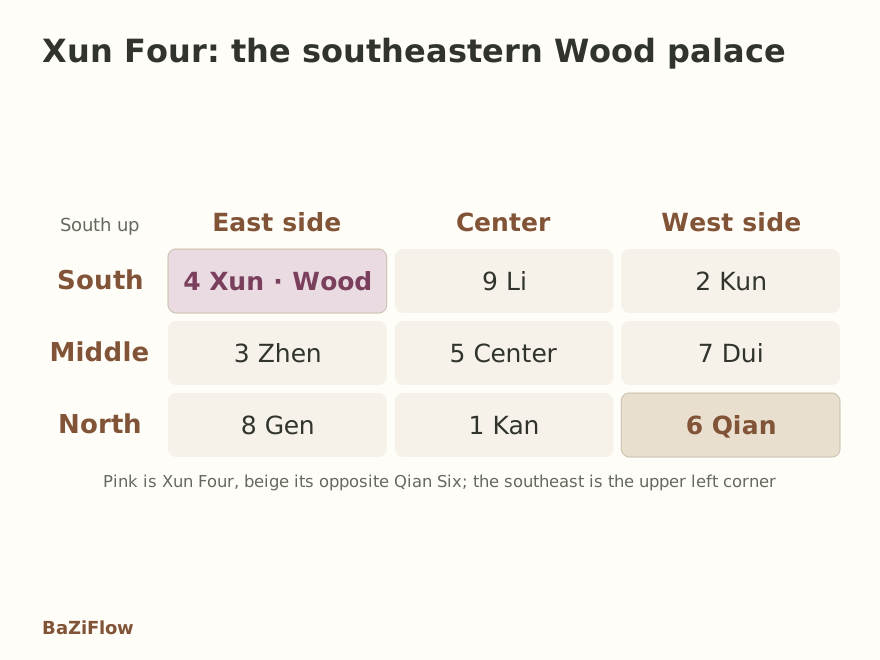
Nine-palace base grid with south at the top and east on the left. Directions and elements follow the usual assignments, the numbers are Luoshu numbers. Pink marks Xun Four and beige its opposite, Qian Six.
The southeast is exactly the upper left corner, which is also the first box when the grid is read row by row; Qian Six sits diagonally across at the lower right, and 4 + 6 = 10. The Shuo Gua (说卦), chapter 5, arranges Xun like this:
All things are set in order in Xun... Xun is the southeast; to be set in order means that all things become clean and even.
"Set in order" means tidy and complete, which the passage glosses as everything becoming clean and even. That describes the Xun trigram itself; what the Xun Four palace draws on in a Qimen chart is mainly the southeast direction and the element Wood.
The last trigram that Yang mode reaches: Start of Summer, Grain Buds, Grain in Ear
Juan 3 of the Ming-dynasty text Dun Jia Yan Yi (遁甲演义) shares the twenty-four solar terms among the eight trigrams, three apiece, and puts the first half of the year, from the Winter Solstice onward, under Yang mode. Reading down its list, those twelve terms go in turn to Kan, Gen, Zhen and Xun. Those four are the trigrams Yang mode uses, and the Start of Summer, Grain Buds and Grain in Ear of Xun Four are the last three of them. The next term, the Summer Solstice, belongs to Li and begins the Yin mode.
Enlarge diagram · scroll sideways to read
The Yang Wood Horse cycle: Xun Four in Yang ju 1, Qian Six in Yin ju 9
In the hourly examples every cycle has a head. Juan 1 of the book writes Yang-mode ju 1 like this:
Yang Wood Horse is at Xun; Tian Fu is the duty star and the Block Gate the duty gate, in charge of ten double-hours and ending at the Yin Water Rabbit hour.
The six cycles of Yang ju 1 run Yang Wood Rat, Yang Wood Dog, Yang Wood Monkey, Yang Wood Horse, Yang Wood Dragon and Yang Wood Tiger, each governing ten double-hours; Yang Wood Horse is fourth and lands in the fourth palace, Xun. In the Yin-mode ju 9 example right beside it, though, the Yang Wood Horse cycle sits at Qian, with Tian Xin as duty star and the Open Gate as duty gate.
Enlarge diagram · scroll sideways to read
Qian Six is exactly the opposite palace of Xun Four. Compare the home table (see the home positions of stars and gates): Tian Fu and the Block Gate have their home in Xun Four, Tian Xin and the Open Gate in Qian Six, so in both ju the star and gate of the Yang Wood Horse cycle are at home. Tian Fu and the Block Gate are names, and on their own they say nothing about an exam or a blockage.
The Wind escape: which lines actually name the Xun palace
Juan 2 lists a set of patterns named "escapes": the Heaven, Earth, Human, Spirit and Ghost escapes, and also the Wind, Cloud and Dragon escapes. The Wind entry quotes five lines of verse, and the first of them is:
The Yin Wood in heaven joins the three gates and meets the Xun palace from above: this is the Wind escape.
"Meets from above" means a heaven-plate stem pressing down on a position of the earth plate. Of the five lines only the first two name the Xun palace. The second has Yang Fire joining the Open Gate and meeting Xun from above, with the added condition "not hit by Tomb or Pressure". The other three name stems on the earth plate, and the entry ends with one more line in which Yang Fire and the Open Gate meet the Kun palace.
Enlarge diagram · scroll sideways to read
So when "Wind escape" comes up, first ask which line is being followed: whether its condition names a palace or a stem, and whether it carries the "not hit by Tomb or Pressure" clause. The mere presence of a Xun position on a chart does not make it a Wind escape; and in the other direction a Wind escape need not land in Xun Four.
The fourth stop of the daily round, and its end at day sixty
Return to the daily scheme once more. The Rest Gate's fourth halt is at Xun, covering the Yin Water Rooster, Yang Wood Dog and Yin Wood Pig days. Twenty-four days later the twelfth halt is Yin Fire Rooster, Yang Earth Dog and Yin Earth Pig, and twenty-four days after that the twentieth is Yin Metal Rooster, Yang Water Dog and Yin Water Pig, where the sixty-day round closes and Yang Wood Rat begins afresh from Kan One.
Enlarge diagram · scroll sideways to read
Quick checks
Which trigram holds Start of Summer, and is it Yang or Yin mode?
The book says "Xun takes Start of Summer, Grain Buds and Grain in Ear". They sit within the twelve qi after the Winter Solstice, so they are Yang mode.
Yin Wood Pig day: where does the Rest Gate stand?
Yin Wood Pig is the last day of the group Yin Water Rooster, Yang Wood Dog, Yin Wood Pig, still within the fourth stop, which is Xun Four.
Next you can read Center Five, the one box in the grid that has no direction yet is so often "lodged" somewhere else.
Questions readers ask next
Is Xun Four the palace that is in charge of wind?
That is too neat a summary. In the Shuo Gua the Xun trigram is tied to wind, and the book has a pattern called the Wind escape, but only two of its five verse lines name the Xun palace and their conditions differ. The palace supplies a position; whether the Wind escape holds depends on the full set of conditions the line states.
Start of Summer, Grain Buds and Grain in Ear all belong to Xun. Do charts for those three terms all start at Xun Four?
Not necessarily. A term says only which trigram it belongs to and whether the mode is Yin or Yang; the ju number is settled separately by the upper, middle or lower period. The book's Grain Buds middle-ju example is ju two and starts Yang Wood Rat in Kun Two, so its start is not in Xun.
Why is the Yang Wood Horse cycle sometimes in Xun Four and sometimes in Qian Six?
The palace of a cycle head changes with the ju. In Yang-mode ju 1 the Yang Wood Horse cycle lands in Xun Four, in Yin-mode ju 9 it lands in Qian Six, and Qian Six happens to be the opposite palace of Xun Four. So when you see "the Yang Wood Horse cycle", ask which ju first.
Was this article helpful?
Sources & references
Continue reading
Zhen Three: the Eastern Wood Palace, Checked Against the "Flying Bird" Example ↗
Center Five: the Directionless Middle Box, and Why the Book Lodges It in Kun Two ↗