

Nine Earth: two seats behind the Chief
Content version · · Sources & references
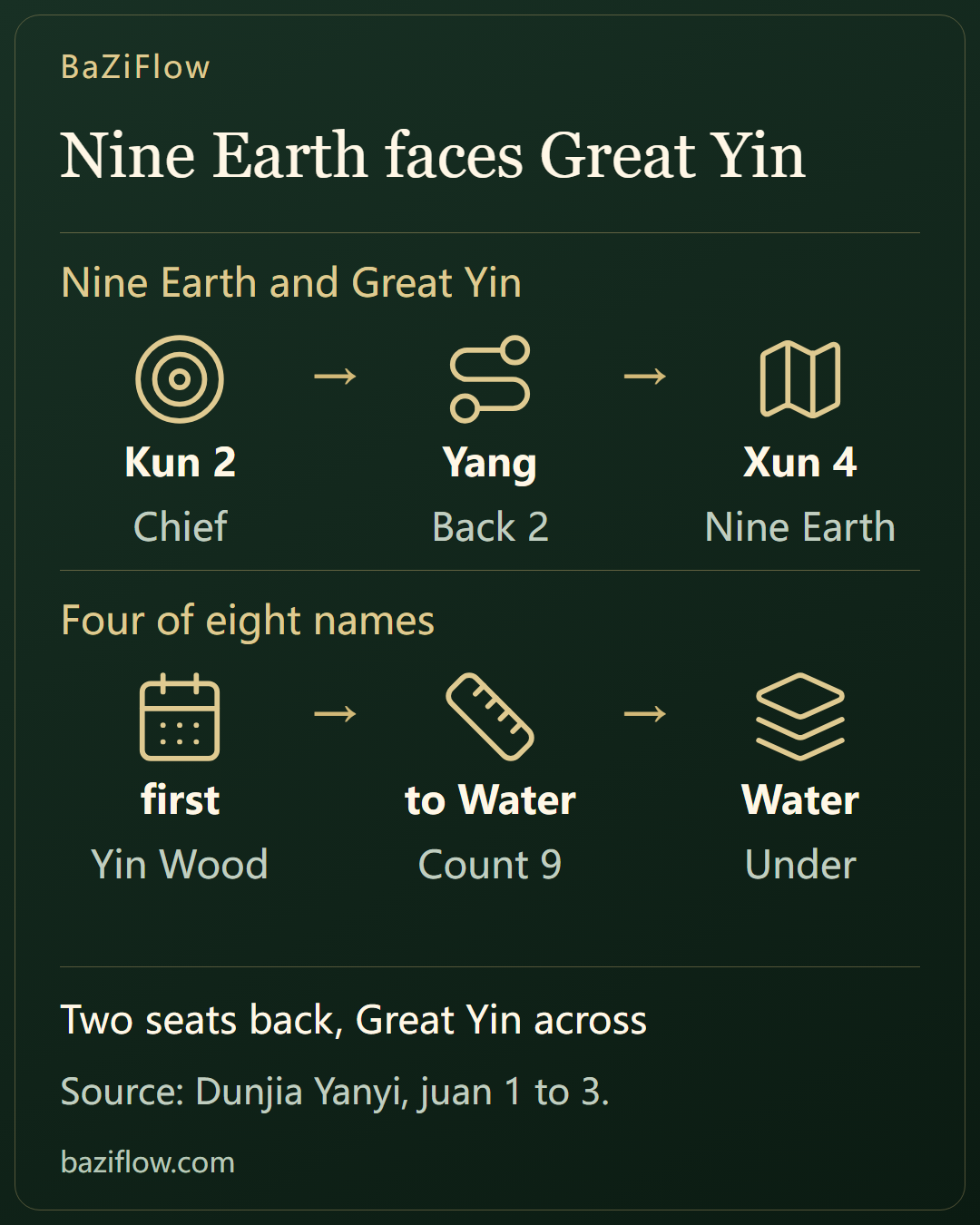
Nine Earth is the seventh Qimen god and always faces Great Yin. The word "hide" in Dunjia Yanyi, Wang Zhang's count of nine from Yin Wood to Yin Water, and the four of eight ruses and feints that name it.
The short version7 min read
Wherever the Dunjia Yanyi describes Nine Earth, the word it lands on is hiding. On the chart Nine Earth stands two boxes behind the Chief, two ahead in Yin mode, directly across the center from Great Yin.
- In Yang mode Nine Earth is two seats behind the Chief and in Yin mode two seats ahead of it; either way it faces Great Yin, and each worked example in the book agrees.
- The verdicts all turn on hiding: sturdy enough to hold a position, deepest of the secluded, able to veil traces. Unlike the White Tiger, the Black Tortoise and the Serpent, its line carries no exception clause.
- Of the eight ruses and feints, four sit above Nine Earth (Double Ruse, Earth, Spirit and Ghost feints), the most of any god. "Under the Nine Earth" is a separate layer, a stem: it looks at where the heaven-plate Yin Water lands.
Read first
Two seats behind the Chief, straight across from Great Yin
Nine Earth (九地) is seventh among the eight gods. In Yang mode it stands two seats behind the Chief (值符); in Yin mode, two seats ahead. Either way it ends up across from Great Yin (太阴).
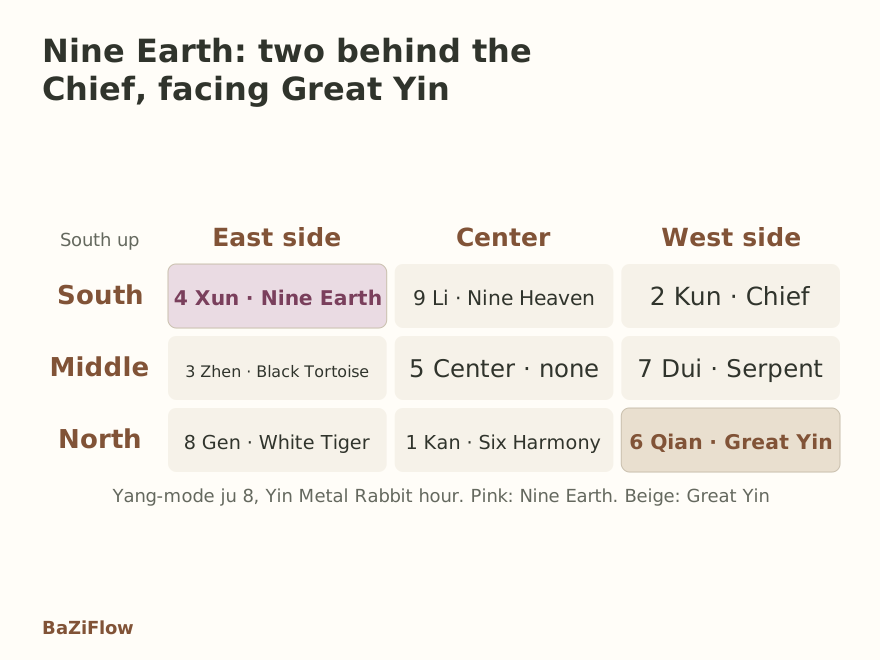
Nine-palace base, south up and east on the left. The seats follow one example in juan 2 of Dunjia Yanyi, in the passage on the five places not to strike (Yang-mode ju 8, Yin Metal Rabbit hour): the Chief, Life Gate, Nine Earth and duty gate the book names match the engine, and the rest are filled in by the same order. Pink is Nine Earth, beige Great Yin.
The chart comes from the passage in juan 2 of Dunjia Yanyi (遁甲演义) on the "five places not to strike": Yang-mode (阳遁) ju 8, Yin Metal Rabbit (辛卯) hour. The text puts "Heavenly One" (天乙), its name for the Chief's palace, in Kun Two, the Life Gate in palace 3, Nine Earth in 4 and the duty gate in 8. The site engine, given the same ju and hour, agrees on all four. Nine Earth is in Xun Four and Great Yin stands in Qian Six across the center; the two palace numbers add up to ten, as opposite palaces always do.
Enlarge diagram · scroll sideways to read
The word the book keeps using is "hide"
Wherever Dunjia Yanyi describes Nine Earth, it lands on one word. Four places side by side:
Four places, one word
Hiding troops below the Nine Earth
The Rhapsody on the Workings of Dunjia (遁甲神机赋) pairs the two: above the Nine Heaven is might, below the Nine Earth troops and horses are hidden.
Hide, and a camp can stand
The angler's rhapsody says that Nine Earth hides, a camp may be set, and for an ambush one turns toward Great Yin.
A sturdy god
"Nine Earth is a sturdy god. It can be used to hold ground and shelter a city", then the line that the good defender hides below the Nine Earth.
The deepest seclusion
The commentary calls Nine Earth the deepest of the secluded, hiding so deep that it is the height of defense, and the dim breath of the ground that can veil traces.
The four add up to one picture: deep underground, able to defend, hide and make camp. It pairs with Nine Heaven, "moving above the Nine Heaven", one deep and one high. One more detail is worth noting: in the same passage the White Tiger, the Black Tortoise and the Serpent each close on an escape clause for a bearing that a wonder and a gate share. The line on Nine Earth has none and gives only a use.
"Under the Nine Earth": counting nine from Yin Wood
Beside the god, the book has a second use of "under the Nine Earth", and this one is about stems. Wang Zhang's note in juan 3 explains it:
Under the Nine Earth are the six Yin Water pillars (六癸酉): wherever Yin Water stands it is called under the Nine Earth. To flee and leave no trace, go in and out by the bearing where the heaven-plate Yin Water sits. The Changes say Kun takes Yin Wood and Yin Water, and Kun is earth, the way of earth descends, and counting from Yin Wood to Yin Water also gives nine.
"Kun takes Yin Wood and Yin Water" is the common pairing of the trigram Kun with two stems. Counted from Yin Wood, the ten stems reach Yin Water at exactly nine, which is why that stem is called "under the Nine Earth".
Enlarge diagram · scroll sideways to read
The note gives a rule for the stem layer: see which palace the heaven-plate Yin Water lands on, and that bearing is "under the Nine Earth". Back on the chart above, the heaven Yin Water sits in Kan One, while the god Nine Earth is in Xun Four. The same words point to two different boxes.
Enlarge diagram · scroll sideways to read
Eight ruses and feints, four of them over Nine Earth
In the ruse-and-feint passage of juan 2 the book first sets out three ruses (True, Double and Rest) and then five feints (Heaven, Earth, Spirit, Human and Ghost). That makes eight names, and each says which god the combination sits above. Side by side:
Enlarge diagram · scroll sideways to read
Of the eight names, four sit above Nine Earth, two above Nine Heaven and one each above Great Yin and Six Harmony. The four Nine Earth names use different gates: the lucky gates for the Double Ruse, Block for the Earth feint, Harm for the Spirit feint and Death for the Ghost feint. What they share is only the palace beneath. Juan 2 has one more link to Nine Earth: the fourth of the "five places not to strike" is the palace where Nine Earth stands.
Finding Nine Earth on a chart: one worked example
Find the Chief first
Take Yin ju 7, Yang Fire Tiger (丙寅) hour. The book puts the heaven-plate Chief in palace 9, Li Nine.
Then step ahead two
Yin mode deals the gods the other way round the ring, and the book says "two ahead is Nine Earth": one ahead of Li Nine is Kun Two, two ahead is Dui Seven. That matches the original, "Nine Earth in palace 7".
Last, look across
Across from Dui Seven is Zhen Three, where Great Yin stands on this chart; 7 and 3 also add up to ten.
Doors, stars and gods each have their own job, and what doors, stars and spirits each do sets them out. Across the center stands Great Yin; the high counterpart of this deep god is Nine Heaven; just before Nine Earth in the sequence stands the Black Tortoise.
Questions readers ask next
Are Nine Earth and the earth plate the same thing?
No. Nine Earth is one of the eight gods, counted from the Chief; the earth plate is the layer of the nine palaces that carries the earth stems. Nor is it palace nine: there are nine palaces, but gods stand only on the eight of the outer ring, and the center has none.
Why say Nine Earth faces Great Yin?
The eight gods form a ring of eight seats. Nine Earth is seventh and Great Yin third, four apart, which on the outer ring is one diagonal. Across the site engine's 1,080 combinations there is no exception. The song says "Nine Earth hides and can hold a camp; for an ambush, turn to the seat of Great Yin". Literally that is camp at Nine Earth, ambush toward Great Yin; the book never writes "opposite", so that part is a reading from the geometry.
Where does Nine Earth land most often?
Casting 18 ju and 60 hour pillars, 1,080 combinations in all, Nine Earth is in Xun Four and Qian Six 180 times each and in every other outer palace 120 times; it is never in the center. The extra comes from the Chief landing in Kun Two twice as often as elsewhere, and in those charts Yang mode sends Nine Earth to Xun Four and Yin mode to Qian Six.
Was this article helpful?
Sources & references
Continue reading
Black Tortoise in Qimen: a Northern Name on a Chart That Can Seat It in the South ↗
Nine Heaven in Qimen: the Last Seat of the Eight Gods, and a Phrase That Names Two Boxes ↗