

Complementarity or repetition
Content version · · Sources & references
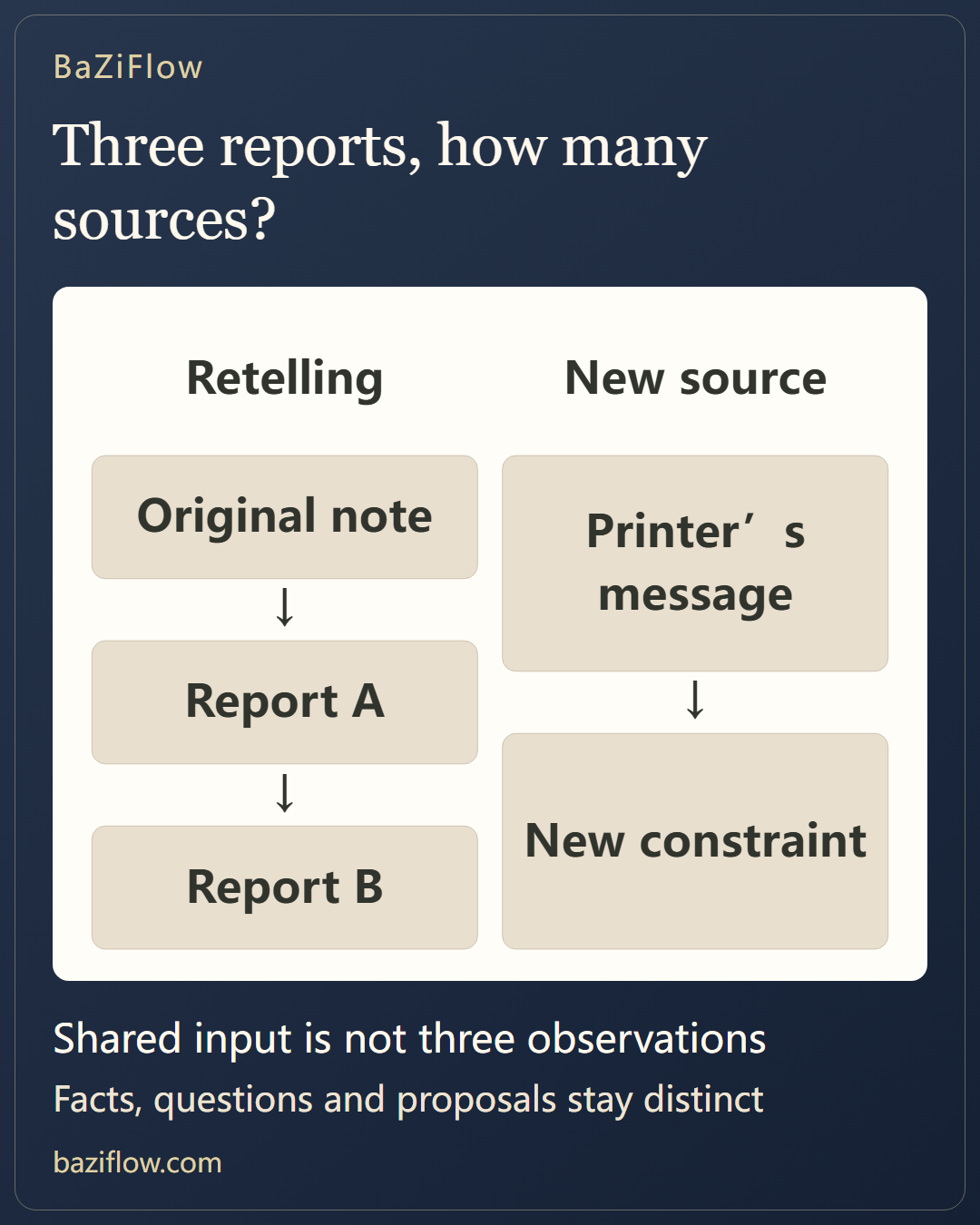
Trace a newsletter brief through three reports, distinguish new constraints from optional experiments, and use deletion to identify each contribution.
The short version6 min read
Trace the shared newsletter note before counting three reports as a consensus. A Friday deadline, a shorter-layout proposal and another reminder to prepare add different things to the editing decision.
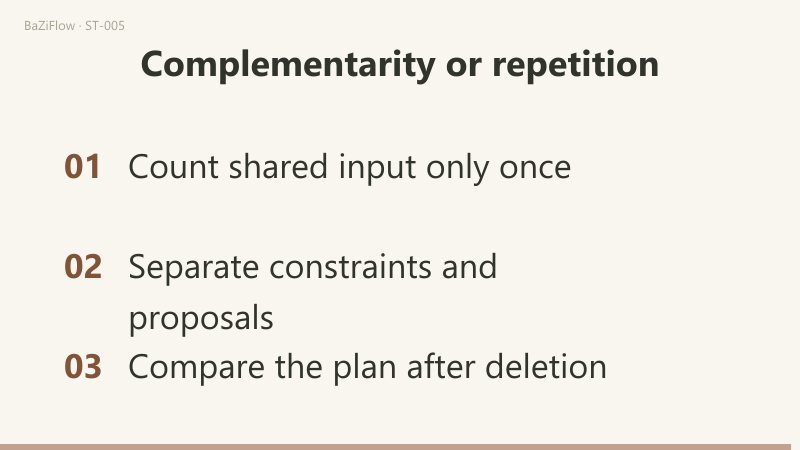
- Reports may share the same note or repeat one another, so their wording does not create independent observations.
- The printer’s deadline is a received constraint; a shorter layout is an option whose result still needs a trial.
- The deletion test asks what fact, question or action disappears, rather than assigning a universal score to prose.
Read first
Combination, Opposition and Star: Similar Words, Different Rules ↗
Draw the provenance map first
Imagine three interpretive reports that all received the same note: “Our community newsletter has six pages, and the final contribution has not arrived.” Each report recommends patience and preparation. Before calling that a consensus, draw one box for the original note and three branches for the reports. Three branches do not create three observations of the missing contribution. Separately, the printer later sends one new message, a Friday submission deadline; it gets its own box because it has a different source.
This is the first test for useful synthesis: what did each report have access to? One may have read your note, another may have read the first report, and a third may have used different symbolic material while still receiving the same description of the problem. These histories affect what can count as a new contribution. A change of terminology does not erase shared information.
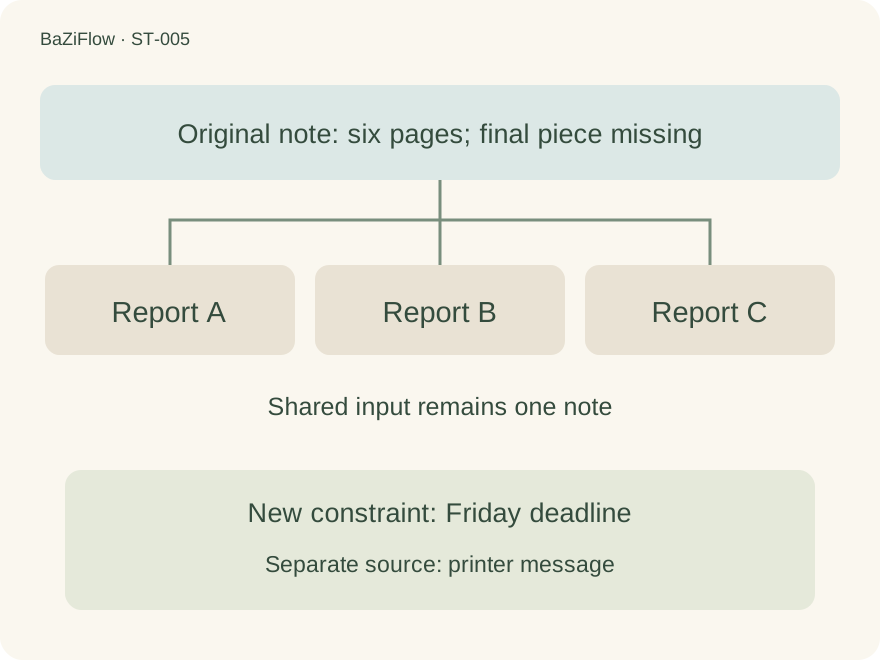
Original provenance diagram, not an empirical model of divinatory accuracy.
The diagram is an editorial exercise, not a statistical model of the systems. It does not assume that separate symbolic procedures are validated measurements. It simply prevents a known source from being counted repeatedly when explaining where a conclusion came from.
Retelling one source
Separate information
Trace what each addition changes
- Repeated advice
- A rephrasing that adds no fact, relevant question or available option to the current decision.
- Complementary question
- A distinct issue worth considering, without assuming that its answer verifies another method.
Distinguish a new fact from a new way of working
Suppose the editor then receives two additions. The printer confirms a Friday submission deadline. A reading suggests trying a shorter feature so that the missing piece would not control the whole issue. The first addition supplies an external constraint; the second supplies a possible editorial strategy. Both may matter, but they contribute in different ways.
| Material added to the file | Contribution to this decision | Appropriate status |
|---|---|---|
| “Take time to prepare” | Repeats advice already present | Merge with the existing reminder |
| The printer's Friday deadline | Adds a checkable production constraint | Record the message and its date |
| A shorter feature layout | Introduces an option to test | Keep as a proposal until tried |
| “The issue will be successful” | No defined outcome or supporting observation | Preserve the claim without promoting it to a fact |
Trying the shorter layout might reveal that the page becomes unbalanced, or that the remaining text fits well. That discovery comes from the layout trial. If a reading prompted the experiment, give it credit for prompting an experiment; do not turn a workable design into retrospective proof of every symbolic statement in the report.
There is also room for a preference rather than a discovery. The editor may prefer a quieter page with more empty space. That preference can guide the issue without becoming a fact about what every reader will enjoy. A useful synthesis retains these different statuses instead of calling everything “supporting evidence.”
Friday deadline
- Contribution
- Changes submission plan
- Status
- Received constraint
Shorter feature
- Contribution
- An option to try
- Status
- Proposal
Certain success
- Contribution
- No defined outcome
- Status
- Unverified claim
Complementarity can mean different questions, not mutual confirmation
Waite's 1911 account of the Celtic method assigns distinct subjects to positions in the spread: for example, environment and hopes or fears. The historical distinction illustrates that the question attached to a reading element matters. It does not make a card in an environment position a verified report from the printer, and the text's predictive claims are not adopted here.
Apply that distinction to the newsletter. “What do we hope this issue will express?” differs from “What must reach the printer by Friday?” A reflective interpretation might help formulate the first question. The production message answers part of the second. Their usefulness does not depend on both producing the same sentence, and neither needs to be converted into the other's vocabulary.
What should it express?
- Editorial goal
What must arrive Friday?
- Production requirement
What fits the page?
- Trial observation
Ask where a claimed addition came from
The U.S. National Archives' document-analysis worksheet asks readers to consider authorship, context, purpose, distinctive information and other evidence. Those source questions are helpful when assessing a report's contribution. The worksheet is a general document-reading resource, not an endorsement of any divinatory method. Here it helps keep a production instruction, an interpretive passage and your own planning note from being treated as interchangeable documents.
When two systems address different questions, describe the separation explicitly. A long-term symbolic reading and a prompt about today's editorial choice may coexist in a notebook without validating each other's claims. If a report never defines its question, write “scope unclear.” Inventing a complementary role after seeing the output can make nearly any pair of texts appear to fit.
Repeated reminder
- Same preparation advice
Traceable addition
- Named author
- Date and purpose
Use the deletion test, then keep a smaller file
Temporarily remove the second and third versions of “prepare carefully.” Does the decision lose a fact, a relevant question or an actionable option? In this example it does not. Restore the printer's message, however, and the deadline returns. Restore the shorter-layout proposal, and an optional experiment returns. The deletion test reveals the kind of contribution; it is not a universal quality score for prose.
Now retain a compact record: the known six-page limit, the Friday instruction, the unreceived contribution, the proposed layout trial and its observed result when available. Keep the uncertain success claim separate if it needs later examination. This record may be shorter than any original report while being more useful for the next editing session.
Repeated advice can still serve as a reminder. It just should not be presented as newly discovered information. Likewise, a fresh metaphor can be creatively useful without supplying independent evidence. The aim is to name those benefits accurately rather than force every benefit into the language of confirmation.
For a deeper look at differing question roles, see the layers of the Celtic Cross. For terminology that appears similar across methods, see why similar terms are not interchangeable. In a well-kept synthesis, every retained passage has a job, and the information used to give it that job remains traceable.
Repeated preparation lines
- What deletion removes
- No existing constraint
Printer’s message
- What deletion removes
- Friday deadline
Shorter-layout idea
- What deletion removes
- An optional experiment
Keep the original file
Mark the six-page note, repeated preparation advice, Friday message and layout proposal separately.
Remove one contribution at a time
Compare the record without repeated wording, then without the deadline and without the proposed trial.
Attribute the observed change
Record which constraint or option disappears and where the trial result came from; do not credit report agreement for new printer information.
Questions readers ask next
Why are three preparation reminders not three observations?
They may share a note or copy one another, without adding another observation or constraint. Their reminder value should not be counted as new evidence.
Can an unverified new angle still be useful?
Yes. It may suggest an experiment. Preserve it as a proposal and record what actually happens when tried.
Does an unchanged decision make a deleted sentence worthless?
No. The test concerns its contribution to this decision. Encouragement or repetition may have another role without supplying new evidence.
Was this article helpful?