

Seven of Pentacles: a long look
Content version · · Sources & references
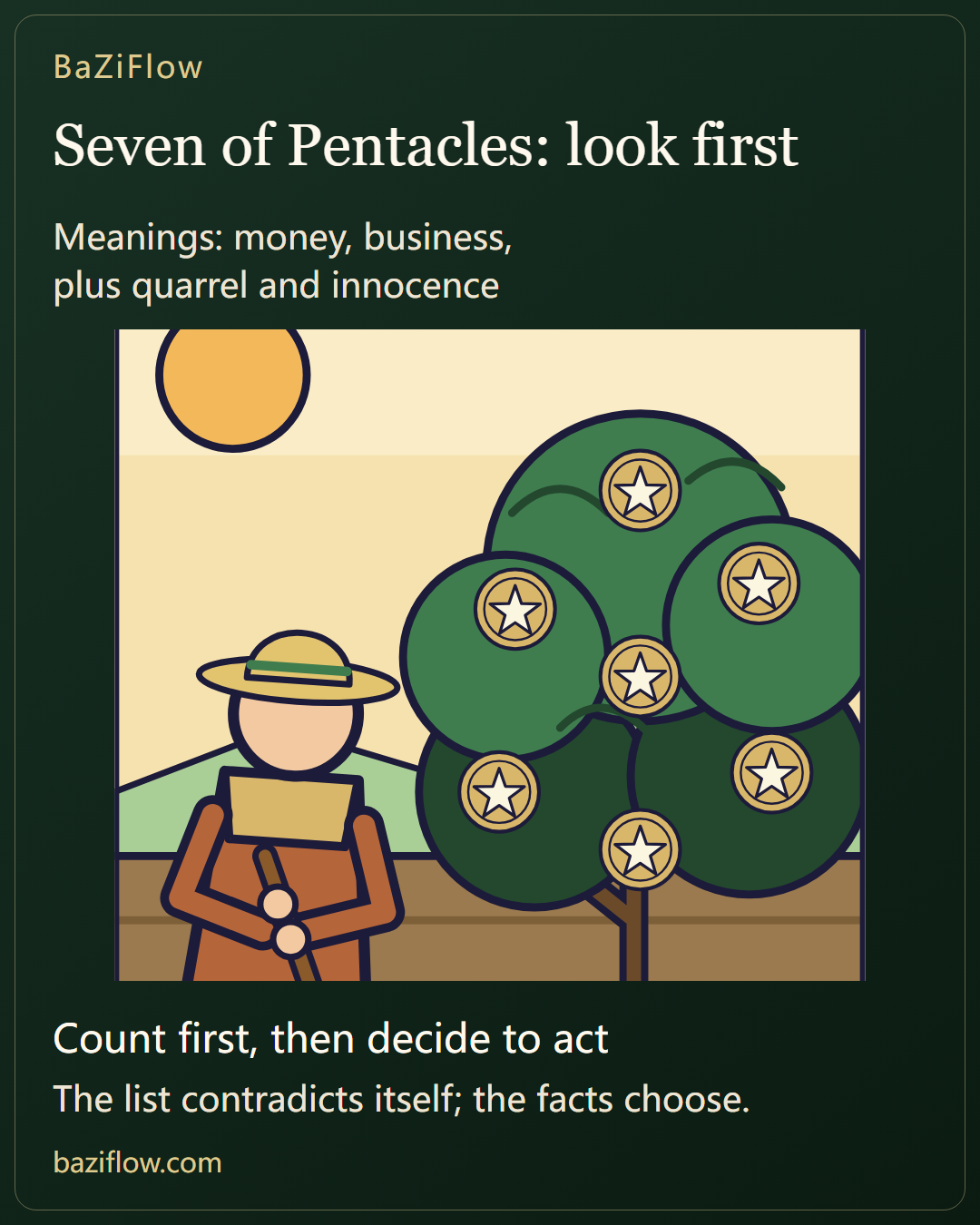
The Seven of Pentacles shows a young man leaning on a staff, gazing at seven pentacles in a clump of greenery. Read the picture, the contradictory word list and the extras apart, then practice on a subscription clean-up.
The short version6 min read
The figure in the Seven of Pentacles has not acted; he leans on his staff and looks. Waite also admits that the word list contradicts itself, so you take stock of what is in front of you first and pick a reading afterwards.
- In the picture a young man leans on a staff and studies seven pentacles on greenery at his right; Waite guesses they are his treasures and his heart is with them.
- He calls the main word list "exceedingly contradictory": mainly money, business and barter, but one reading gives quarrel and another innocence, ingenuity and purgation. Reversed, anxiety about money that may be lent.
- The additional meanings give a marriage-minded 1910 reading, and reversed, impatience, apprehension and suspicion. Mark these as other readers' words when you use them.
Read first
Start with the picture: leaning on a staff, looking at coins in the leaves
Waite describes this card in a single sentence. A young man, leaning on his staff, looks intently at seven pentacles attached to a clump of greenery on his right; "one would say that these were his treasures and that his heart was there".
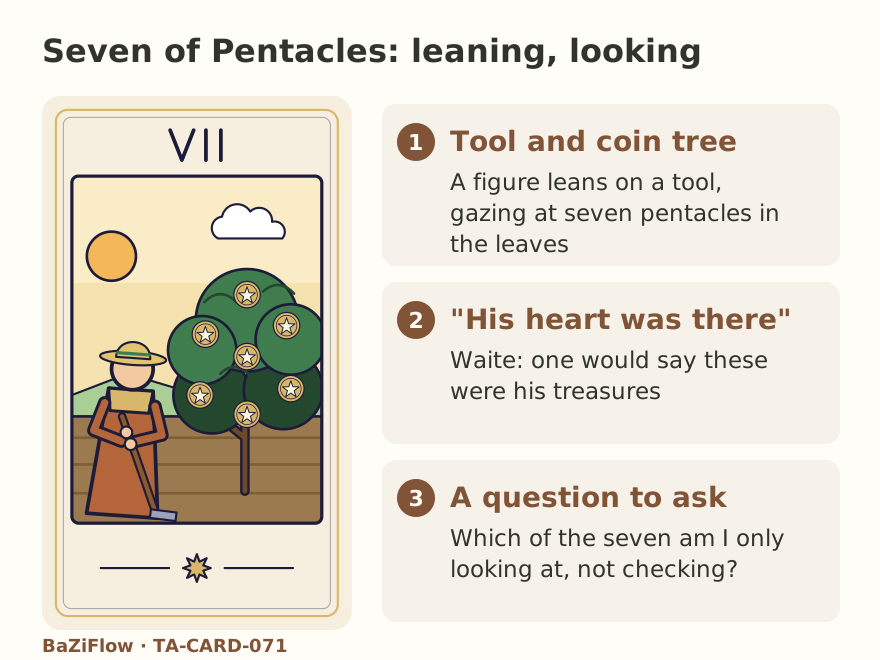
BaZiFlow original Seven of Pentacles: leaning by the tree
In the RWS original he rests both forearms on top of the staff with his head tilted onto them, in an orange tunic and blue sleeves. Six pentacles sit in the leaves to the left, and the seventh lies on the ground by his foot. The BaZiFlow drawing puts all seven on one tree and dresses the figure in a straw hat with a field tool. What the two share is that nobody is reaching out to pick anything; the figure only looks.
Enlarge diagram · scroll sideways to read
What Waite lists: a card that admits it is "exceedingly contradictory"
The entry opens by saying that the meanings are exceedingly contradictory. He goes on to say that in the main it is a card of money, business and barter; one reading gives altercation and quarrel, and another innocence, ingenuity and purgation. Reversed: cause for anxiety regarding money which it may be proposed to lend.
These are exceedingly contradictory; in the main, it is a card of money, business, barter; but one reading gives altercation, quarrel... Reversed: Cause for anxiety regarding money which it may be proposed to lend.
Enlarge diagram · scroll sideways to read
In the entry for the Five of Pentacles Waite writes that its alternatives cannot be harmonized, and the Seven is another case. So the three directions should not be blended into a "combined meaning". Safer is to get hold of the actual matter first and then see which reading the facts support.
In the additional meanings the upright line is an improved position for a lady's future husband, which reflects a marriage-minded way of asking around 1910 and is usually not carried over today. The reversed words, impatience, apprehension and suspicion, can stand on their own.
Staff, leaves and the seventh coin: what the text says, what the picture shows
There is little to take apart in the Seven of Pentacles: the staff, the greenery, and the seven coins themselves. On one point Waite's words and the RWS picture do not quite agree.
Staff, leaves, seventh coin: sources compared
- Staff
- Waite says he leans on his staff. The text does not say what it is for; the BaZiFlow drawing makes it a field tool as an illustration.
- Greenery
- Waite writes "a clump of greenery" with seven pentacles attached. Plants bear fruit by the season, a link that modern teaching often borrows; it is not Waite's own wording.
- The seventh coin
- Waite says all seven are attached to the greenery; in the RWS picture six sit in the leaves and the seventh lies on the ground by his foot. Text and image differ slightly, so say which one you follow.
Enlarge diagram · scroll sideways to read
How to read it: lay out the seven and let facts pick the reading
The card's own shape is seven things, one person looking, and no action yet. Moved to daily life, that is taking stock. Say you want to clean up the subscriptions on your phone, seven of them:
Look first, hands off
Lean on the staff the way the figure does and do not cancel anything yet. Write one line per item, only the name, with no verdict on keeping or stopping.
Reconcile each, three entries
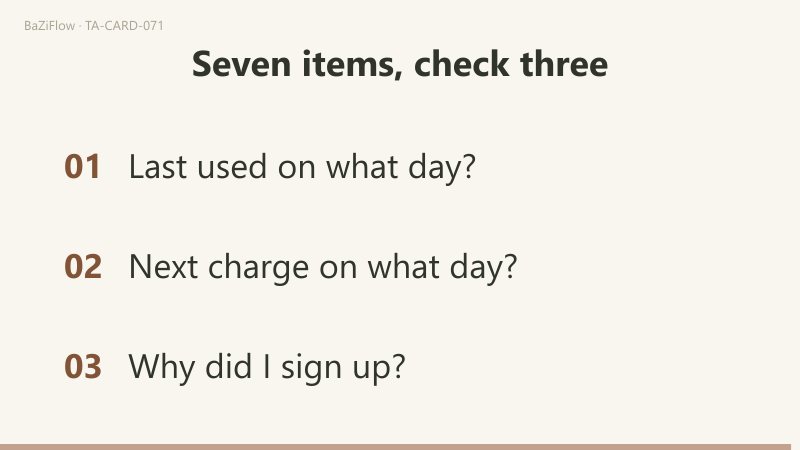
Add three entries for each: the last day you really used it, the day of the next charge, and why you signed up. If any one is blank, that coin is the one not yet seen clearly.
Let the records pick the reading
The card allows money and business, quarrel, or innocence as readings. Write the facts first, then see which fits: an account that adds up is the "money" reading; a shared plan nobody can explain is a seed of "quarrel"; one taken on a whim is the "innocence".
Enlarge diagram · scroll sideways to read
After the stocktake, three piles
Keep
- Used within the last week
- Charge date and amount match
To check
- Cannot recall why it was bought
- Shared with someone, unclear split
Stop first
- Unopened for three months
- Covered by another plan
Reversed and neighboring cards: money that may be lent, impatience, suspicion
Reversed, the main entry ties the Seven of Pentacles to lending: cause for anxiety regarding money which it may be proposed to lend. Here only the wording is taken apart, and whether to lend, or how much, is not discussed. The three additional reversed words, impatience, apprehension, suspicion, make a contrast with the leaning figure: he is still looking while the mind has already started to hurry.
Neighboring cards, and where each puts the looking
Weighs, then hands over
The Six of Pentacles is about weighing and sharing; the figure in the Seven has done neither yet.
Head down, one piece at a time
The Eight of Pentacles shows a craftsman already cutting a pentacle; the Seven stops just before the work starts.
Visions rising from cups
Waite calls those chalices imaginary, with "nothing permanent or substantial"; the seven coins here point toward money and business.
Enlarge diagram · scroll sideways to read
Questions readers ask next
Is the Seven of Pentacles a card of a harvest on its way?
Waite does not put it that way. He writes that a young man leans on his staff and looks at seven pentacles, guessing in a "one would say" tone that they are his treasures. His list is money, business and barter, with quarrel or innocence allowed as readings pointing elsewhere.
Why does the word list contradict itself?
Waite says in the entry that the meanings are exceedingly contradictory, and sets money and business beside quarrel and beside innocence and ingenuity without ranking them. The readings simply stand side by side. Which one applies depends on the specific matter in the question.
What does the Seven of Pentacles mean reversed?
The main entry gives cause for anxiety regarding money which it may be proposed to lend; the additional list gives impatience, apprehension, suspicion. Both are about unease with money. The text names no further subject, and whether to lend is not something this card answers.
Was this article helpful?
Sources & references
Continue reading
Six of Pentacles: scales in one hand, coins from the other, so ask what was weighed ↗
Eight of Pentacles: six hung, one in hand, one on the ground, so count what is finished ↗