

Waite, Marseille and Thoth
Content version · · Sources & references
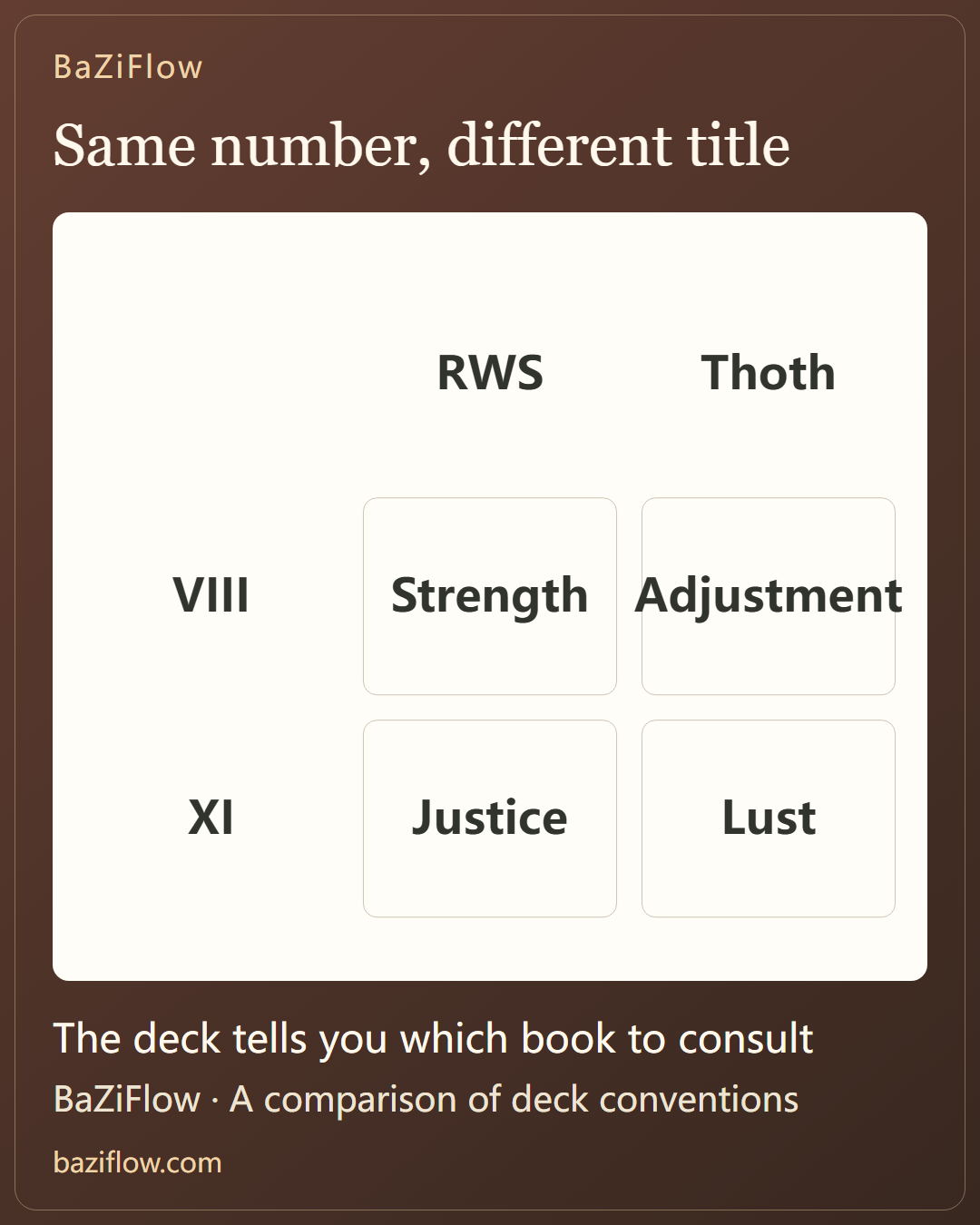
The same card number can be a different card in another deck. A side-by-side table, an edition record and a three-column note separate RWS, Marseille and Thoth, and show what to rewrite when you switch.
The short version5 min read
A tutorial says card eight is Strength, but your deck prints Adjustment at eight. Most likely nothing is misprinted: you are looking at two systems. Identify yours first, then decide how to read.
- RWS has VIII Strength and XI Justice, an arrangement Waite himself documents; Thoth's own book lists VIII Adjustment and XI Lust.
- "Marseille" names a historical pattern, not one person's work; a study has to land on a named maker, reproduction or redraw.
- After switching decks, refill the "what I see" and "what the book says" columns; "what I think" associations cannot simply be inherited.
Read first
One number, three decks
You learn from a tutorial that "card eight is Strength", then open your own deck and find Adjustment printed at VIII. Nobody has necessarily made a mistake. Tarot comes in several systems with different numbering, titles and pictures, and the tutorial may not describe the one in your hands.
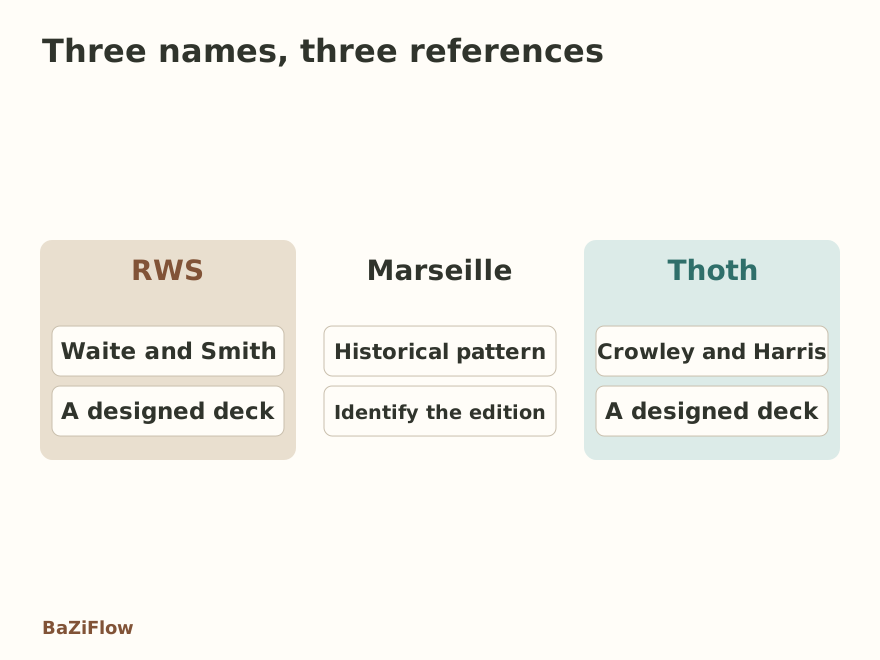
Comparison sketch: side-by-side lists show differences, not card-for-card equivalence; Marseille is not one fixed specification.
Three common names are worth separating, because they are not the same kind of label. RWS (Rider–Waite–Smith) is the collaboration of A. E. Waite and the artist Pamela Colman Smith. Marseille is a historical pattern. Thoth is associated with the work of Aleister Crowley and Frieda Harris.
VIII and XI: the two most useful checkpoints
Enlarge diagram · scroll sideways to read
In his chapter on Strength, Waite states that he exchanged Strength with Justice, which was ordinarily numbered eight. That is why RWS has Strength at VIII and Justice at XI. Thoth's own book lists VIII Adjustment and XI Lust.
Translated titles vary between editions, so keep the original English beside any translation. Then a difference of wording will not be mistaken for a new card.
"Marseille" is not one person's work
Enlarge diagram · scroll sideways to read
The Bibliothèque nationale de France describes Marseille tarot as a historical pattern with Latin suits, made in more places than Marseille itself. So the name cannot be turned into "invented in a given year by a given person".
Some tutorials discuss a museum card, others a modern restoration, and their colours, printed lettering and details may not be interchangeable. To find out what number a card carries, look at that edition's own face or a traceable catalogue image.
When a design is built mainly from suit emblems, count their number, direction and ornament first, and only then look for that tradition's own way of reading them. A common trap is to describe the action of an RWS figure on a picture where that figure does not exist: a detail that is not in the image cannot serve as evidence.
One page, three columns
Enlarge diagram · scroll sideways to read
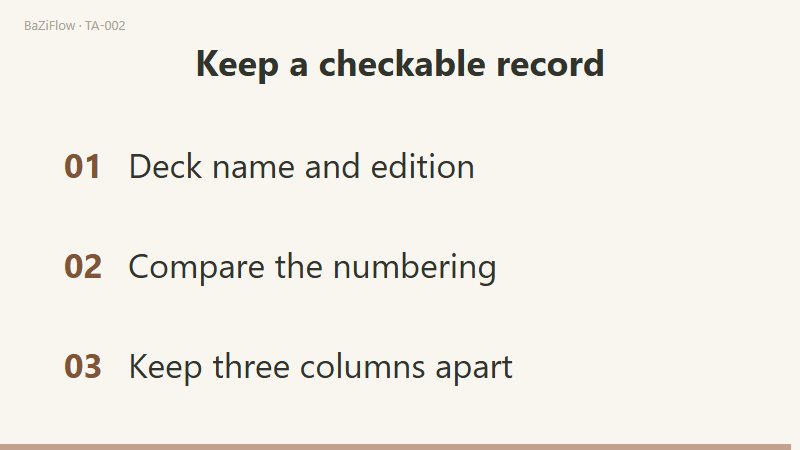
After switching decks, the easiest mistake is to write three different things in one column. Say you hold a page of notes on RWS VIII and now have to start a new page for Thoth VIII. Work it like this:
What I see
Look at this card afresh: which people, animals and objects are actually on it.
What the book says
Look up VIII Adjustment in the Thoth book. Do not carry over the RWS Strength paragraph.
What I think
Associations can be as free as you like, but afterwards they must not be reported as "the fixed meaning of this card".
The first two columns have to be filled in again; the third cannot simply be inherited. The exercise in symbols versus facts practises the same split.
Keeping the old records after you change decks
Keep the deck field on old records
Do not delete old notes; add which deck you were using.
Write deck and edition on new ones
Keywords from two decks must never share a column.
Compare questions, not hits
To compare two sessions, compare which questions each raised, not which system "hit" more.
Enlarge diagram · scroll sideways to read
BaZiFlow's single-card series uses RWS and separates image observation, Waite's text and modern practice. Keep that scope in mind when reading pip and court cards. Mastering one system and then comparing another reveals the real differences more clearly than mixing explanations, unlabelled, in one set of notes.
Questions readers ask next
My deck prints Adjustment at VIII. Is that a misprint?
Most likely not. Thoth's own book is organised that way, while RWS fixed VIII as Strength. Check which system the box or booklet names, then decide which book to consult.
Both decks have a Knight. Can I read them as a matched pair?
No. A court row only lists each deck's members. Position, symbolic role and interpretation have to be looked up in each deck's own source. A correspondence needs a named rule that supports it.
Can my old notes still be used after I change decks?
Keep them as old records, labelled with the deck and edition. Refill the first two columns on a new page, and never merge keywords of two decks or use "which one hit more" to argue that a deck is more powerful.
Was this article helpful?
Sources & references
- A. E. Waite, The Pictorial Key to the Tarot (1911), II: VIII Strength ↗
- A. E. Waite and Pamela Colman Smith, The Pictorial Key to the Tarot: contents and card names ↗
- Jude Talbot, BnF: Un tarot qui rebat les cartes – Collections (2026) ↗
- Aleister Crowley, The Book of Thoth (1944): contents, VIII Adjustment, XI Lust, court cards ↗
Continue reading
The Four Tarot Suits: Enter Through Objects, Not Four Sealed Areas of Life ↗