

Knight of Cups
Content version · · Sources & references
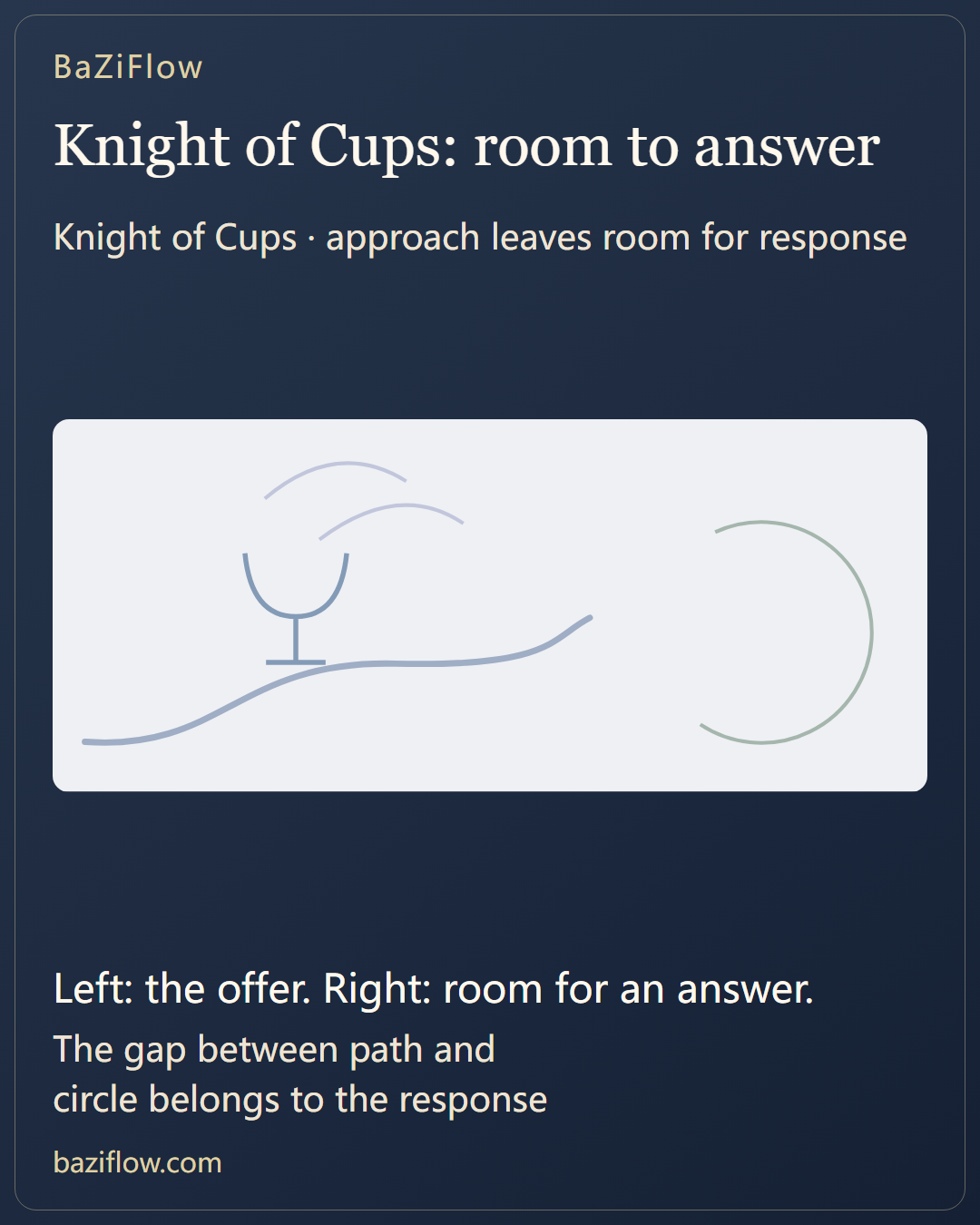
Waite’s quietly riding Knight links imagination with approach and proposals. Distinguish an appealing invitation from acceptance and a promise that can actually be kept.
The short version6 min read
Quiet riding, a winged helmet and an outward offer distinguish the Knight from a story of conquest. Imagination can make a proposal moving; clear timing, participation options and room for response make it an invitation another person can actually answer.
- Waite explicitly describes quiet, non-warlike movement: approach does not force an outcome, and graceful expression is not acceptance.
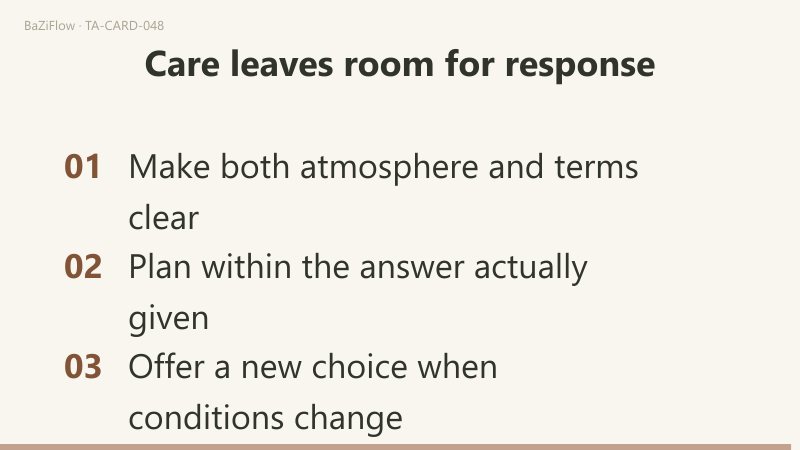
- Atmosphere and terms can both be clear: favorite poems convey care, while timing and a listening-only option make participation answerable.
- Agreement to the first half-hour stays within that span; changed location or participation requirements call for a renewed choice.
Read first
Read the quiet movement in Waite's description
On the RWS card, the knight, in armor with small wings on the helmet, holds a cup out in front as a pale horse walks slowly forward. The tunic is patterned with fish, and a river and reddish rocks lie ahead.
Waite describes the Knight as graceful, not warlike, and riding quietly. The winged helmet connects with the higher graces of imagination; the figure is also a dreamer associated with images of the senses. These details differ from a story of conquest or a charge that forces its way to an outcome.
The main meanings include arrival, approach, a messenger, advances, a proposition, demeanour, and an invitation. They identify themes of movement and expression. They do not establish that a particular real-world offer has been accepted or will be fulfilled.
The reversed entry includes trickery, artifice, subtlety, swindling, duplicity, and fraud. These are historical terms, not a finding about the person who sent or received a message. The supplementary chapter's friend visiting and unexpected money are likewise not adopted as predictions of a meeting date or income.
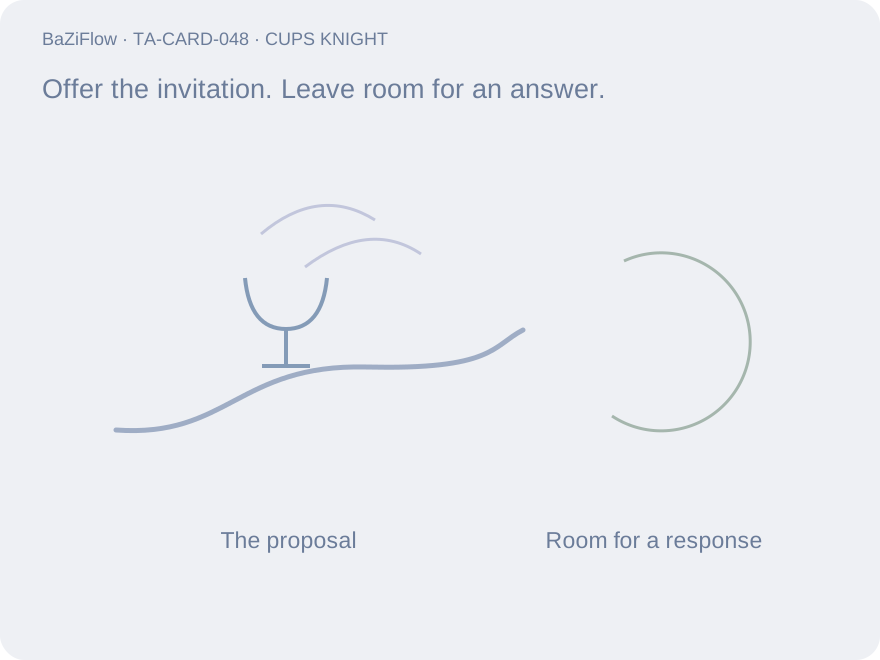
An original BaZiFlow invitation-and-response diagram. The gentle line recalls quiet riding without reproducing the Knight or predicting someone’s arrival.
Quiet riding
- Approach rather than a charge
Winged helmet
- Linked to imagination in the text
Offer and invitation
- Expression leaves room for an answer
Clarity can be part of a gracious invitation
You want to invite a friend to a small poetry reading. The message evokes an evening, a quiet room, and a few favorite poems. That atmosphere can convey genuine care. The recipient still needs to know how long it lasts, whether preparation is expected, and whether attending only to listen is welcome.
Providing those details does not flatten the invitation. It makes the imagined occasion answerable. The other person can decide whether the actual proposal suits them instead of having to guess what accepting the mood would require.
This is one practical way to approach the RWS Knight of Cups. It considers how a proposal moves toward another person without predicting a suitor, proving sincerity from elegant language, or treating a romantic impression as evidence of loyalty.
| Response to the poetry idea | What can reasonably be arranged so far |
|---|---|
| That sounds beautiful | Ask separately whether the time works |
| I can come for half an hour | Plan for that limited attendance |
| I would like to listen, not read | Preserve the listening-only option |
A compliment can be sincere without confirming availability. Acceptance for half an hour does not expand to the whole evening because the host originally pictured a longer gathering. The response retains its own scope even when a broader plan would be more convenient.
If there is no reply, the attendance remains unconfirmed. If the friend declines, that does not automatically invalidate the care in the invitation or show that the relationship has deteriorated. Neither silence nor refusal supplies evidence for the reversed entry's accusations.
The sender has a corresponding responsibility. A room still being requested should be described as provisional. An imagined venue should not become an apparently booked one merely because certainty makes the message sound more attractive.
Two sides of an invitation
Poetry evening
- Convey atmosphere
- A few favorite poems
- State the terms
- Saturday 18:00–19:00
Participation
- Convey atmosphere
- Easy listening and sharing
- State the terms
- Listening only; no preparation required
An invented invitation; the times are not dates supplied by the card.
Leave the gap where another person's choice belongs
A cup travels along a gentle line that stops before an open response circle. The gap is intentional. The proposal has moved outwards, but the recipient's answer is not drawn in on their behalf. Light curves above retain a suggestion of imagination without turning it into a guarantee.
The drawing is an original relationship diagram, not a reproduction of the historical card. The length of the path does not count days until someone arrives. Nor does the open circle mean an obstacle is destined to occur. It simply keeps proposal and response visibly distinct.
For the poetry evening, the gap can be filled only by actual communication. A recipient may ask a question, accept part of the plan, decline, or not yet answer. Each response leads to a different next step; the diagram is not designed to make all routes converge on attendance.
Leave at 18:30 · 18.5
18:00 ↔ 19:00
- Full event · 18–19
- Friend agreed · 18–18.5
Agreement to the first half-hour does not extend automatically to the second.
An accepted invitation has conditions that can change
If the venue moves, the earlier agreement should be checked against the new location. Willingness to attend nearby is not automatic consent to a longer journey. The same applies to a later finishing time or a newly added expectation that every guest must perform.
Communicating a change and allowing a renewed choice respects the original response. It also gives the inviter a better test of care than whether the first message sounded moving: were the terms clear, and were subsequent actions consistent with them?
The Page of Cups can focus on an image taking form and the source of a message. This Knight can examine a proposal already directed outwards. That comparison does not rank actual people by age, gender, or emotional maturity. Keep your convention visible with the upright and reversed methods guide.
After the event, compare the timing, participation options, and location with what was offered. If a change was poorly communicated, address that detail rather than relying on a warm atmosphere to cover it. An imaginative invitation becomes a shared occasion through actual answers and kept arrangements, not through the sender completing both sides of the story.
Keep the atmosphere you want to share
A few favorite poems are more concrete than a vague promise of magic.
Keep the agreed participation option
Someone invited to listen is not suddenly required to perform.
Explain a change anew
A new venue or time may need a new answer.
Questions readers ask next
Does the Knight of Cups always mean a romantic pursuer will arrive?
No. The text includes arrival, approach, a messenger, a proposition and invitation, alongside imagination and quiet riding. Romance is one possible context, but the card does not identify a real person, date their arrival or establish acceptance.
Will a specific invitation lose its warmth or romance?
Not necessarily. Poems, a setting and thoughtful language can convey atmosphere, while timing and participation terms help someone decide. Saying that listening is welcome and preparation unnecessary can reduce uncertainty and preserve a genuine choice.
Does a changed venue require checking an earlier acceptance again?
Consider whether it changes the agreed terms. A nearby venue moved far away, or listening changed to compulsory reading, is no longer the same offer. Explain the change and allow a renewed choice to respect the scope of the original reply.
Was this article helpful?
Sources & references
Continue reading
Page of Cups: give an emerging idea form without inventing a message ↗