

Relationships between cards
Content version · · Sources & references
Use the Three and Four of Wands to separate adjacent numbers from a supported connection. A touring-display example and a position-swap test keep the reading tied to specific material.
The short version6 min read
A multi-card reading needs a defined link: goal and resources, separate responsibilities or alternatives. The outward view of the Three of Wands and gathered scene of the Four offer different material. Assign their jobs before connecting the observations.
- A shared suit and adjacent numbers invite comparison, but establish neither a timetable nor a causal sequence of events.
- The question and predefined positions determine the relationship. The same scene needs a new argument when its assigned task changes.
- A hypothetical position swap tests whether the interpretation uses its inputs. Keep confirmed and unfinished practical matters distinct.
Read first
The Four Tarot Suits: Enter Through Objects, Not Four Sealed Areas of Life ↗
Numbered scenes and court figures: compare what the cards actually do ↗
Name the connection before telling the story
Two plausible card descriptions do not automatically form a well-supported account. Calling the Three of Wands expansion and the Four harmony names themes. It does not explain whether one is a goal and the other a resource, whether they address different responsibilities, or whether they are alternatives.
The missing element is a relationship justified by the question and positions. “Therefore” and “next” can make a paragraph sound connected while introducing causation or timing that the material does not establish. State the kind of link proposed and what would make it inappropriate. Here the Three and Four are chosen precisely because their shared suit and adjacent numbers make an effortless progression tempting.
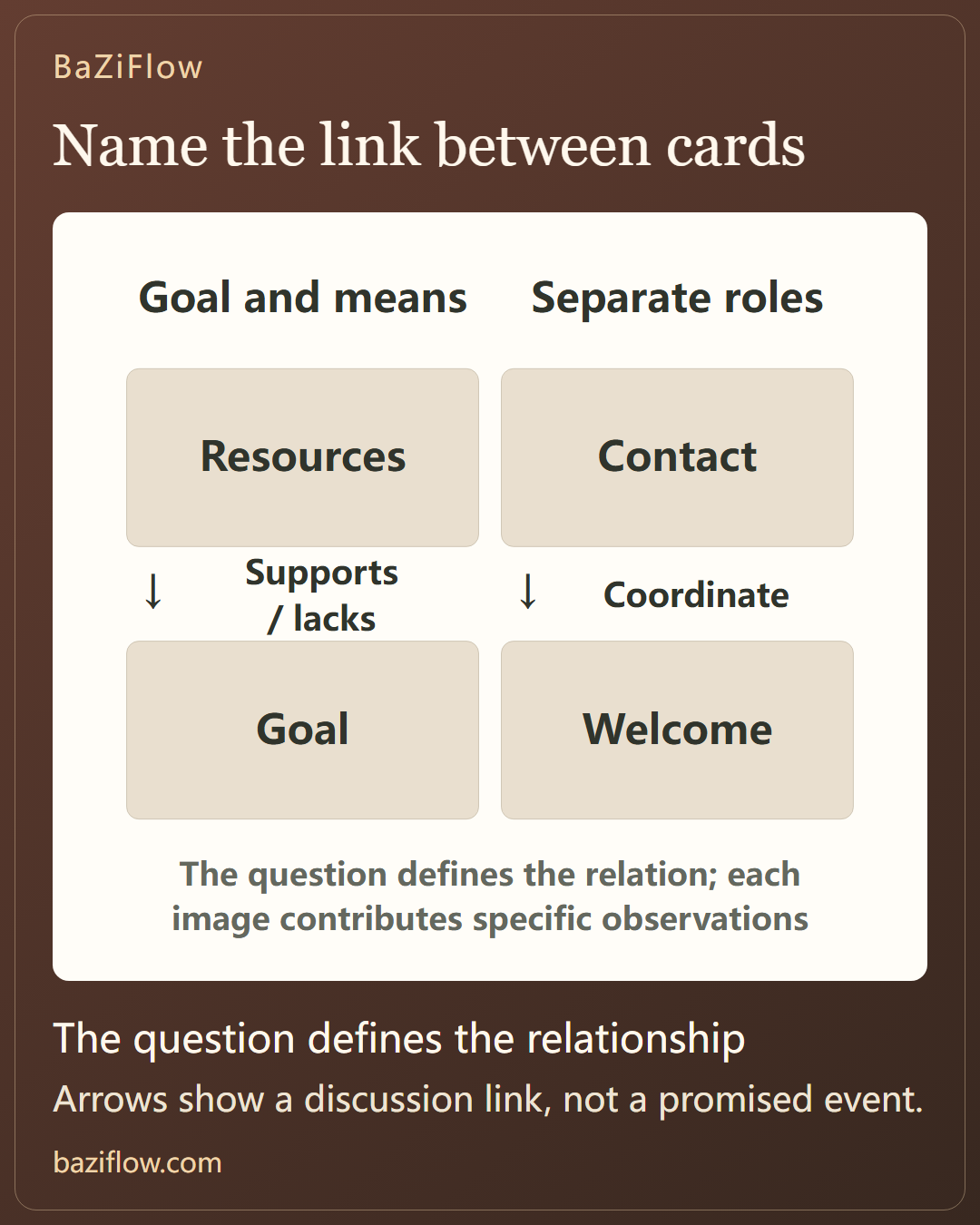
Goal and means
Separate roles
The question defines the relation; each image contributes specific observations
Keep the scenes distinct from their labels
Waite describes the Three with a figure looking from a height towards ships at sea. The Four includes a garland supported by staves, figures holding flowers and a bridge towards a house. An outward view and a gathered setting are different materials. A generic paragraph about positive energy erases that distinction before a relationship has even been considered.
The author also assigns ideas involving enterprise, cooperation or repose. Record these as assignments rather than things literally visible. A ship does not establish that a reader will travel abroad; a garland does not establish a forthcoming wedding. Consulting the source confirms what an author wrote, not what will happen to a particular person.
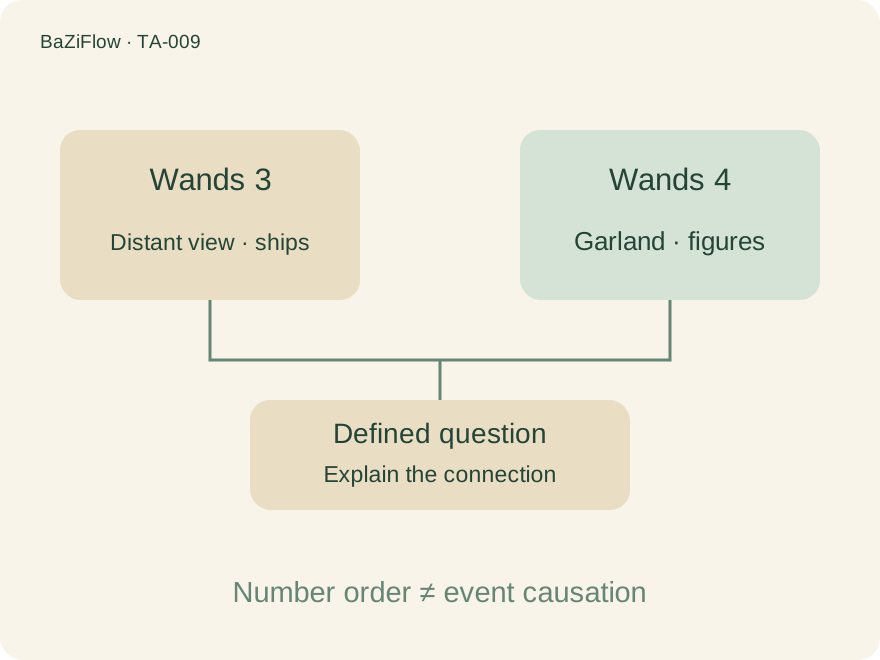
Original BaZiFlow relationship map using textual cues rather than reproduced card faces. No inevitable progression is implied.
A common suit helps organise a comparison but does not force both images to describe the same event. Different suits can contribute to one question as well. Identify the observations being connected instead of collecting every repeated colour or number as if all repetition had equal evidential value.
One part of the display is ready; another is not
A host venue has confirmed a touring display, but nobody has checked whether visitors can reach the room by the proposed entrance. Calling this situation “successful” conceals the unfinished access question. Calling it “blocked” conceals the actual booking. Keep both facts in view before adding any images.
For a deliberately constructed two-card exercise, imagine coordinating that display. One position was defined as contact with host venues, the other as the visitor experience on arrival. In this original exercise, the outward view can prompt a check of external contacts, while the gathered setting can prompt questions about welcome and access. The cards are not predicting attendance.
Answers come from replies, floor plans, staffing arrangements and other information. An unanswered request stays unconfirmed. A favourable interpretation of the second card cannot independently verify that the first request will succeed.
| Positions fixed beforehand | Relationship to examine | What does not follow |
|---|---|---|
| External contact / arrival | How responsibilities connect | The display must succeed |
| Goal / existing resources | Whether the aim is supported | The aim supplies its own resources |
| Option A / option B | Different requirements | A larger number means a better option |
With another pair of positions, the same cards require a new argument. Reusing the venue-contact conclusion would ignore the task. This explains why the same images can support different discussions without arbitrary synonym changes. The positions must have been defined before the draw, not renamed to obtain an easy interpretation.
Assigned task
External contact
- Original placement
- Three: outlook→channels
- Hypothetical swap
- Four: gathering→invitees
Arrival
- Original placement
- Four: gathering→entrance
- Hypothetical swap
- Three: outlook→sightlines
Coherence is not corroboration
You can narrate an outward-looking scene followed by a welcoming scene as preparation followed by achievement. The story may be coherent, yet it confirms neither the venue nor the budget. A chain of compatible guesses remains a chain of guesses until relevant information constrains it.
Two readings generated by the same symbolic convention are not two independent confirmations. A shared suit is a repeated classification, not a second witness. Keep the amount of interpretive material separate from the amount of verified information.
At the end of his additional minor-card meanings, Waite discusses disagreement between entries and the modifying role of position. That gives a reason to attend to context, not a licence to replace every term when a claim becomes inconvenient. Specify the scene details and position definitions supporting the chosen link. Leave unsupported possibilities unused.
Separate item
Host booking
- Known status
- Confirmed
- Relevant source
- Host reply
Visitor access
- Known status
- Not yet checked
- Relevant source
- Floor plan and staff
Swap the positions, then preserve the awkward part
After saving the original record, imagine exchanging the two position assignments. Would the interpretation change? If not, it may not depend on the positions. Next imagine replacing the cards with very different images. If the conclusion remains identical, it may not depend on the cards either. This test does not require opposite advice from every pair; it asks for traceable dependence on the selected material.
If one image has no supported application, record that. Check whether subjects have been mixed or a plan reported as accomplished. Adding another card immediately may conceal the confusion under another association. An unresolved point can instead identify a specific question to investigate.
Return to the two unequal states introduced earlier. A booking confirmation answers the host-contact question. An access plan must answer the entrance question. Neither the shared suit nor a pleasant combined story can substitute for the second document. Save observations, positions, the proposed link and external checks together, allowing later information to revise the relevant part.
For position definitions, return to three-card spreads. For detailed individual observations, use single-card practice. Combining cards means making the connections accountable, not merely making the text longer.
Describe separate scenes
Retain outward gaze and ships versus garland and figures.
State the relationship
Name support, limitation, cooperation or comparison, not just next.
Keep unequal states
Retain confirmed facts and unresolved checks as different states.
Questions readers ask next
Must two cards in the same suit concern the same event?
No. A shared suit is a classification link; the question may assign separate roles such as contact and arrival. Identify each scene detail and position before deciding whether the cards concern one issue or distinct responsibilities.
Can Three followed by Four mean preparation followed by celebration?
That is a proposed story, not a sequence proved by adjacent numbers. This exercise instead connects an outward view and gathered setting through contact and welcome positions, while actual progress comes from real information.
Does the position-swap test change the recorded spread?
No. Save the original, then make a hypothetical comparison: how would the same image address the other task? If nothing changes, the interpretation may not use its position. The actual record retains the original placement.
Was this article helpful?
Part of a learning path
Tarot: from the question to the review · Step 4 of 4 available