

Kun (困): six lines, six things to be stuck on
Content version · · Sources & references
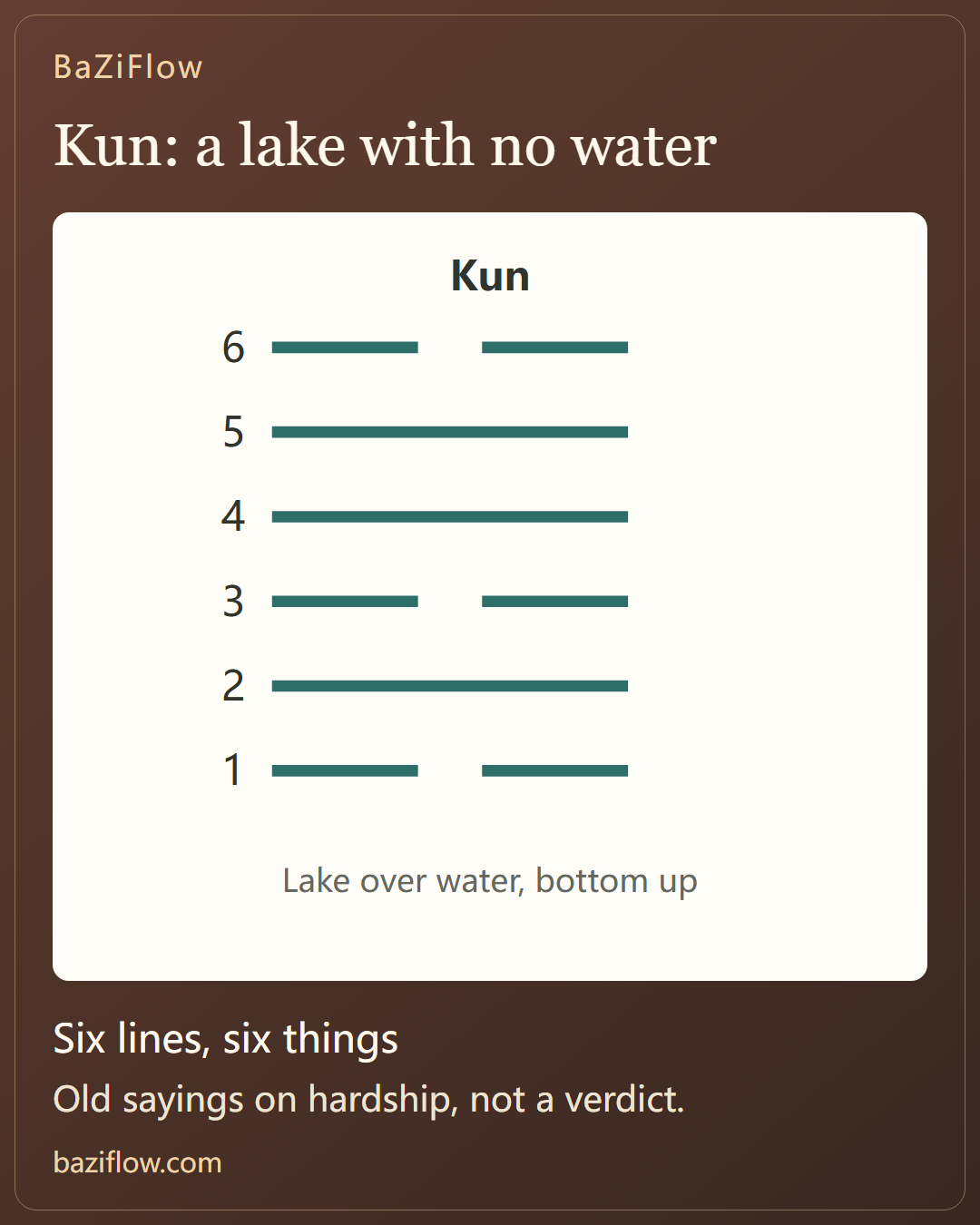
Kun (困) is the 47th hexagram: Dui (lake) above Kan (water), the water sunk below. Read the Commentary’s “the firm is covered” and “words are not believed”, the Image’s “stake one’s life”, and what each line is stuck on.
The short version8 min read
Every one of the six statements of Kun (困) says “stuck”, and each is followed by a different thing: the stump, the stone and the vines are rough, while wine and food, the metal carriage and the red knee-cover are fine things.
- Kun (困) puts Dui (lake) over Kan (water): the water has sunk below the lake, hence the Image, “in the lake there is no water”. The Commentary starts from the figure: the firm is covered, since all three yang lines sit under or between yin lines.
- The six statements all read “stuck on” plus a thing: a stump, wine and food, a stone, a metal carriage, a red knee-cover, vines. Wine and food, the carriage and the knee-cover fall on the three yang lines; none of them is a poor man’s thing.
- The Commentary ends on “prizing the mouth ends in exhaustion”, and the Shuo Gua gives upper Dui the image of mouth and tongue. The Image says to see the will through; the Small Images of lines 4 and 5 say “the will is below” and “not yet achieved”.
Read first
The Sixty-Four Hexagrams: How Upper and Lower Trigrams Form One Figure ↗
Judgment and Line Statements: Whole Hexagram or Single Line? ↗
A lake with no water: Dui above, Kan below
Kun (困) is Dui (lake) above and Kan (water) below. A lake ought to hold water, but here the water lies beneath it, and that is the Image’s “in the lake there is no water”. This is not the Kun (坤) of the second hexagram, which is six yin lines. The Shuo Gua gives Dui the word “gladness” and Kan the word “pitfall”, and also says Dui stands for mouth and tongue: above, speaking and rejoicing; below, a pit. Reading upward, the lines go yin, yang, yin, yang, yang, yin. Both ends are yin, and each of the three yang lines is either between yin lines or pressed under one.
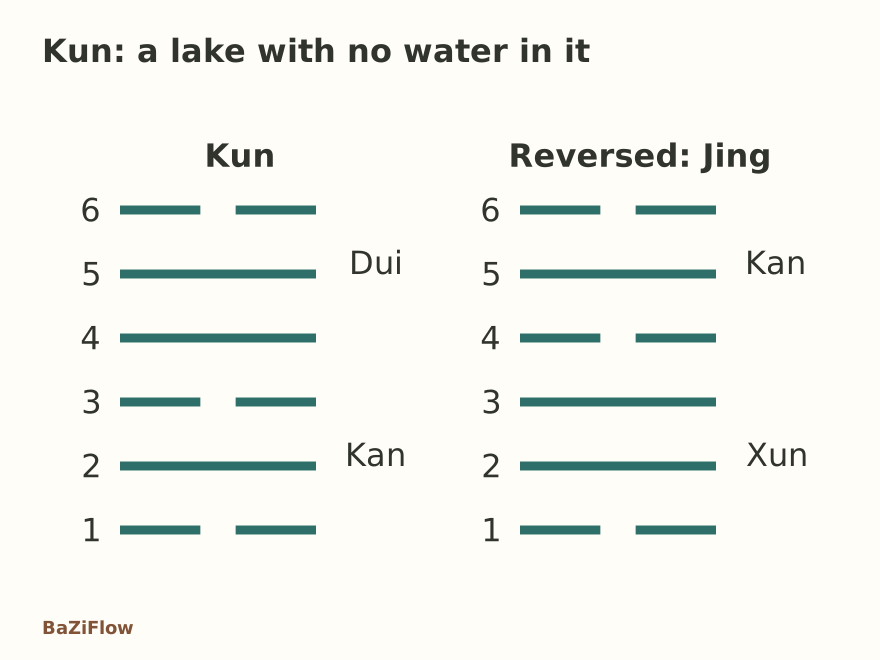
Kun (困) and its reversed hexagram Jing: the water that lies below the lake in Kun is raised above the wood in Jing.
Enlarge diagram · scroll sideways to read
Three words before reading
- Kun (困)
- The Commentary on the Judgments defines it directly: the firm is covered. The Xu Gua puts it after Sheng: rising without stopping must end in being stuck.
- The firm covered
- Firm means a yang line, and covered means hidden under something. Line 2 sits between lines 1 and 3, and lines 4 and 5 stand side by side under line 6.
- Stuck on
- All six statements use this pattern (line 1 reads “the buttocks are stuck on a tree stump”), and what follows is different every time.
The judgment and the Commentary: first the name, then “words are not believed”
The judgment has four short phrases: success; for the great person steadfastness is fortunate; no blame; there are words but they are not believed. The Commentary on the Judgments explains it from two ends.
Kun means the firm is covered. Danger met with gladness: in distress yet not losing one’s place, and so succeeding. Only a noble person could manage that, could he not? “For the great person, steadfastness is fortunate”: because of the firm at the center. “There are words but they are not believed”: to prize the mouth is to end in exhaustion.
Enlarge diagram · scroll sideways to read
The Commentary first explains the name from the figure itself: all three yang lines are covered by yin ones. Then it describes the hexagram’s character: “danger met with gladness”, the lower trigram Kan being danger and the upper trigram Dui gladness, so even inside danger there is a way to be glad, and that is why “in distress yet not losing one’s place, and so succeeding”. “Only a noble person could manage that, could he not?” is a rhetorical question. “For the great person, steadfastness is fortunate” is credited to “the firm at the center”, that is, lines 2 and 5 holding central places.
The last sentence reads: “there are words but they are not believed; to prize the mouth is to end in exhaustion.” Relying on talk ends at the end of the road. In the Shuo Gua the upper trigram Dui stands for “mouth and tongue”, so the two ends match: the one cautionary phrase in the judgment points at the mouth.
The Great Image: no water in the lake, staking one’s life
The Great Image (大象) of Kun (困) reads: in the lake there is no water, Kun; the noble person stakes his life to see his will through.
Enlarge diagram · scroll sideways to read
Tradition usually reads “stakes his life” as being ready to give one’s life, and “see through” as carrying it out. The direction of the sentence is that even when circumstances hold one fast, the aim is still to get the will accomplished. Two Small Images also mention the will. At line 5, “the will is not yet achieved”; at line 4, “the will is below”, which tradition usually reads as the line’s intent turning toward line 1 below, its counterpart. The Image says to see the will through while the Small Image of line 5 says it is not yet achieved, and that is a contrast to keep in view.
Six lines: each one is stuck on something
“Stuck on” appears six times in the six statements, and what comes after it is different each time.
Enlarge diagram · scroll sideways to read
Sort the six things and a pattern shows. The three yin lines, 1, 3 and 6, are stuck on a stump, a stone and vines, all rough things. The three yang lines, 2, 4 and 5, are stuck on wine and food, a metal carriage and a red knee-cover, which are fine things; the knee-cover is a part of an official’s dress. The Commentary says “the firm is covered”, and the ones covered are exactly these three yang lines.
Line 1: “the buttocks are stuck on a tree stump; he enters a dark valley; for three years he is not seen”. He sits on a stump and cannot move, goes into a deep valley, and for three years no one sees him. The Small Image: the dark is not bright.
Line 2: “stuck in wine and food. The red knee-cover is just arriving; it is fitting to make offerings. Setting out brings misfortune; no blame.” The red cover of rank is about to arrive, offerings are suitable, going out is not. Yet the Small Image says: in the center, celebration.
Line 3: “stuck by a stone, leaning on thorns. He enters his house and does not see his wife: misfortune.” The Small Image explains the first half: he rides on the firm. Line 3 is a yin line lying right on top of line 2, a yang line.
Line 4: “he comes slowly, slowly, stuck in a metal carriage. Regret; there will be an end.” The Small Image: the will is below; though the place is not proper, he has allies.
Line 5: “nose and feet are cut off; stuck in the red knee-cover. Then, slowly, there is delight; it is fitting to sacrifice.” The cutting is a punishment. The Small Image: the will is not yet achieved, and then it says: through being central and straight.
Line 6: “stuck in creeping vines, in unsteadiness. One says, ‘if I move, I will regret it.’ Having regretted, going is fortunate.” The Small Image says: not yet fitting; going is fortunate.
Lines 4 and 5 both carry the word “slowly”: at line 4 he comes slowly, and at line 5 the delight comes slowly.
Jing, Bi and Jiaren: where the water goes next
The reversed hexagram (综卦) of Kun (困) is Jing (井): turn it upside down and Kan, unchanged when inverted, rises from the bottom to the top, while Dui, inverted, becomes Xun at the bottom, leaving Xun below and Kan above. The inverse hexagram (错卦) is Bi (贲), which swaps the polarity of every line. The nuclear hexagram (互卦) is Jiaren (家人): hidden in the middle four lines of Kun are Li (fire) and Xun (wind), and Li below Xun is Jiaren.
Enlarge diagram · scroll sideways to read
The Xu Gua puts Kun (困) after Sheng: rising without stopping must end in being stuck; and whoever is stuck at the top must come back down, so Jing follows. Sheng, Kun (困) and Jing form a chain. The Image of Kun is “in the lake there is no water”, the water sunk below; the Image of Jing puts water above the wood. It is the same water, but in one it falls beneath the lake and in the other it is lifted up.
Questions readers ask next
Does Kun (困) simply mean poverty and bad luck?
The text says more than that. The judgment opens with “success” and adds “for the great person, steadfastness is fortunate; no blame”. In the six statements wine and food, a metal carriage and a red knee-cover are fine things, yet they are written with the same “stuck on”. The hexagram reads as being held fast by something, not only as lacking something.
How do I tell Kun (困) from Kun (坤)?
This one is the 47th hexagram, Dui above Kan, with yin and yang lines mixed. The other is the second hexagram, six yin lines. In romanization they are the same word, so go by the original character, here the one with a tree inside a box.
Does “words are not believed” tell you to stay silent?
The Commentary explains it as “to prize the mouth is to end in exhaustion”: relying on words leads to the end of one’s resources. It puts the line inside the hexagram of being stuck, where what one says is not believed. The Shuo Gua gives Dui, the upper trigram, the image of mouth and tongue, and the two places agree.
Was this article helpful?
Sources & references
Continue reading
Sheng: a tree grows in the earth, rising and offering by turns to “rising in darkness” ↗
Jing: water above the wood, from “mud in the well” to “do not cover the well” ↗
The Sixty-Four Hexagrams: How Upper and Lower Trigrams Form One Figure ↗
Judgment and Line Statements: Whole Hexagram or Single Line? ↗