

Dazhuang: where strength stops
Content version · · Sources & references
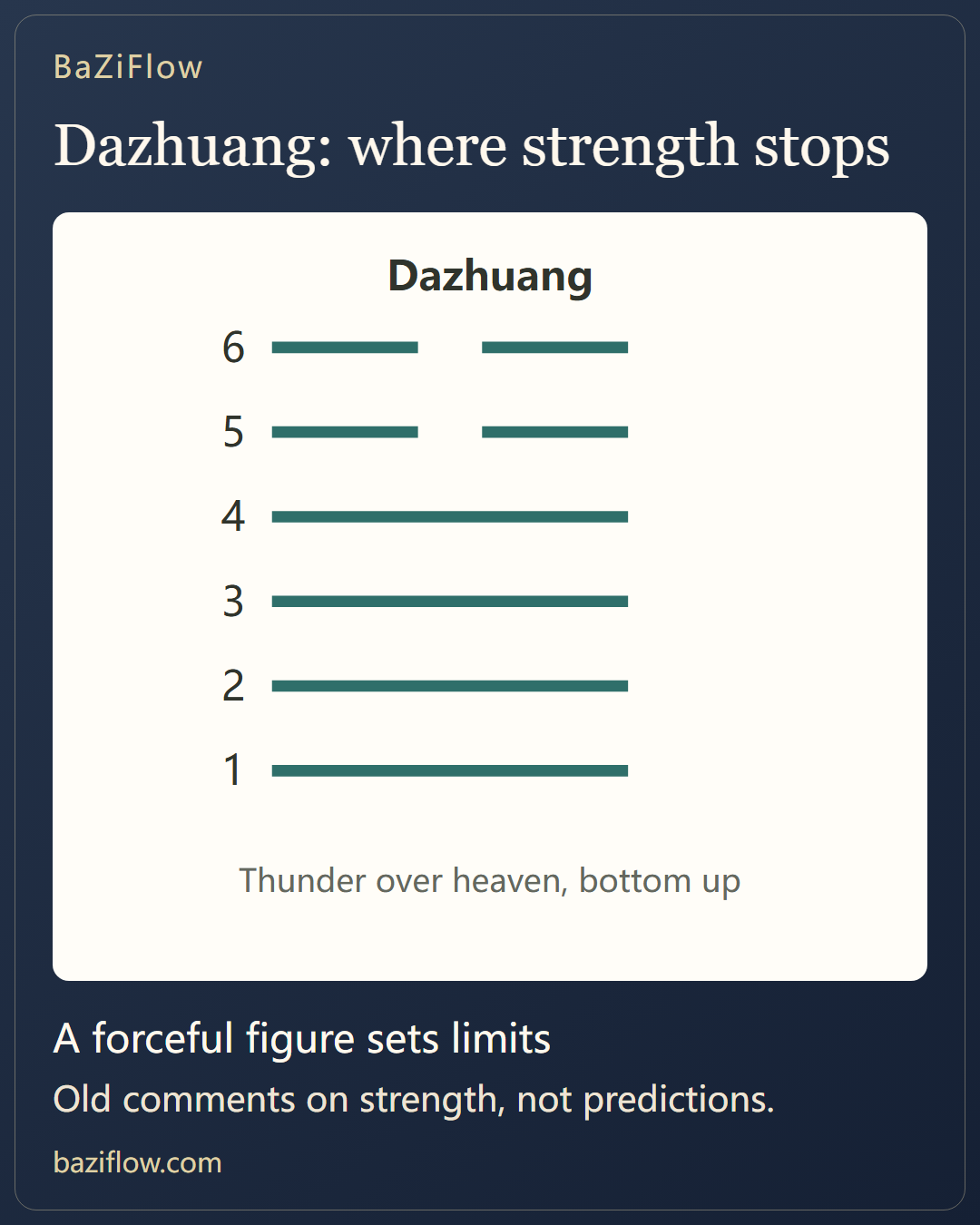
Dazhuang is the 34th hexagram: Zhen (thunder) above Qian (heaven), four yang lines rising from the bottom. See how the judgment keeps one phrase, how the Commentary adds “upright”, and how a ram meets one hedge twice.
The short version7 min read
Dazhuang has four yang lines out of six, yet no sentence in its text simply urges anyone to show force. The judgment keeps only “fitting to stay on course”, the Image says “do not tread”, and the ram meets the same hedge twice.
- Dazhuang stacks Zhen (thunder) on Qian (heaven), with four yang lines rising from the bottom. The Commentary on the Judgments explains the name: “the great are strong”, and “the firm acts by moving, hence strong”.
- The judgment is two characters, “fitting to stay on course”, with no “success”. The Commentary adds “the great are upright”, and the Great Image turns uprightness into conduct: tread on nothing against ritual propriety.
- “A ram butts the hedge” appears on line 3 and line 6, which are a corresponding pair: once its horns are caught, once it can neither retreat nor advance. Line 4 between them says “the hedge is broken open”.
Read first
The Sixty-Four Hexagrams: How Upper and Lower Trigrams Form One Figure ↗
Judgment and Line Statements: Whole Hexagram or Single Line? ↗
Thunder in the sky: four yang lines rising
Dazhuang (大壯) puts Zhen (thunder) over Qian (heaven). By the Shuo Gua’s words, Qian is strength and Zhen is moving. In the figure, four yang lines run unbroken from the bottom, and only then come two yin lines: the yang climbs from the foot to the fourth place.
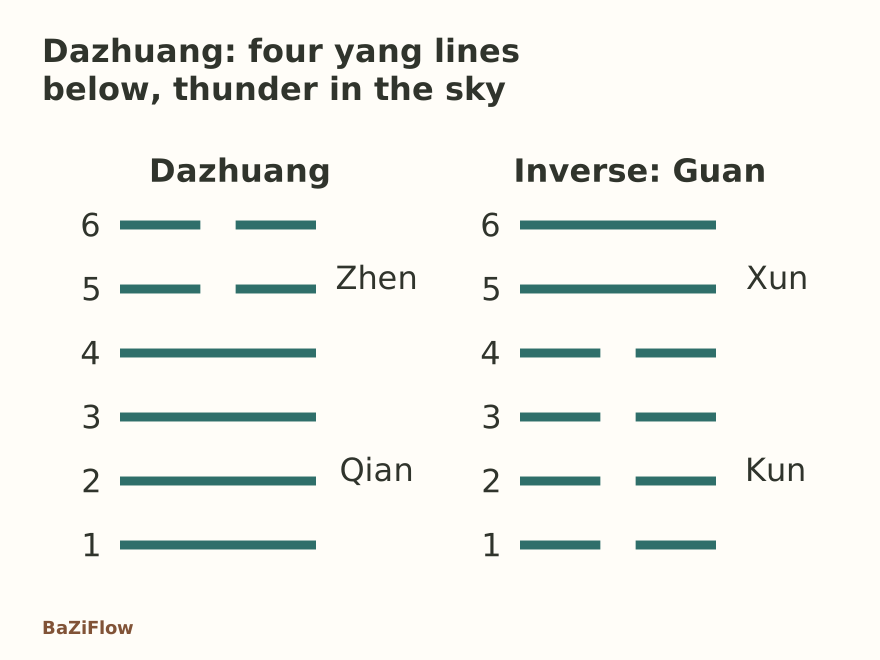
Dazhuang and its inverse hexagram Guan: the inverse flips every line, so four yang lines at the bottom become four yin lines at the bottom.
Enlarge diagram · scroll sideways to read
Key words in Dazhuang
- Great
- The Commentary says “the great are strong”. “Great” stands for yang; four of the six lines are yang, so the great side is strong.
- Strong
- Its explanation is “the firm acts by moving, hence strong”: the lower trigram Qian is firm and the upper trigram Zhen is moving, so being firm and moving makes it strong.
- Fitting to stay on course
- The only two characters of the judgment, with no “success” beside them. Tradition usually reads them as: right for keeping to what is upright. The very next sentence of the Commentary reads “the great are upright”.
The judgment and the Commentary: strength, then uprightness
The judgment of Dazhuang is shorter than many: two characters (利貞), “fitting to stay on course”. The Commentary on the Judgments (彖传) writes four sentences about it.
Dazhuang: the great are strong. The firm acts by moving, hence strong. “Dazhuang: fitting to stay on course”: the great are upright. When what is upright is great, the true nature of heaven and earth can be seen.
Enlarge diagram · scroll sideways to read
Note that “the great” appears twice, followed by a different word each time: first “the great are strong”, about force; then “the great are upright”, about direction. Strength is the name of the hexagram, but the praise lands on uprightness, and the last sentence again puts “upright” in front of “great”.
That order matters. The judgment has no “success” and no “origin”, only “fitting to stay on course”. One way to read it: strength is not praised alone; what is praised is strength that stays upright.
The Great Image: thunder in the sky, and “do not tread”
In such a forceful figure, the Great Image (大象) speaks of what not to do.
Thunder in the sky: Dazhuang. The noble person treads on nothing that goes against ritual propriety.
“Thunder in the sky” is what strength looks like: thunder sounding up in the heavens. What the noble person takes from it is to tread on nothing improper. “Tread” is also the name of hexagram ten, Lu.
Enlarge diagram · scroll sideways to read
Read together with the Commentary: strength has to be upright, and the Great Image turns uprightness into the most concrete of acts, where to put the foot. It says nothing about charging; it speaks of someone with force who does not step in certain places.
Six lines: the ram meets the hedge
Across the six line statements one picture keeps returning: a ram and a hedge.
Enlarge diagram · scroll sideways to read
Line 1, “strong in the toes”, has its strength only in the toes: marching out is ominous, though there is sincerity, and the Small Image says that sincerity will run out. Line 2 says only “staying on course: good fortune”, with the reason that he is central.
Line 3 is the longest in the hexagram: “The petty person uses strength; the noble person uses none. Staying on this course is dangerous. A ram butts the hedge and its horns are caught.” The first half sets petty person against noble person, one using strength and one using none (tradition usually reads the second word as “not using”). The second half is a metaphor: the ram butts the hedge and its horns get tangled. Line 4 changes the outcome: “the hedge is broken open and nothing is caught”, and strength is put to work in the underpinning of a great cart (the word is also written with a variant), with the Small Image saying it is right to go on.
Line 5, “loses the sheep at yi”, is a loss and yet “no regret”. The word yi has been read two ways, as a place name or as “easily”, and the Small Image only says that the place is not fitting. Line 6 repeats line 3 word for word, “a ram butts the hedge”, but this time continues “cannot retreat, cannot advance”. The Small Image calls it not auspicious, then adds “in hardship, good fortune: the blame will not last”.
Lines 3 and 6 are exactly a corresponding pair, the third place and the sixth, one yang and one yin. The same sentence about the ram and the hedge sits on this pair: once with horns caught, once with no way forward or back.
Dun, Guan and Guai: three hexagrams around Dazhuang
Turn Dazhuang upside down and you get Dun (遯), so Dun is its reversed hexagram (综卦). The inverse hexagram (错卦) is Guan (觀), shown above. The nuclear hexagram (互卦) is Guai (夬), the same one that Heng has: the middle four lines (lines 2 to 5) split into two overlapping groups of three, lines 2–4 and lines 3–5, and stack as Qian below and Dui above.
Enlarge diagram · scroll sideways to read
Dun comes first and Dazhuang follows, since retreating cannot go on forever, as the Xu Gua has it. At Dazhuang the Xu Gua adds a sentence of its own, and this one too puts a limit on strength:
Nothing can remain strong right to the end, and so Jin is received next; Jin is advancing.
Strength cannot go on to the very end, so the next hexagram is Jin, which means advancing. From the judgment through the Commentary and the Great Image, to the hedge in the lines and then the Xu Gua, this hexagram is, all the way, about the limits of strength. The next article opens with the sunrise of Jin.
Questions readers ask next
Does Dazhuang mean the stronger the better?
The text does not say that. The judgment keeps only “fitting to stay on course”, the Great Image ends on “do not tread”, and the Xu Gua says that nothing can stay strong to the end, which is why Jin follows.
How should “the petty person uses strength, the noble person uses none” be read?
It is the first half of line 3: the petty person parades strength, the noble person does not use it. The word for “none” is set against the word for “strength”, and tradition usually reads it as “does not use”. The second half, the ram and the hedge, is a metaphor within the same line.
How are Dazhuang and Dun related?
Their six lines are swapped top for bottom: turn Dazhuang upside down and you have Dun. The Xu Gua says that retreat cannot go on forever, which is why Dazhuang follows Dun.
Was this article helpful?
Sources & references
Continue reading
Dun: a mountain under heaven, from the tail of the retreat to the ample one ↗
Jin: light over the earth, from three audiences to the horns ↗
The Sixty-Four Hexagrams: How Upper and Lower Trigrams Form One Figure ↗
Judgment and Line Statements: Whole Hexagram or Single Line? ↗