

Follower-Seven Killings and the site's Yang Fire Rat-day shape
Content version · · Sources & references
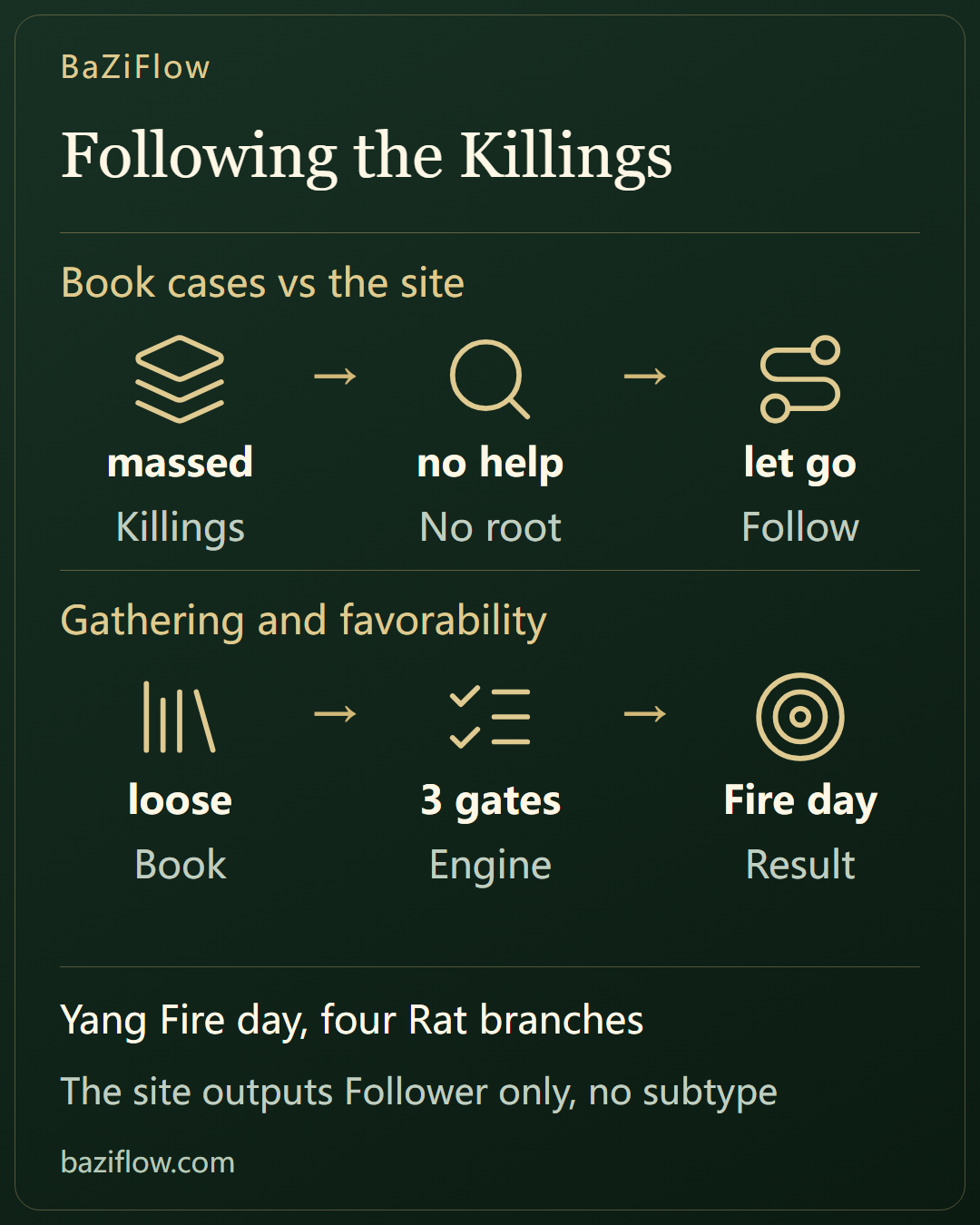
The Follower-Seven Killings pattern: a rootless Day Master gives way to massed Killings. Conditions, breakers and disputes from the Sanming Tonghui and Di Tian Sui, set against the site's single Yang Fire Rat-day shape.
The short version10 min read
The Follower-Seven Killings pattern is a Day Master so isolated, facing Killings so heavy, that it stops resisting and goes along with them; the book's conditions are loose, and the site's engine is strict enough to leave only a Yang Fire day in a Rat month at a Rat hour.
- Three things form it: Killings gathered into a force, no Companion or Resource beside the Day Master, and no root of its own. Juan 5 states "not a single Companion or Resource in the four pillars" as the precondition.
- Almost every breaker is support for the self: a root in the natal chart or a luck period that props the Day Master up sets it fighting the Killings, and the Six Gods note names strong-self and Eating God luck as the great dread.
- The engine outputs only "Follower" and a target element; enumerated by its rules, only a Yang Fire day in a Rat month at a Rat hour follows the controlling element, the hour stem being Yang Earth, or Yang Metal in the late zi hour.
Read first
BaZi patterns explained: how formation, disruption and assistance work ↗
Bind, control or follow: the third way with Killings
Put plainly, the Follower-Seven Killings pattern is a Day Master with no root of its own, facing Killings so heavy that it stops resisting and goes along with them. The Killings stem is whichever stem controls the Day Master while matching its yin or yang: Yang Water for a Yang Fire Day Master, Yin Metal for a Yin Wood one.
Juan 12 of the Sanming Tonghui carries the "Yuan Li Fu" (元理赋). Its note on Killings shown on a stem with nothing to restrain them lists three ways to deal with them: bind them with the blade, control them with the Eating God, or follow them. The first two have the Day Master act; the third has it step aside, which the book calls giving up the self to follow the Killings.
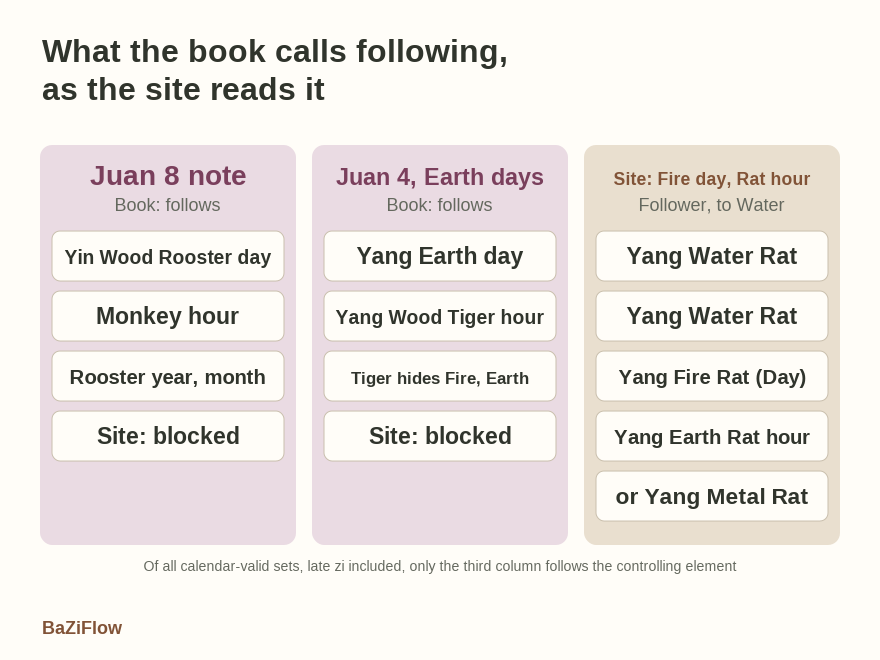
The two left columns are day-and-hour combinations the book explicitly calls following the Killings; the right column is the only Killings-type case the site's engine finds among all calendar-valid charts, with two possible hour stems. The bottom line of each column is the site's verdict.
Juan 5 gives this its own entry, placed after entries such as Killings on the year stem and the single noble on the hour. It quotes the rhymed Du Bu (独步) verses and then explains:
In the Follower-Seven Killings pattern the Killings are too heavy and the self has nowhere to turn, so it follows because it must. The luck should run through places where Killings and Wealth are strong, and only when the four pillars hold not a single Companion or Resource can one speak of it.
Three layers, then: Killings too heavy to hold off; a self with "nowhere to turn", not one Companion or Resource in the pillars; and luck through Killings-strong and Wealth places. The first two are natal, the third is luck.
Enlarge diagram · scroll sideways to read
The Killings must gather; following them welcomes Wealth
Four lines of the Du Bu pair following the Killings with following Wealth; juan 5, juan 6 and juan 12 all quote them, wording varying slightly:
To abandon the self and follow the Killings, the Killings must gather. Following Wealth dreads Killings; following Killings welcomes Wealth.
"Gather" literally means to come together: the Killings must form one force, and a single stray Killings stem cannot carry a pattern of following. The text gives no count, and the site has not made gathering a rule.
"Following Killings welcomes Wealth" because Wealth produces Killings: once the Killings rule, what feeds them runs with the current. A chart following Wealth dreads Killings in turn, so the two patterns treat the same stems differently; the Wealth side is in Follower-Wealth.
In juan 11, the Six Gods chapter (六神篇) notes on "when Officer and Killings bully the master, the master must follow": with too many Officer and Killings, a powerless Day Master and nothing to hold, following is the better course, and the luck to dread most is "strong-self and Eating God luck". One props the Day Master up; the other controls the Killings.
The site's Follower pattern has a three-grade favorability table: the element followed is favorable, the Day Master's element and its Resource unfavorable, the rest neutral. Beside the book, for the Killings-type case the site produces, a Yang Fire day:
Enlarge diagram · scroll sideways to read
The two sides part on Wealth and output: the book welcomes one and dreads the other, the site leaves both neutral. Follower-Output runs on yet another table, while Favorable, Useful and Unfavorable Gods explains the general grading.
What breaks it: roots, a returning emolument, and the Eating God
Nearly every breaker in the book comes down to one event: the Day Master is propped up again and turns to fight the Killings.
A root turns up
The Du Bu line in juan 5 says that meeting a root harms the fate beyond doubt: once a chart has given itself to the Killings, a root for the Day Master is a bad sign. Juan 12 words it slightly differently.
Emolument returns
Juan 5: luck that props the self up turns the Day Master into an enemy of the Killings, its following no longer wholehearted. A Six Gods note agrees: back at its emolument, the Day Master trusts its strength and fights, few against many.
Eating God control
Eating God control rescues an ordinary Seven Killings pattern; here it runs against the current, and the Six Gods note dreads its luck.
The Yuan Li Fu itself puts both ends in one couplet: heavy Killings over a soft self is why such a chart does well, and luck that props up the stem is why it turns midway. Support can arrive at three depths:
Enlarge diagram · scroll sideways to read
A chart that must follow yet keeps a little help inside is, in the Di Tian Sui, partial following; the engine has no such output.
With Resource present, as juan 5 implies, the chart returns to the Seven Killings pattern and its tools, which the Six Gods chapter puts as "Resource in a Killings place transforms them by virtue".
Who can follow: one line on "hard and soft", two readings
A Yuan Li Fu line says that whether one gives up the stem and goes with the Killings is settled by hard and soft; juan 5 quotes it with "self" for "stem". Two places in the same book explain it differently:
Enlarge diagram · scroll sideways to read
Juan 5's reading: the stem is given up and the branches followed. A yin stem following pure Killings is often noble, since softness can yield; a yang stem ranks lower, since it does not accept control. Water, Fire, Metal and Earth can all follow; only Yang Wood cannot, being dead timber that the axe only damages further.
The juan 12 note says instead that yang is hard and yin is soft, that Metal, Water and Earth can follow, and that Wood and Fire cannot. The two readings part ways on Fire and on Yin Wood: juan 5 says yes, juan 12 says no.
Juan 4 says a Yang Earth day with a Yang Wood Tiger hour follows the Killings without question and that Wood and Fire luck suits it; but Fire produces Earth and props up the Day Master, which juan 5 counts as the danger. The book leaves this unreconciled.
The site's gate: only the cleanest case of heavy Killings over a soft self
Since they cannot stand level, better to follow the Killings. Only where the Killings are heavy and the self soft can one follow; otherwise one cannot.
The note names "heavy Killings, soft self" and gives no measure. The site's rule takes the Di Tian Sui's idea of no support from any layer and turns it into three hard conditions, all required. Applied to the Killings case they read: no stem other than the day stem, and no hidden stem in any branch, belongs to the Day Master's element or produces it; every branch has the controlling element as its main hidden stem, the month branch included; and two or more of the three non-day stems carry that element too.
Every set of pillars the calendar allows comes to 518,400, since each year stem dictates its month stems and each day stem dictates its hour stems; the Rat hour was also run with its stem taken from the next day. Put through those conditions, only a Yang Fire day in a Rat month at a Rat hour follows the element controlling the Day Master, with two possible hour stems:
Enlarge diagram · scroll sideways to read
Why only this case? The controlling element must hold the main hidden stem of all four branches, and no branch may hide the Day Master's element or its Resource; most branches, like the Monkey or Tiger, bring help. As the calendar ties month stems to years and hour stems to days, only a Yang Fire day in a Rat month at a Rat hour fits. With the hour stem taken from the day stem the hour is Yang Earth Rat; in the late zi hour after 23:00 the site keeps the day pillar but takes the hour stem from the next day: Yang Metal Rat. Between 1900 and 2100 both occur only on December 26, 1912 and December 11, 1972; on each date the Yang Earth Rat hour falls between 0:00 and 1:00 and the Yang Metal Rat hour between 23:00 and 24:00.
The book would note the hour stem. Yang Earth is an Eating God to Yang Fire and controls Yang Water; the Six Gods note dreads Eating God luck but does not say how to treat one already in the chart, and the site ignores output stems. The late zi set swaps in Yang Metal, an Indirect Wealth to Yang Fire, the kind of stem the book means by "following Killings welcomes Wealth".
The figure's two cases from the book stop at the first condition: in the juan 8 one, the Yang Wood hour stem is the Day Master's own element and the Monkey hides Yang Water, a Resource; in the juan 4 one, the Tiger hides Yang Fire and Yang Earth.
Questions readers ask next
A weak Day Master with lots of Seven Killings: is that automatically this pattern?
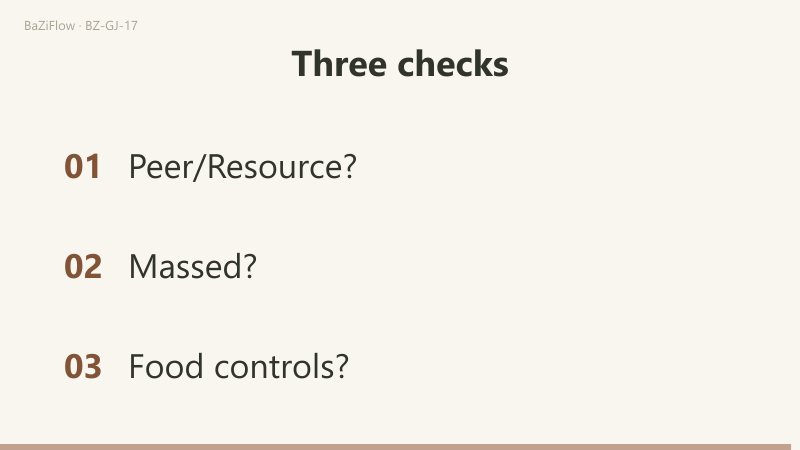
First check whether anything stands beside the Day Master. Juan 5 allows not one Companion or Resource; the site is stricter still and refuses the Follower label if a single peer or Resource stem sits even among hidden stems. That is why a Yang Earth day with a Yang Wood Tiger hour, which the book calls following, fails here: the Tiger hides Yang Fire and Yang Earth.
How does this pattern relate to the ordinary Seven Killings pattern?
Same Killings, opposite handling. In the Seven Killings pattern the Day Master stands up to them, using Eating God control, Resource or a blade binding; in this pattern it gives up standing alone, and those same tools become breakers. Once Resource or a peer appears in the pillars, the book goes back to reading the chart as Seven Killings.
If this pattern welcomes Wealth, is an Eating God good or bad for it?
The book leans toward bad. The Six Gods note puts Eating God luck next to strong-self luck as the great dread, and the Yuan Li Fu note lists control by the Eating God and following as two separate ways of handling Killings. The site's favorability table puts both Eating God and Wealth in neutral and makes no separate call.
Was this article helpful?
Sources & references
Continue reading
Follower-Wealth Pattern: Strict Conditions, the Root That Breaks It, and Disputes ↗
Follower-Output Pattern: "My Child Meets a Child," and the Site's Three Strict Gates ↗