
Life and Body palaces: two placements, not two lives
Content version · · Sources & references
Learn why Shen Gong sits inside an existing palace, how its placement differs from Ming Gong, and why an age slogan cannot replace a method.
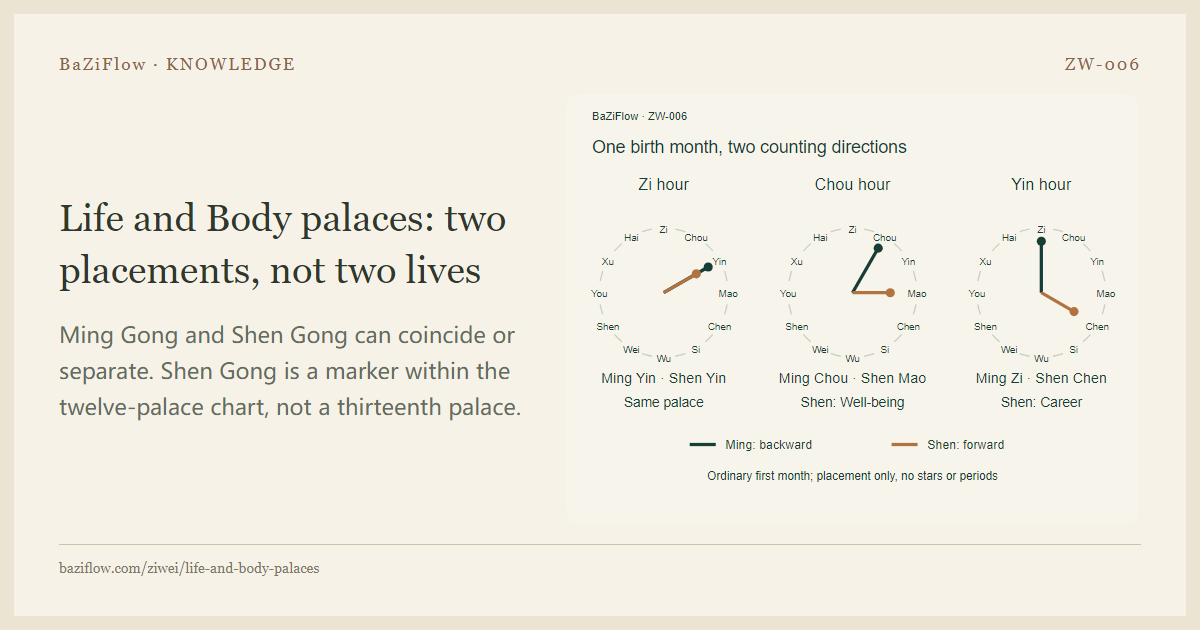
Ming Gong and Shen Gong can coincide or separate. Shen Gong is a marker within the twelve-palace chart, not a thirteenth palace.
Read first
Read the label before the metaphor
A chart may label a box Career and also mark it Shen Gong, commonly translated as Body palace. That is not a contradiction. Ming Gong, the Life palace, anchors the arrangement of the twelve topic palaces. Shen Gong is a separately derived location within that arrangement. It does not add a thirteenth box. Review the twelve palaces first if their names are unfamiliar.
Keep this exercise on the natal layer. A Life-palace label on an annual or major-period overlay belongs to that layer; it is not another name for the natal Shen Gong.
Try the counting operation
Volume two of Zi Wei Dou Shu Quan Shu describes starting the first birth month at Yin and counting forward to the birth month. From that location, start with the Zi hour: count backward to place Ming Gong and forward to place Shen Gong. Our examples assume an ordinary first month and an already resolved traditional hour. They deliberately leave leap-month and clock-conversion questions outside the exercise.
At the Zi hour both markers are at Yin. At Chou, Ming is at Chou and Shen at Mao. At Yin, Ming is at Zi and Shen at Chen. These are coordinate examples, not complete charts. Without a year and day we have not supplied stars, transformations or a biography.
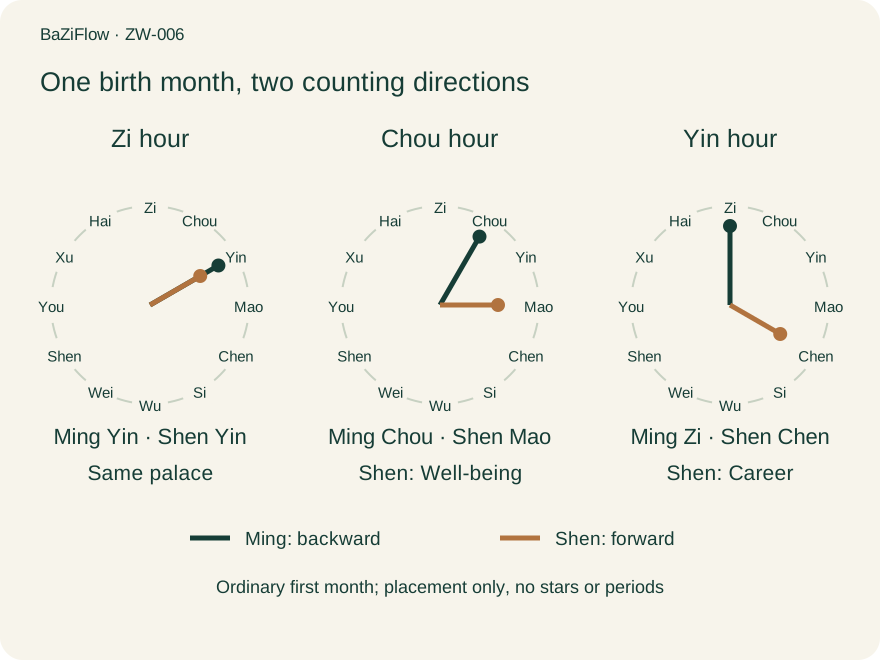
Original BaZiFlow teaching diagram; schematic, not a personal chart.
Turn a coordinate into a topic palace
Return to the ordinary first-month, Chou-hour example. Ming is at Chou. Following the palace order backward gives Siblings at Zi, Spouse at Hai, Children at Xu, Wealth at You, Health at Shen, Travel at Wei, Friends at Wu, Career at Si, Property at Chen, Well-being at Mao and Parents at Yin. Shen was placed at Mao, so it falls in Well-being in this arrangement. No star interpretation was needed for that result.
Check the other two rows yourself: the Zi-hour case coincides at Yin; the Yin-hour case has Ming at Zi and Shen at Chen, placing Shen in Career under the same ordering. The topic at a branch depends on the chart’s anchor, so “Mao means Well-being” is not a universal rule.
Carry both the branch and the topic into your first-chart record. For a different kind of location framework, continue to Zi Wei and Western houses.
Translate the result in stages
“Shen at Mao” first names a branch location. To identify the topic palace there, consult the palace arrangement anchored to that chart's Ming Gong. Do not borrow the topic label at Mao from a different person's chart. Under this arrangement, Shen Gong falls in Life, Spouse, Wealth, Travel, Career or Well-being. That set is a consequence of placement relationships, not a ranking of six life types.
Modern teaching often contrasts general orientation with practical engagement when discussing Ming and Shen. Treat that as an interpretive convention. It is not a measured split between mind and body. Coincidence does not prove inner harmony; separation does not prove conflict. A Shen marker in Spouse does not make every achievement dependent on a partner.
No birthday switches one off
The slogan that Shen Gong “takes over after thirty” is too compressed to serve as a calculation or reading rule. Shen is present in the natal chart from the start; Ming does not disappear at a birthday. A discussion of changing life stages should specify its period technique and school, while retaining the natal placements. A fixed age cannot do the work of that method.
Uncertain birth time introduces a different issue. If the recorded interval crosses an hour boundary, both markers may move. Keep the candidate combinations and identify which interpretation depends on the unresolved time. Choosing the description that feels most familiar does not independently establish that time.
Sources & references
Continue reading
Your first Zi Wei chart: make a map before a reading ↗
Twelve palaces, twelve houses: compare the questions, not the labels ↗