

Ease–Break: six places every third step
Content version · · Sources & references
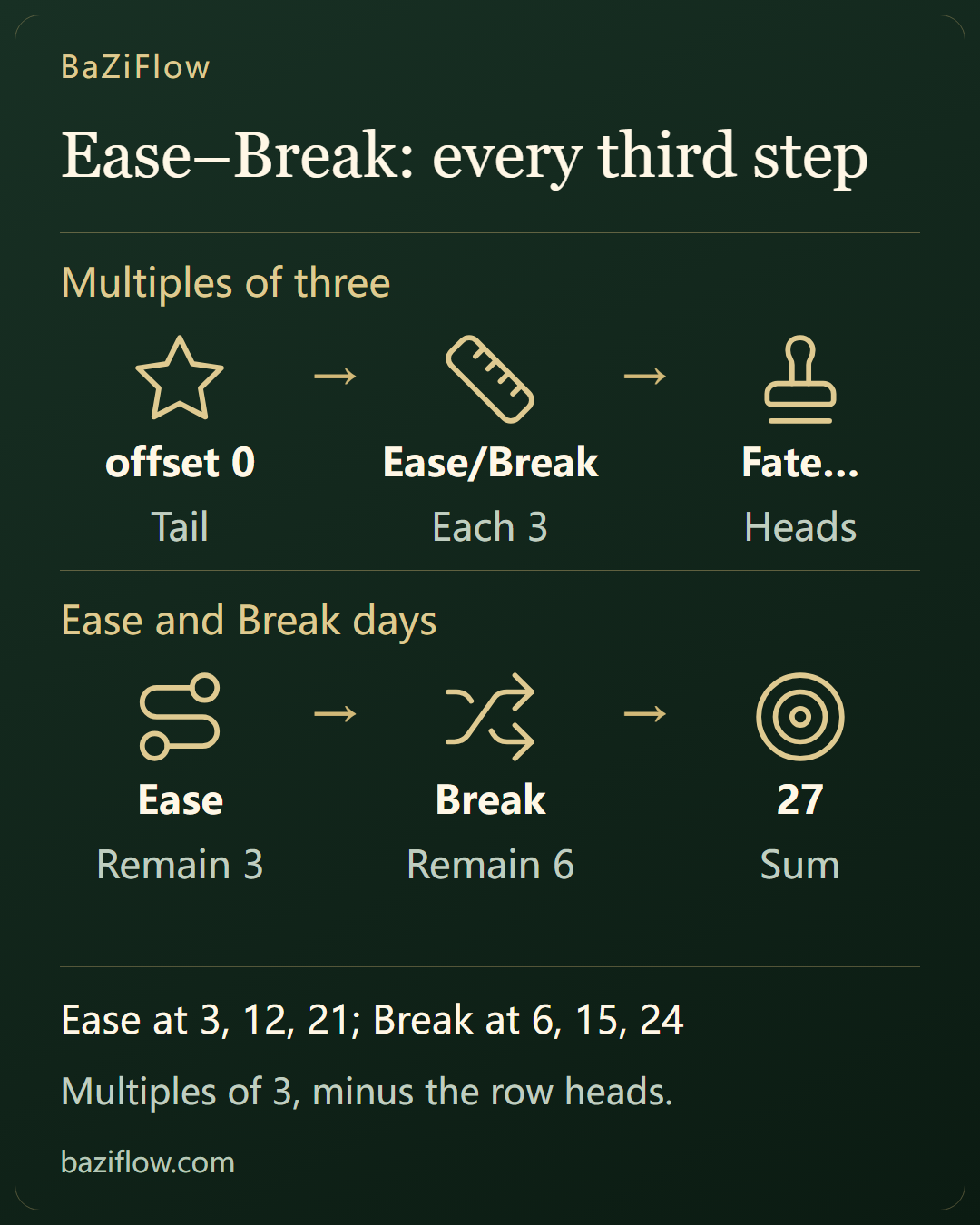
Ease lands on offsets 3, 12 and 21 and Break on 6, 15 and 24, multiples of 3 that are not multiples of 9. A ring, a chain of three-step jumps, three pairs of examples and the book's Ease-day and Break-day statements.
The short version6 min read
All six landing places of Ease and Break are multiples of 3: Ease at offsets 3, 12 and 21, Break at 6, 15 and 24. Take the multiples of 3 from 0 to 26, set aside the row heads Fate, Karma and Womb, and exactly these remain.
- Every three steps from the start, the names cycle through Ease, Break and a row head: Fate, Ease, Break, Karma, Ease, Break, Womb, Ease, Break, and back to Fate.
- 3 pairs with 24, 6 with 21 and 12 with 15, each adding to 27. Taking the shorter way round, the gaps are 3, 6 and 12, all multiples of 3.
- The book says an Ease day suits moving house and travel, while a Break day, listed with Peril, is "not suitable" for travel and suits suppression and attack: one deed, opposite statements.
Read first
The nine points every third step
From 0 to 26 there are nine multiples of 3: 0, 3, 6, 9, 12, 15, 18, 21 and 24. Offsets 0, 9 and 18 are the row heads Fate, Karma and Womb, and the other six are Ease and Break: 3, 12 and 21 are Ease, and 6, 15 and 24 are Break.
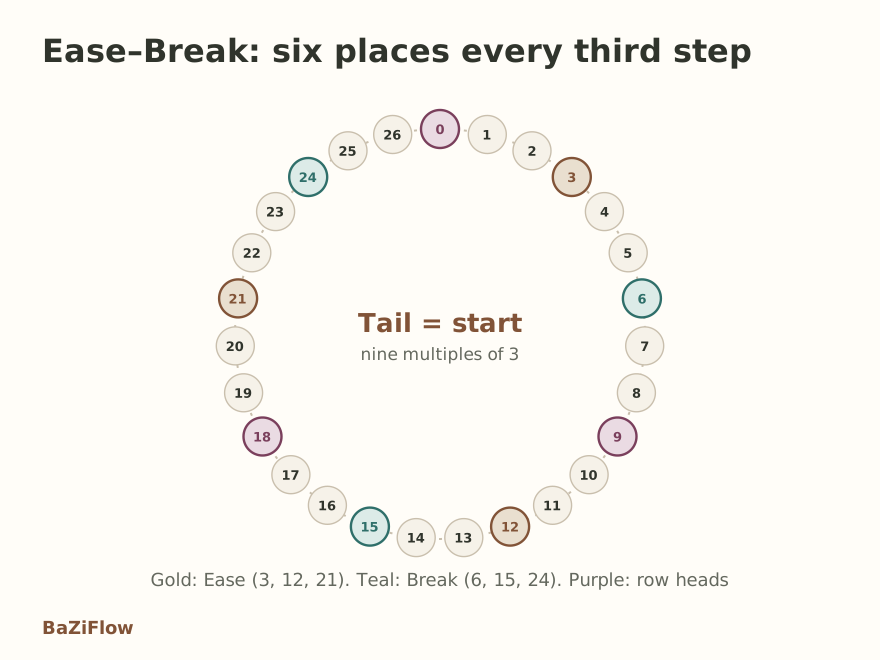
Sketch: the ring of 27 mansions starting at Tail, with the start at offset 0 (place 1 if the start is counted); a point is marked every third place, six of them Ease and Break and three purple ones row heads.
The picture starts at Tail (尾). Gold is Ease at offsets 3, 12 and 21: Girl, Net and Chariot. Teal is Break at 6, 15 and 24: Encampment, Well and Root. The three purple slots are the row heads at offsets 0, 9 and 18: Tail, Bond and Star.
Three-step jumps: what you meet on the way round
Jumping three steps at a time from the start, the names turn up in this order:
Enlarge diagram · scroll sideways to read
The other eighteen places go to Prosper–Kin, Friend–Decline and Peril–Attain. Here are the six Ease–Break landing places:
| Offset | Name | Lands on (from Tail) |
|---|---|---|
| 3 | Ease | Girl |
| 12 | Ease | Net |
| 21 | Ease | Chariot |
| 6 | Break | Encampment |
| 15 | Break | Well |
| 24 | Break | Root |
Three pairs, each seen from both sides
Reversing the direction turns d into 27−d: 3 pairs with 24, 6 with 21, and 12 with 15.
Enlarge diagram · scroll sideways to read
Gap 12 is the largest in this group, one step short of the directly opposite 13. The same name sitting at 3 and at 12 means very different places on the ring, which is why the gap has to be read in addition to the name.
The book on Ease days and Break days: one deed, opposite verdicts
When choosing days, Ease and Break are the most directly contrasted pair in the Sukuyō Sutra. Of an Ease day it says:
On an Ease day, moving and traveling afar, repairing house and garden and bedding, and setting up an altar are all auspicious.
Of a Break day:
On a Break day it is suitable to suppress and subdue enemies, and to attack and thwart wicked schemes; everything else is unfit.
Putting the two passages in one table shows the same deed receiving opposite verdicts on the two days:
Enlarge diagram · scroll sideways to read
For moving about and traveling, an Ease day is "auspicious" while a Break day, listed with Peril, is "not suitable for travel, comings and goings, moving house, trade or marriage"; what belongs to a Break day alone is suppression and attack. The book puts Ease in the Prosper, Ease, Attain, Friend and Kin group and Break in the Decline, Peril and Break group; that grouping is explained under Friend–Decline.
A quick way to check
Once the offset is worked out, three steps identify Ease–Break:
Ask whether it is a multiple of 3
If not, it cannot be Ease–Break; if so, go on.
Rule out multiples of 9
0, 9 and 18 are Fate, Karma and Womb; the other multiples of 3 are Ease–Break.
Divide by 9 and look at the remainder
Remainder 3 is Ease and 6 is Break: 12 leaves 3, 15 leaves 6, 21 leaves 3 and 24 leaves 6.
Two Ease–Break exercises
Turtle Beak to Wall, and Wall back to Turtle Beak?
Turtle Beak is place 3 and Wall place 24. From Turtle Beak to Wall is offset 21, which leaves remainder 3 on division by 9: Ease. From Wall to Turtle Beak it is offset 6: Break. 21 plus 6 is 27.
Winnowing Basket to Ghost, and the way back?
Winnowing Basket is place 18 and Ghost place 6, so going from Winnowing Basket to Ghost means wrapping round: offset 15, remainder 6, Break. From Ghost to Winnowing Basket it is offset 12, remainder 3: Ease.
The two groups beside Ease–Break are Friend–Decline and Peril–Attain; how six groups come from two directions is in the six relationship types; why the names do not settle good or bad is in why Ease–Break cannot be judged as good or bad.
Questions readers ask next
Does "Break" mean the mansion is bad?
Break is the name of the seventh place in a row. It shares a word with "broken", but in the table it is only a position. The book's "on a Break day it is suitable to suppress enemies" says what such days are for; it does not judge the mansion or the person who lands there.
Why are all Ease–Break offsets multiples of 3?
In a row of nine, Ease stands 3 steps and Break 6 steps from the head. The rows are 9 steps apart, and 9 is also a multiple of 3, so Ease and Break in every row land on multiples of 3. The row heads 0, 9 and 18 are multiples of 3 too, so every third step from the start meets an Ease, a Break or a row head.
Is an Ease day good for everything?
No. The book lists moving house, travel, repairing house and garden, bedding and setting up an altar. What is listed has been said, and what is not listed has not. When you read "auspicious", first look at which deeds it covers.
Was this article helpful?
Sources & references
Continue reading
Friend–Decline (友衰): why the indexes add up to 9, and how the book groups the two names ↗
Peril–Attain (危成): the mid-row couple, the farthest pair and Peril-day readings ↗