

Empty palaces and borrowed stars
Content version · · Sources & references
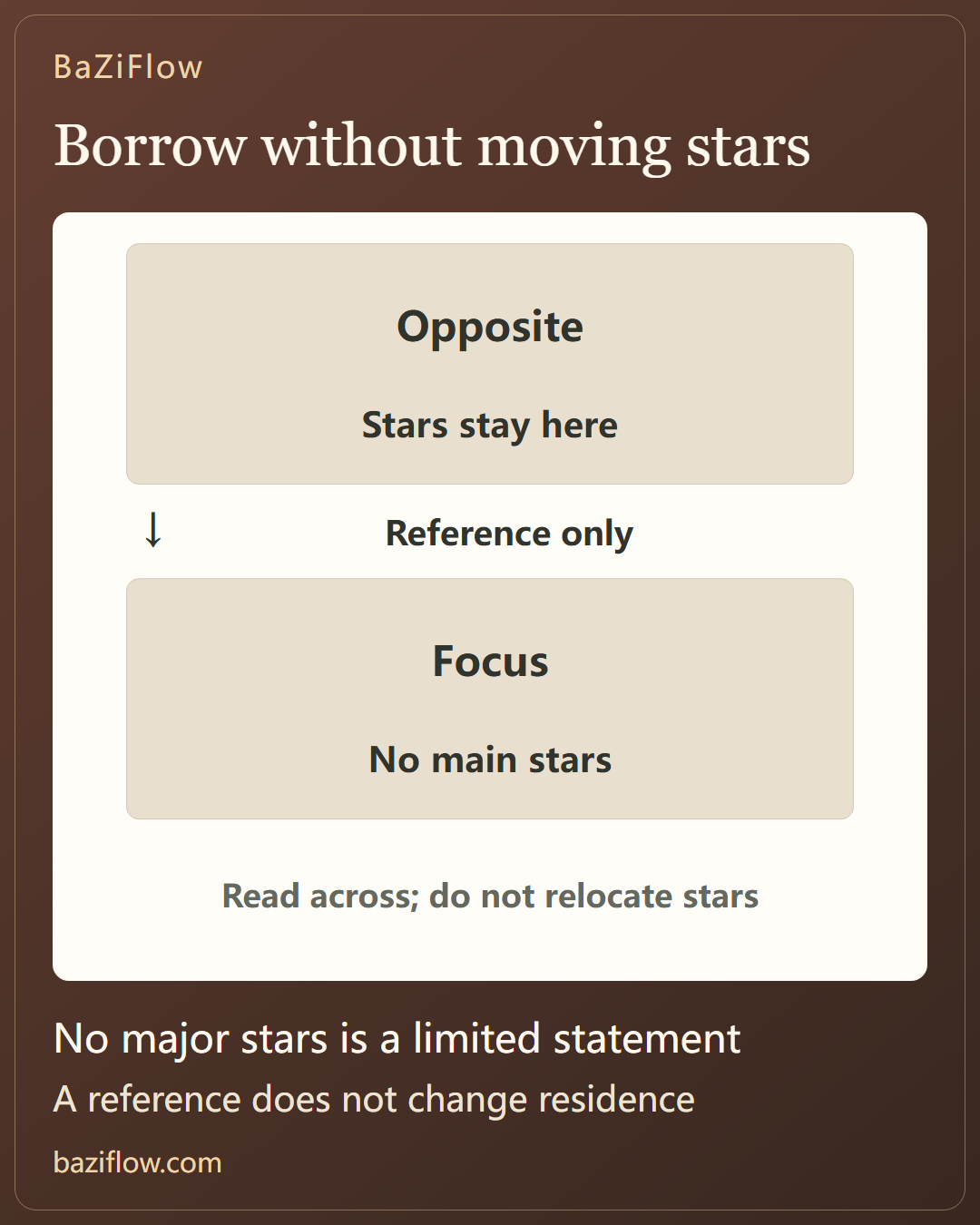
An empty Zi Wei palace lacks major stars, not all information. Learn how an opposite-palace reference differs from moving stars into the focus palace.
The short version6 min read
An empty palace lacks the fourteen major stars, not every kind of information. Borrowing adds a reference from the opposite palace without changing the original placements. A small Mao–You example lets you separate residence, display and attributes that were never supplied.
- An empty palace commonly means no fourteen major stars; other stars, its topic and its positional relationships remain.
- Consulting Tai Yang and Tian Liang at You while reading Mao does not relocate either star to Mao.
- Keep display conventions and source locations visible; do not invent brightness, transformations or a universal percentage for borrowing.
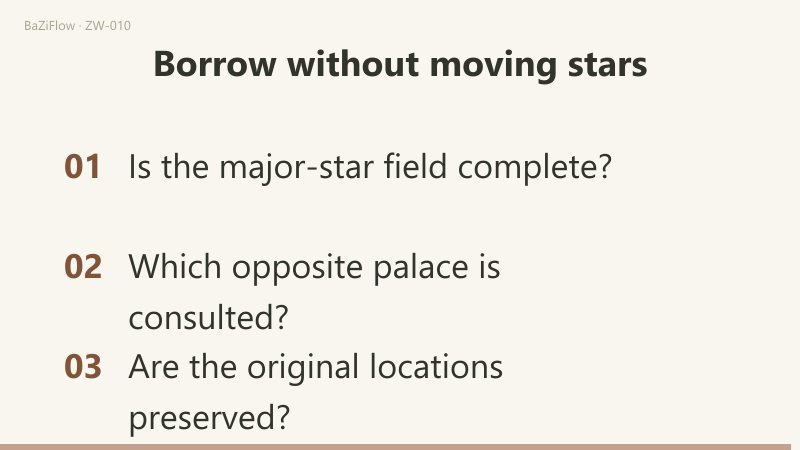
Read first
The fourteen major stars: learn the roster and its structure ↗
What is missing from an empty palace?
In common Zi Wei usage, an empty palace is one without any of the fourteen major stars. Other stars may still be present, and its palace topic, branch position and relationships remain part of the chart. “No major star” is a narrower statement than “nothing is there.”
It is also different from “not visible in this screenshot.” A collapsed panel or a cropped image can hide information that exists in the full record. Confirm the complete major-star field before classifying a palace as empty.
The fourteen-star roster helps establish exactly which names are being counted. Do not promote another star into that roster just to fill a space. Nor does an empty Partnership or Wealth palace establish an absence of relationships or income in someone's life. A technical category does not supply that personal outcome.
Field hidden
- Supported statement
- Unconfirmed
Full field empty
- Supported statement
- No major stars
Other stars present
- Supported statement
- Keep their record
Follow a stated method, not a preferred set of stars
The iztro major-star introduction describes consulting the opposite palace when a palace lacks major stars. Its plugin documentation gives a concrete example: it first looks for major stars in Life and, if none are obtained, reads them from Travel. The example makes the source of the reference visible.
It is an illustration of one documented approach, not proof that every school uses identical details. It also does not make a chart owner's personality dependent on a software lookup. The mechanics of retrieving names and the interpretation of a person are separate claims.
Do not select whichever palace has the most attractive stars as the source. Identify the actual opposite position. Do not assign an unsupported numerical discount, such as automatically halving a borrowed star's effect. A dashed line in a teaching diagram denotes reference, not a measured strength.
A record that preserves the borrowing
Take a partial teaching example: Mao has no major stars, while its opposite, You, contains Tai Yang and Tian Liang. If the selected method consults the opposite palace's major stars, these two names become references when discussing Mao. Their actual location remains You.
| Field | Record in this exercise |
|---|---|
| Major stars resident at Mao | None |
| Reference location | You, opposite Mao |
| Stars being consulted | Tai Yang and Tian Liang at You |
| Unsupported rewrite | Tai Yang and Tian Liang are resident at Mao |
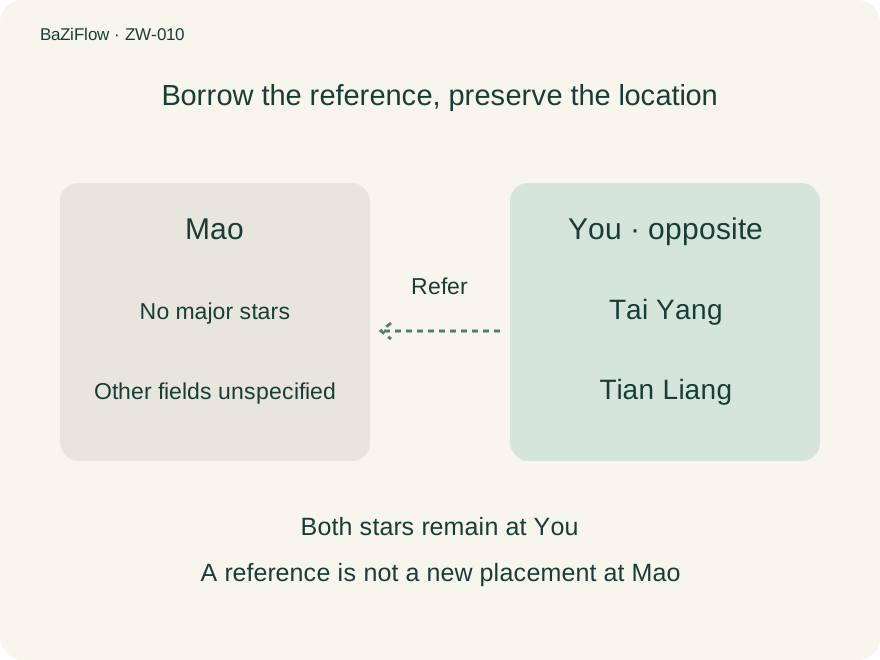
Original BaZiFlow borrowing example. The diagram supplies only local conditions, not a complete personal chart.
No birth date, palace topic, auxiliary stars, brightness values or transformations have been supplied. Those fields remain unspecified. The exercise tests whether another reader could reconstruct the local positions from your note; it does not authorize completing a fictional personal chart around them.
A good sentence therefore says that Mao is being read with reference to the two stars at You. A sentence that simply lists the stars “in Mao” loses the condition that made this a borrowing exercise.
Test the note with three statements. “Mao has no major stars” records the focus palace. “You contains Tai Yang and Tian Liang” records the source. “Read Mao with reference to You” states the operation. Removing the third loses the borrowing; changing You to Mao in the second invents a placement. Do not compress all three into “Mao contains the pair.” The opposite can also be checked by counting: after Mao come Chen, Si, Wu, Wei, Shen and You, six branch steps in total.
Placement record
- Mao: no main stars
- You: Tai Yang + Tian Liang
Reading note
- Mao refers to You
- No new residence
Preserve the conditions that borrowing does not replace
The focus palace can still contain other stars, and its triad relationships remain relevant to methods that use them. Two empty palaces need not have the same surrounding information. Repeating a stock description of indecision for every empty palace would discard those differences.
If the additional information has not been supplied, however, do not invent contrasting configurations to make the prose look individual. List the missing fields: resident auxiliary stars, opposite-palace stars and annotations, relevant triad positions and timing layer. The whole-chart context guide explains how to keep such records connected to their locations.
Brightness and transformations require particular care. Record where a marker actually appears, which star it qualifies and which time layer it belongs to. Then consult the chosen school's treatment of borrowed references. Copying a star into the focus palace and silently recalculating its attributes as if it had always resided there changes the facts of the record.
When sharing the chart again, retain the legend or write “referenced from the opposite palace” beside the names. As a final check, hide the image and read your own notes. Can you still tell which palace had no major stars, where the consulted stars were placed and what information was never provided? If the note instead appears to place the same pair in both palaces, correct the transcription before interpreting it.
Shared category
- No main stars
Still to compare
- Other local stars
- Opposite and triad
Check the legend before counting the stars
A chart may print borrowed stars inside an empty palace using brackets, lighter text or a different color. If you copy those names without the legend, you can accidentally create a record in which the same stars physically occupy two palaces.
Before interpreting that display, ask what the formatting represents. Is it a natal placement, or a convenience showing stars consulted from the opposite palace? A readable interface can combine these views, but a reliable note must preserve the distinction.
The word “borrowing” describes a reference in the reading process. It should not quietly become an edit to the underlying star positions. That distinction is the central skill in this introduction.
Display
Brackets or lighter type
Position
Residence and reference source
Attributes
Brightness, transformations, timing
Questions readers ask next
Does an empty palace contain no stars at all?
Usually not. The term refers to the absence of the fourteen major stars. Other stars may remain. First confirm that the full major-star field is visible rather than hidden by a collapsed panel or a crop.
Should borrowed stars be moved into the focus palace?
No. In the Mao–You exercise, both stars remain resident at You. A separate note says that Mao is read with reference to them. Recording the pair as resident in both palaces loses the distinction between reference and placement.
Does borrowing always reduce a star’s effect by half?
The sources checked here do not establish a universal numerical discount. The dashed line denotes reference only. A method-specific treatment of strength or attributes needs its own stated rule and should not be presented as raw placement data.
Was this article helpful?
Sources & references
Continue reading
Three sides, four directions: the four palaces read together ↗