

Keep the source beside the numbers
Content version · · Sources & references
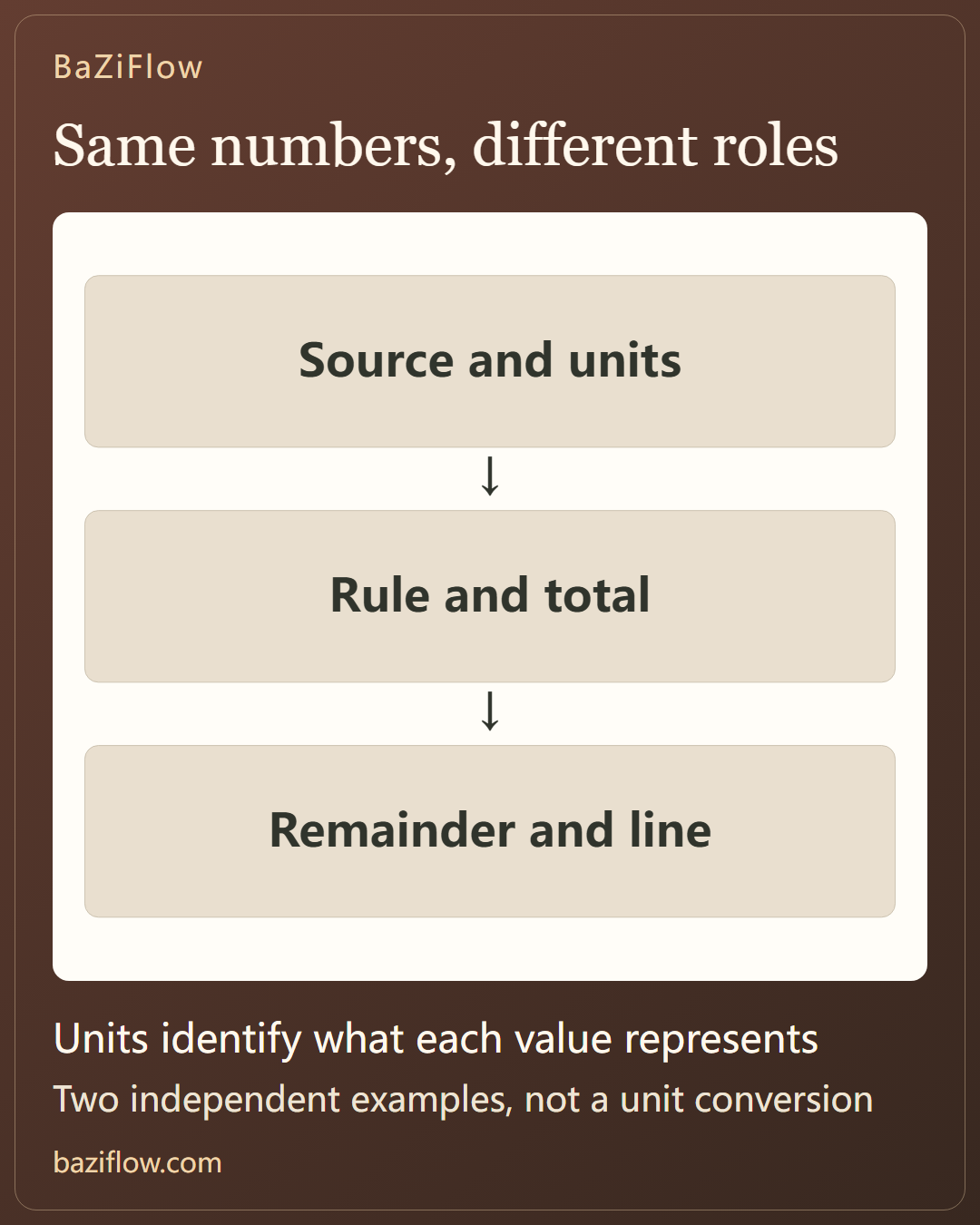
Compare two classical measurement procedures using the same pair of values, and learn why units, original numbers and grouping must survive in a casting record.
The short version6 min read
Two and five can select the same trigrams but different moving lines. The measurement procedures differ over adding an hour value. Keeping the units and procedure beside the original values explains that difference before any interpretation is attempted.
- The zhang-and-chi procedure combines the two measurement values; the chi-and-cun procedure adds an hour value for the moving line.
- Both examples select upper Dui and lower Xun, but totals 7 and 16 select lines one and four respectively.
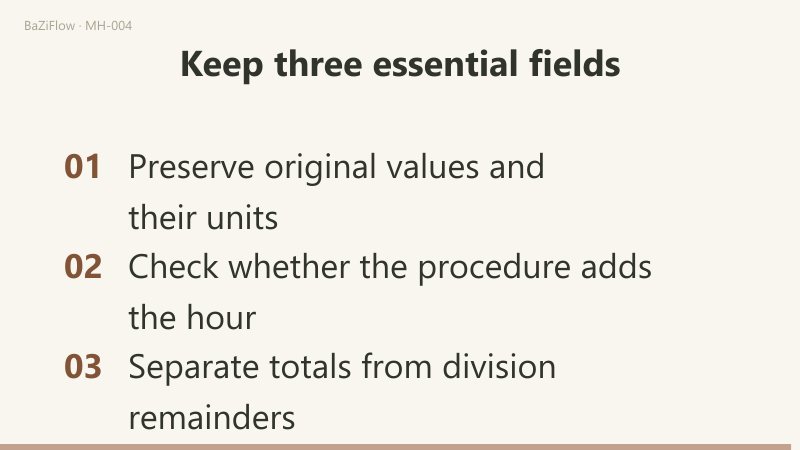
- Two and ten have the same remainder on division by eight but different remainders on division by six. Preserve the original values.
Read first
A pair of numbers is not a complete input
The numbers 2 and 5 might describe counted objects, spoken choices or two fields in a measurement. Erasing those labels leaves arithmetic that can no longer be tied to a procedure. Volume 1 of Meihua Yi Shu provides a particularly useful comparison: its zhang-and-chi procedure and its chi-and-cun procedure do not specify the same moving-line calculation.
A zhang, chi and cun are traditional length units. No conversion to modern metres is needed here, and the two examples below do not describe one object measured in two ways. They are independent teaching records constructed to compare the two passages. The first takes the zhang value for the upper trigram and the chi value for the lower, then combines the numbers for the moving line. The second uses chi and cun and adds the hour value when determining the moving line.
Zhang 2
- Chi 5
Chi 2
- Cun 5
Same trigram values, different totals
For the first record, suppose the zhang value is 2 and the chi value is 5. The upper trigram is Dui, associated with 2, and the lower is Xun, associated with 5. Their sum is 7. Since 7 = 6 × 1 + 1, the moving position is line 1. The passage also excludes the cun value, so adding an undeclared smaller-unit value would change the stated procedure.
For the second record, independently suppose chi is 2, cun is 5 and the hour-branch value is 9. The upper and lower trigrams remain Dui and Xun, but the moving-line total is now 2 + 5 + 9 = 16. Since 16 = 6 × 2 + 4, line 4 moves.
| Declared procedure and inputs | Upper and lower values | Moving-line calculation |
|---|---|---|
| Zhang-and-chi: 2 zhang, 5 chi | 2 and 5 | 7 leaves remainder 1 |
| Chi-and-cun: 2 chi, 5 cun, hour value 9 | 2 and 5 | 16 leaves remainder 4 |
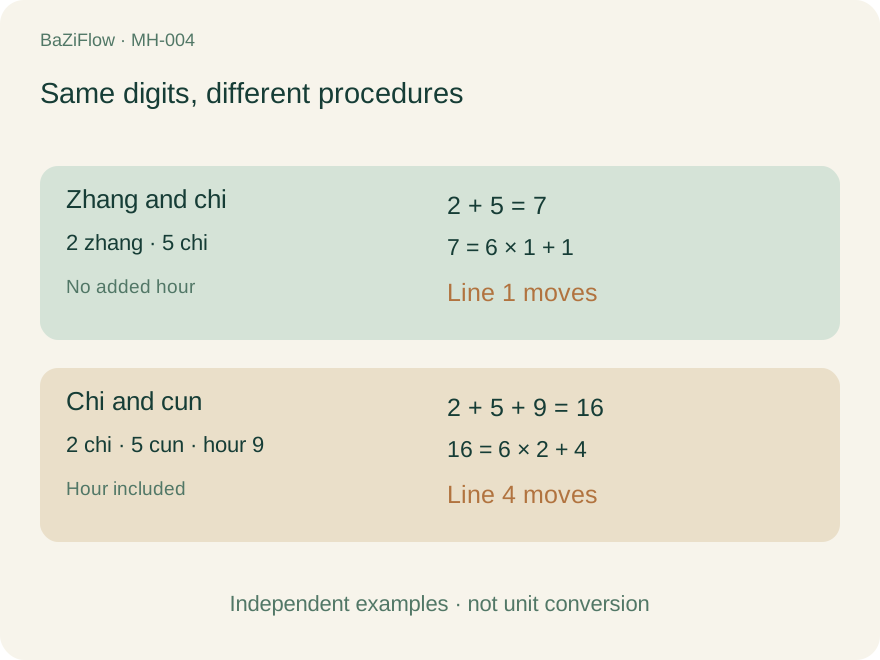
Original BaZiFlow teaching diagram of two independent procedures; not a unit conversion for one object and not a personal reading.
A universal instruction to always add the hour would alter the first example. A universal instruction never to add it would omit an input from the second. One caution: the general entry on dividing by six in Volume 1 says that the line should be taken “with the hour added”, whereas the entry for lengths in zhang and chi says only to combine the two numbers to take the line and does not mention the hour. This article follows the individual entries and does not settle how the two statements relate. The relevant question is which passage or declared convention is being followed. This article stops at the moving positions rather than inventing outcomes for the examples; determining the moving line treats that operation separately.
Zhang + chi
- 2 + 5 = 7
- 7 → line 1
Chi + cun + hour
- 2 + 5 + 9 = 16
- 16 → line 4
Preserve the number before reducing it
Original values, totals, remainders and trigram names are different fields. A note containing only Dui and Xun cannot recover the original observations. Two and ten both leave remainder 2 when divided by 8, but their remainders on division by 6 are 2 and 4. Reducing every original value to an eight-item trigram code before checking the intended procedure can therefore change later calculations.
That comparison is an arithmetic demonstration, not a new casting method. It shows that reduction loses information. Where the wording of a particular starting procedure admits different readings of a term such as trigram number, preserve the interpretation being used instead of assuming every teacher uses the same one.
Chapter 2 of the Shuo Gua describes the six lines and six positions of a figure. It supports the structural background, not a modern formula about adding an hour to spoken numbers. A shared occurrence of the number six does not make an unrelated numerical convention an ancient instruction.
2
- Remainder ÷8
- 2
- Remainder ÷6
- 2
10
- Remainder ÷8
- 2
- Remainder ÷6
- 4
Grouping sounds is part of the observation
Two knocks, a pause, then five knocks are not the same recorded event as seven uninterrupted knocks. A procedure might use groups or a total, but the choice must be declared before interpretation. If the pause was not recorded, write that the grouping is unknown. Repartitioning the sounds after an outcome is known creates an input that was never observed in that form.
A modern exercise using spoken numbers similarly needs an explicit agreement: how many numbers, which one supplies each trigram, whether a separate value selects the moving line and whether an hour is added. Such an agreement can be coherent without being presented as the sole original Meihua method. The manual's separate sections for object counts, sounds and measurements are a reason to keep their instructions distinct.
Changing the spoken numbers to obtain a preferred figure changes the input. It is not a second calculation of the same record. A classroom comparison can retain all the trials; deleting earlier trials removes the evidence of where selection occurred.
2 | pause | 5
- 2 + 5 = 7
7 uninterrupted
- 7
Contemporary sources need contemporary explanations
Ticket numbers, digits on a display and numerical encodings of text require their own selection decisions. Which part was taken? Were leading zeros retained? Why was that segment chosen? These are modern operational choices and do not acquire classical authority simply because they produce a valid six-line figure.
The two measurement examples make units, procedure names and time conditions visible together. That is why their different moving positions can be checked without interpreting an event. Numbers do not announce their own role: source and procedure give them one. For a source with additional calendar dependencies, continue with recording time-based casting rules.
Questions readers ask next
Why can the same two values select different moving lines?
These are independent records using different procedures. Combining two and five gives seven and line one; adding hour value nine gives sixteen and line four. They are not two measurements of the same object converted between units.
Can values with the same remainder replace each other?
Not across an unexamined calculation. Two and ten both leave remainder two on division by eight, but leave two and four on division by six. Early reduction discards information needed by another operation.
Does the same sound total mean the same observation?
Two sounds followed by a pause and five sounds preserve a grouping absent from seven uninterrupted sounds. Declare whether groups or the total are used. An unrecorded pause must not be reconstructed after seeing a result.
Was this article helpful?
Sources & references
Continue reading
Time-based Meihua casting: record the calendar before the sum ↗
Determining a moving line: position first, then the change ↗