

Ask a clear question
Content version · · Sources & references
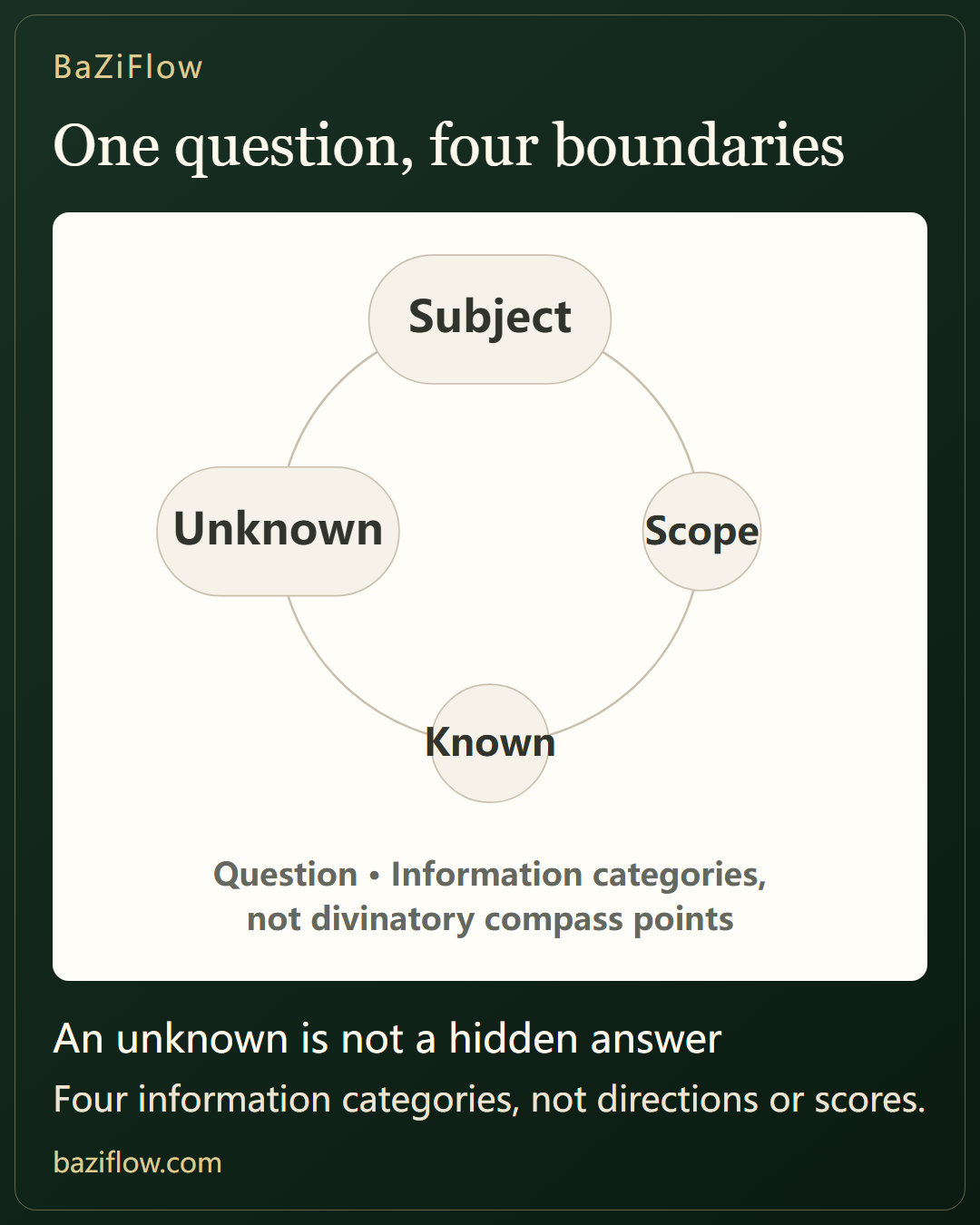
Build a question from its subject, scope, known facts and unknowns, then choose a route through Tarot, Liuyao or Qimen without changing the question to fit an answer.
The short version6 min read
A question such as “Why do they not want to work with me?” may already contain an unsupported answer. Identify the record behind it before interpreting the other person’s intention.
- No reply and an explicit refusal are different observations.
- Subject, scope, known and unknown constrain one question rather than score it.
- An action question differs from an outcome question, and later evidence must retain its date.
Remove the answer hidden inside the question
“Why have they decided not to work with me?” may contain a conclusion you have not established. Perhaps the observable fact is only that an invitation has not received a reply. Before interpreting the situation, separate that observation from an explanation of the other person's intention.
Add enough context to make the observation meaningful: when the invitation was sent, what arrangement it concerned and what remains unconfirmed. You do not need to supply a life history or guess someone else's private thoughts. A short question with visible limits can be clearer than a long account built on assumptions.
Assumed answer
- They do not want to cooperate
Actual record
- No reply has arrived
Separate subject, scope, known and unknown
- Presupposition
- A judgment built into a question before it has been established.
- Question version
- The wording, scope and known information at a specified time, with additions kept separate.
Choose the scope before choosing a method
Ask which matter you want to examine and over what period. “Will things improve?” expresses a real concern, but leaves the subject open. A response could quietly choose work, a relationship or mood and appear relevant without answering what you meant.
You might instead distinguish an outcome question from an action question: whether an arrangement will proceed, or what you can prepare while waiting for confirmation. These questions are related, but changing between them changes the task. Keep the original wording rather than pretending the revised question was there from the start.
| Component | What it makes explicit |
|---|---|
| Subject | The person, arrangement or matter being discussed |
| Scope | The relevant period or boundary |
| Known | Observations that can currently be confirmed |
| Unknown | Information still needed rather than assumed |
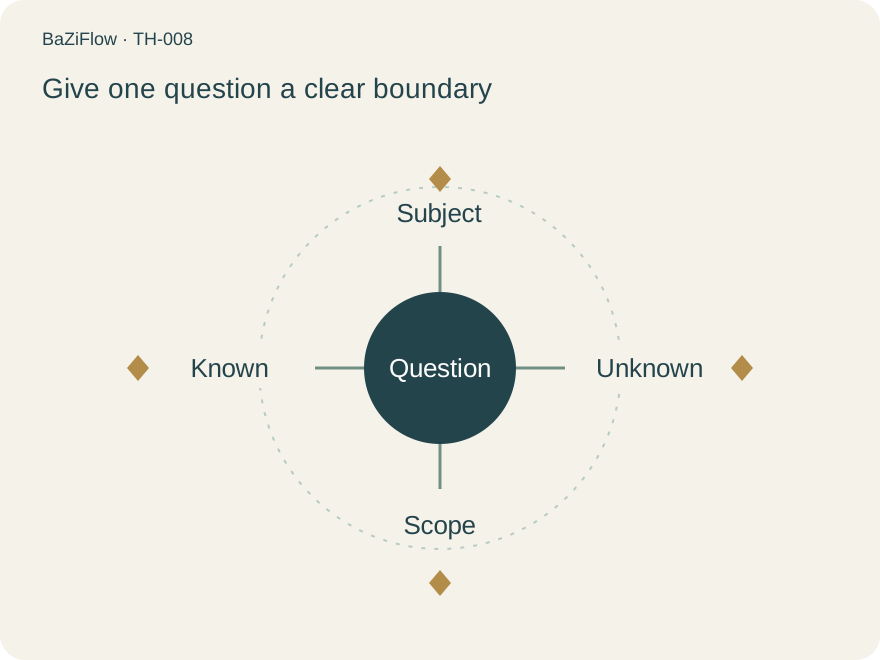
Original BaZiFlow question compass. It organizes information; it is neither a divinatory direction chart nor a scoring system.
The four markers serve one central question. They are not compass directions for divination and they do not grade a question's quality. If several unrelated matters appear in your draft, separate them so that a later answer can be traced to the matter it addresses.
Invite on Monday
- Established
- Message and sending time
- Still unknown
- Whether it was read
No reply by Wednesday
- Established
- The absence of a reply so far
- Still unknown
- Willingness to cooperate
Follow the method's entrance, not just its vocabulary
Asking Tarot questions is a useful starting route. Waite's alternative-method chapter asks for a specified period when a time-bounded reading is intended; its supplementary practice notes also call for a clearly formulated question, although the method itself is recommended for a general reading when no definite question is asked. These passages document a traditional approach to framing, not proven access to future facts or another person's mind.
For Liuyao, choosing the useful god directs attention to how the matter asked about relates to the method. Do not transfer the BaZi meaning of a similarly named term without checking its context. Nor should the subject of the question be switched after the result appears to make the reading fit.
If you are comparing tools, Qimen versus Liuyao methods offers a route into their different inputs and treatment of the question. Discussing the same topic does not make their chart terms interchangeable. Similar answers also do not automatically constitute independent verification.
Tarot scope
- Keep its role
- What this reading concerns
- Do not substitute
- Unconfirmed future facts
Liuyao selection
- Keep its role
- The question’s object in that method
- Do not substitute
- A BaZi term with the same name
Treat a record as material to examine
The National Archives' document-analysis teaching progresses from identifying and observing a source to interpreting it and using it as evidence. Here it offers a helpful discipline for reading what is actually recorded before adding an explanation. It is a history-education method, not an endorsement of divination.
For your own question, that means keeping the original message or factual note distinct from what you infer. If information arrives later, date the addition. Otherwise a review may accidentally count later knowledge as something available when the question was first asked.
A method's source has its own limits too. Historical instructions may include assumptions about intuition, gender or authority that need not be adopted to understand how a question was framed. Identify the particular point a source supports instead of treating an entire book as a certificate for every conclusion.
Wednesday question
- Record at the time
- No reply by that date
- Later addition
- Preserve the original record
Thursday reply
- Record at the time
- New wording known on Thursday
- Later addition
- Add the reply with its date
Reframing should leave a trail
Changing “Will this definitely succeed?” to “Which conditions can I check?” can make a discussion more practical. It does not produce the same answer in a more positive tone; it asks for something different. Record why you made the change and what you still do not know.
When another person is involved, focus on observable interaction and questions you can ask respectfully. An interpretation does not establish their consent, disclose a hidden intention or remove their ability to choose. Their unexpressed position remains unknown unless they communicate it.
Repeatedly rewording a question in search of reassurance may add no information. Check whether the difficulty is missing evidence, excessive scope or an interpretive disagreement. These are different problems. Where a fact can be confirmed directly, a reliable record or a conversation may be the appropriate next step.
Finish with a version you can revisit
Save the question, time, chosen method and known conditions together. Add later information separately rather than overwriting the starting point. A later review can then ask whether the response addressed the original question and whether its claims stayed within the available evidence.
Clarity does not guarantee the answer you want. It makes an answer's limits visible and allows an honest unresolved result. That is a stronger basis for learning than turning every uncertainty into a confident sentence.
Will it succeed?
- An outcome question
What can I confirm?
- A preparation question
Locate the unsupported judgment
In “Why do they not want to cooperate?”, ask whether unwillingness came from their reply or your interpretation.
Restate only the observation
Record an invitation sent on Monday and no reply by Wednesday. Do not invent a read receipt or refusal.
Add later information separately
If a reply arrives Thursday, preserve its date and wording. Review what was available on each day rather than treating both records as simultaneous.
Questions readers ask next
Is a longer question clearer?
Not necessarily. A defined subject, scope and evidence can be enough; unrelated private information and guessed motives add no certainty.
May I change an outcome question to an action question?
Yes, while recording the change in focus. Checking preparation does not establish that the outcome will succeed.
May I add a later reply to the original record?
Add it with its date rather than replacing the original state of knowledge. Otherwise a review may count later information as earlier evidence.
Was this article helpful?
Start reading
Frame a tarot question that leaves room for evidence ↗ · Tarot
Choosing the useful god: define the subject and retain candidates ↗ · Liu Yao
Qimen and Liu Yao: compare the records before the answers ↗ · Qimen Dunjia
Sources & references
Continue reading
Frame a tarot question that leaves room for evidence ↗
Choosing the useful god: define the subject and retain candidates ↗