

A Missing Element Is Not an Automatic Remedy Request
Content version · · Sources & references
A zero in an element chart depends on what was counted. Separate absence, strength, interpretive usefulness and real-world action before treating a missing category as something to add.
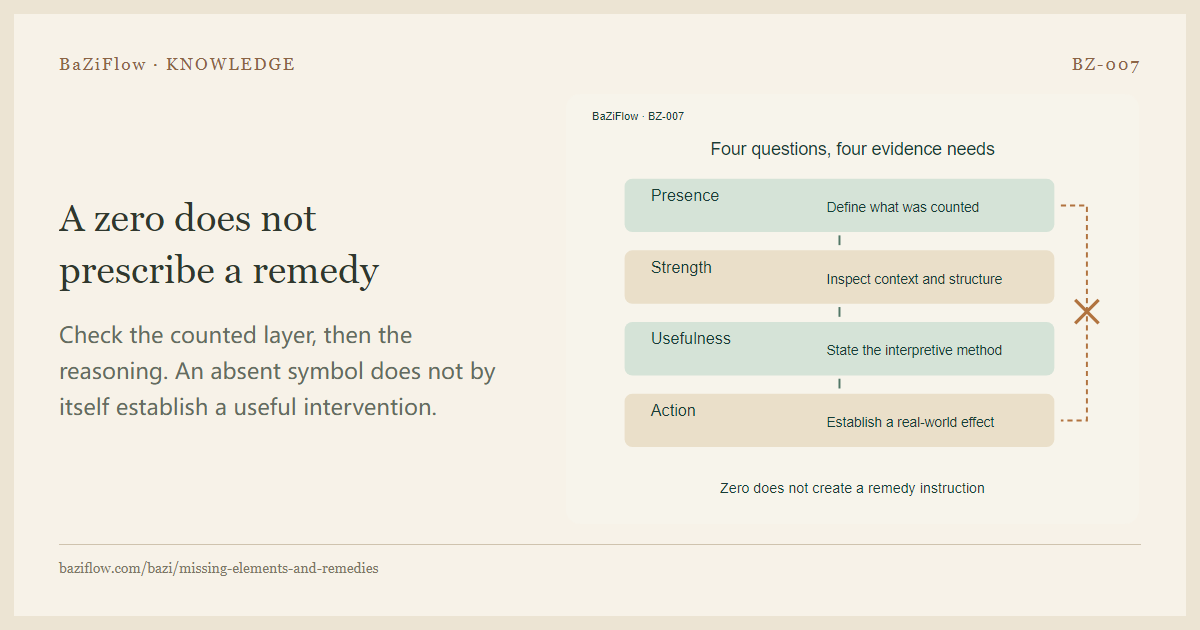
Check the counted layer, then the reasoning. An absent symbol does not by itself establish a useful intervention.
Read first
Five Elements cycles: learn the relationships, not just the order ↗
Read a recommendation backwards
Consider the sentence “Your chart lacks Fire, so you need a red object.” Start at its end. What effect is the object supposed to have, and what evidence connects its colour to that effect? Even a correct chart count cannot answer those questions. A traditional symbolic association and a claim about a real-world outcome are different kinds of statements.
Now move backwards through the sentence. Why would more Fire be useful under the chosen interpretive method? Was Fire judged weak, or merely absent from a display? What was actually counted? This reverse reading exposes the steps that a confident “so” can hide. It also gives a way to review an existing report without first accepting its conclusion.
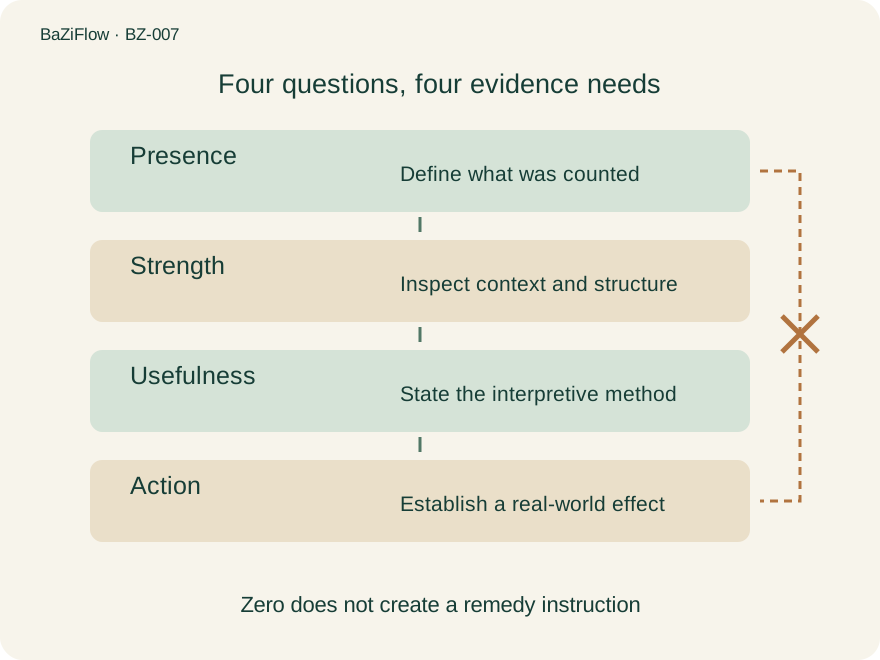
Original BaZiFlow diagram separating four evidence questions; not a prescription for adding an element.
Reconstruct the observation from fields
Take a deliberately incomplete exercise: the visible Heavenly Stems contain neither Yang Fire nor Yin Fire, but a confirmed Earthly Branch is the Tiger. In the common Hidden Stem table, the Tiger contains Yang Wood, Yang Fire and Yang Earth. The visible stems therefore show no Fire while the expanded branch contains a Fire stem. Neither observation tells us its strength in a whole chart.
| Record supplied | A claim that can be checked | A claim it does not establish |
|---|---|---|
| Visible stems contain no Yang Fire or Yin Fire | No Fire stem in that visible layer | No Fire anywhere in the chart |
| A confirmed Tiger branch, using the stated table | Hidden Yang Fire is listed | Fire is strong or helpful |
| No complete configuration | Its overall role remains unknown | A Fire remedy is required |
This example has no birthday and does not calculate anyone's chart. Its point is that the counting scope belongs inside the claim. “Absent from the visible stems” is more precise than “absent.” The Hidden Stems article explains the additional layer. Missing birth-time data or a cropped screenshot creates another issue: an unseen field may be unknown, not empty.
Do not try to repair an incomplete record by counting phase words in the interpretation. Ordinary words can contain the same Chinese characters as Metal or Water without naming chart entities. Conversely, a writer may omit a phase that exists in the structured record. The data source is the confirmed chart field, not word frequency.
Why the traditional strength discussion does not supply a shopping list
The consulted strength commentary in Di Tian Sui discusses strength containing weakness and weakness containing strength. San Ming Tong Hui, volume 2, also rejects treating every vigorous seasonal state as favourable and every diminished state as unfavourable. These passages challenge a simple shortage rule within the tradition. They do not validate a contemporary product's effect.
Absence, weakness and usefulness answer separate questions. Absence concerns presence within a defined set. Weakness interprets a configuration under specified conditions. Usefulness asks what a relationship contributes within a named method. They are not successive marks on a common scale. A rare item need not be weak; calling something weak still does not establish that increasing it is useful.
An assessment of support for the Day Master and a traditional discussion of seasonal heat or cold may ask different questions. Their reasoning cannot be supplied by the smallest bar alone. The Day Master, seasonal context, roots, visible and hidden layers and surrounding relationships are among the omitted conditions. This article does not resolve those frameworks or select a Useful God for an incomplete example.
Decide what kind of choice is being offered
You can enjoy a colour or a symbolic object without claiming that the chart requires it. That is an aesthetic or cultural choice. A promise that buying, wearing or renaming something will prevent misfortune makes an additional causal claim and needs evidence beyond correspondence. “Wood” as a phase category is not a measured quantity increased by adding wooden furniture.
Be especially careful when the meaning of “support” changes mid-explanation: first it describes a relationship in an interpretive model, then it becomes an instruction to purchase or consume something. That change of meaning is not a demonstrated mechanism. Element counts cannot by themselves establish nutritional, medical, investment or career necessities.
Finally, compare tools only after aligning their definitions. One graph may count visible stems, another main branch phases, another all Hidden Stems, and another weighted values. Different heights need not be answers to the same arithmetic question. Where a definition is unavailable, preserve that limitation. A complete, stated count can establish absence in its scope; the next questions remain separate. Favourable, useful and unfavourable factors takes up the interpretive terminology without turning a zero into an action order.