

Bo: stripped from the bed legs, one fruit left
Content version · · Sources & references
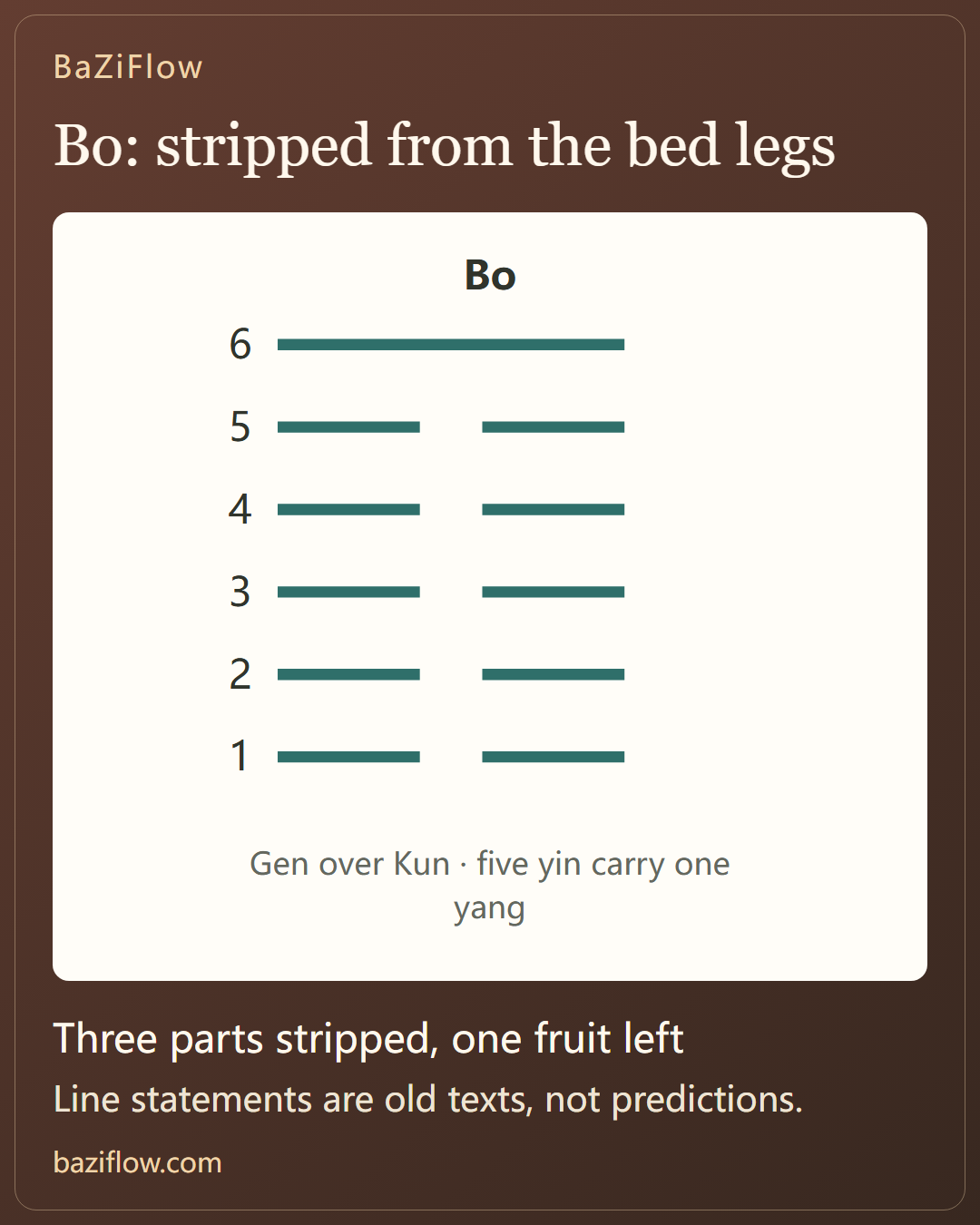
Bo (剝) is the 23rd hexagram: a mountain clinging to the earth, five yin lines under one yang. The bed is stripped at legs, joint and skin; line five turns to "a string of fish", and a great fruit is left uneaten.
The short version7 min read
Bo literally means to strip. Five yin lines stand below, with a single yang line left on top. In the statements the stripped part moves closer to whoever lies on the bed, line five turns, and the top line leaves a great fruit uneaten.
- Bo (剝) stacks Gen (mountain) on Kun (earth): five yin lines carry the single yang line at the top. The Commentary on the Judgments says "the yielding changes the firm", reading the whole figure as yin rising line by line.
- The judgment is "not fitting to go anywhere", with "the petty are growing" as its reason in the Commentary, then "yielding and stopping it" and "heaven's movement". The Great Image (大象) ends on "keeping the dwelling secure".
- Lines one, two and four strip the bed at its legs, joint and skin; line three has no object, only "stripping it: no blame"; line five turns to "a string of fish", and the top line has the great fruit and "the petty person strips his hut".
Read first
The Sixty-Four Hexagrams: How Upper and Lower Trigrams Form One Figure ↗
Judgment and Line Statements: Whole Hexagram or Single Line? ↗
The mountain clings to the earth: five yin lines carry one yang
Bo (剝) is the 23rd hexagram: Kun (earth) below, Gen (mountain) above. There are five yin lines, and the only yang line left is the top one. The Shuo Gua says "Gen is stopping" and "Kun is yielding". Yin runs from the bottom up to the fifth place, and a single yang line remains at the top, like a mountain, or a fruit, pared from below until only the crown is left.
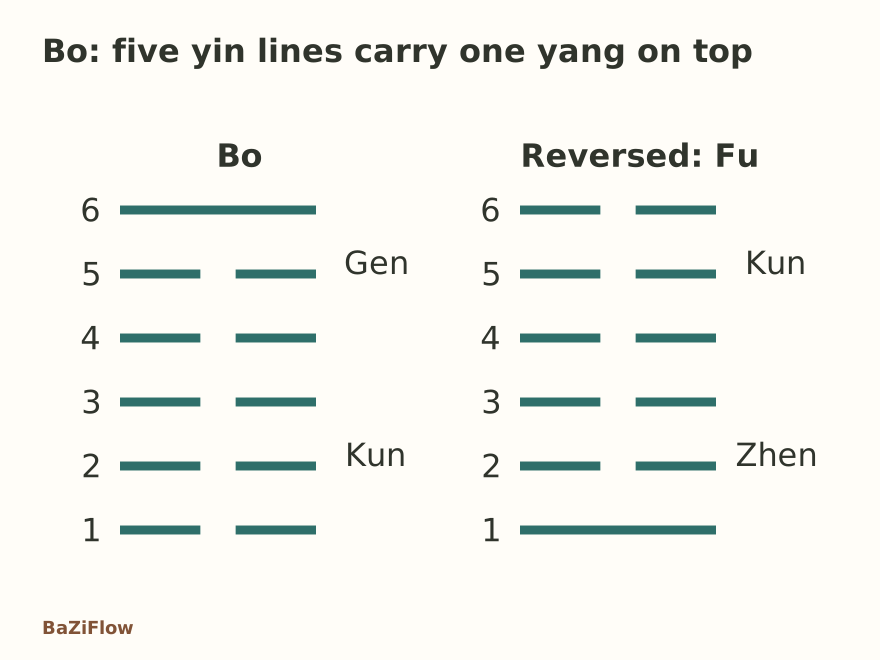
Bo beside its reversed hexagram Fu: turn Bo over and the yang line at the top goes to the bottom.
Enlarge diagram · scroll sideways to read
Three terms before reading Bo
- Bo
- To peel away layer by layer. The Commentary on the Judgments and the Xu Gua explain it with the same brief sentence, "Bo means stripping".
- Bed and joint
- What is stripped first is a bed: its legs, its joint, its skin. The "joint" is traditionally read as the part between the bed's leg and its board.
- Hut
- A simple dwelling. "The petty person strips his hut" in the top line and "keep the dwelling secure" in the Great Image both speak of a place to live.
The judgment and the Commentary: five characters, and a division that changes the sense
The judgment of Bo is only these words:
Not fitting to have anywhere to go.
It can also be divided as "not fitting; there is somewhere to go", while the Commentary quotes the words joined and explains them with "the petty are growing". The two divisions come out nearly opposite: the first is "not fitting, yet there is a place to go", the second "going forward does not suit". The whole Commentary reads:
Bo means stripping: the yielding changes the firm. "Not fitting to go anywhere": the petty are growing. Yielding and stopping it: that is reading the image. The noble person values waning and waxing, fullness and emptiness: this is heaven's movement.
"The yielding changes the firm" is read off the figure: yin lines rise from the bottom and turn the yang lines into yin one after another. "The petty are growing" explains the judgment. Then the Commentary gives an attitude: "yielding and stopping it" is Kun below yielding and Gen above stopping, so one goes along with it and stops it; "that is reading the image" means seeing the image clearly, and the verb for reading is the same character as in Guan. "Values waning and waxing, fullness and emptiness" esteems the turn from decrease to increase and from full to empty, which the Commentary assigns to "heaven's movement".
Enlarge diagram · scroll sideways to read
The Great Image: the mountain clings to the earth, thicken what is below
The Great Image reads:
The mountain clings to the earth: Bo. Those above accordingly thicken what lies below, and keep the dwelling secure.
A mountain stands high, but the word here is to cling: the mountain presses against the ground and its height is sinking. A common reading takes this as the image of a mountain being worn away. The conduct goes the other way: "those above thicken what lies below", strengthening the base, and "keep the dwelling secure", so that the house stands firm.
Enlarge diagram · scroll sideways to read
The figure has the upper part being stripped, while the conduct thickens the lower part, so the two point in opposite directions. Note also that the dwelling is the place to live, and the last line of the hexagram speaks of a place to live as well: "the petty person strips his hut".
The six statements: from the bed legs to a house, what is stripped keeps changing
In the six statements, what is stripped and what is left are all household things.
Enlarge diagram · scroll sideways to read
Line one, "stripping the bed at the legs", begins at the foot of the bed. The next phrase, "ruin to what is steadfast: misfortune", uses a word for ruin or wiping out, which tradition reads as destroying what is right; the Small Image says "it destroys from below". Line two strips the bed at the joint, one step higher than the legs, and the Small Image says "no one stands with it yet". Line four strips the bed at the skin, the surface a sleeper lies on, and the Small Image says "disaster is near at hand".
Line three sits among them and does something different: "stripping it: no blame". It says "stripping it" without saying what is stripped, and nothing is ominous. The Small Image says "it is parted from above and below". Line five changes direction: "a string of fish", like yin lines threaded on one cord; "through the palace women comes favor"; "nothing unfavorable", and the Small Image says "in the end no fault".
The top line is the only yang line in the hexagram: "a great fruit uneaten", one large fruit left on the branch; "the noble person obtains a carriage", where the received text reads "obtains a carriage" and one version has a word for "virtue" in its place; the Small Image also writes "obtains a carriage" and adds "the people carry him"; "the petty person strips his hut", stripping the house he lives in, and the Small Image says "in the end he cannot be used".
Neighbors of Bo: Fu, Kun, Guai, and "running out" in the Xu Gua
Turn Bo over and you have Fu (復): the yang line goes from the top back to the bottom, and the pair are each other's reversed hexagram. The nuclear hexagram is Kun (坤), six yin lines, with even the top yang line gone; the inverse is Guai (夬), each line changed to its opposite, five yang lines below and one yin line on top.
Enlarge diagram · scroll sideways to read
The Xu Gua attaches Bo to Bi (賁) like this:
When adornment has been pushed to the limit, success has run out; so Bo follows. Bo means stripping.
Adornment carried to its limit uses up the way through, and so comes stripping. For what follows, the Xu Gua says that things are not stripped to nothing: when stripping reaches the top and there is nothing left to strip, it turns back to the bottom, and that is Fu.
Questions readers ask next
How should "not fitting to go anywhere" be divided?
Two divisions are common: "not fitting; there is somewhere to go", or the words run together as "not fitting to have anywhere to go". The Commentary quotes the words joined and explains them as "the petty are growing", so following it the hexagram is one in which going forward does not suit. The two divisions come out nearly opposite, so say which one you follow.
Which part of the bed is "the joint"?
Tradition usually reads it as the part between the bed's leg and its board, and some read it as a boundary. The text gives one word, so only one thing is certain: the part stripped is a step higher than the legs.
Is the top line's word "obtains a carriage" or "virtue-carriage"?
The received text reads "obtains a carriage"; one version has "virtue-carriage" instead. The Small Image (小象) writes "the noble person obtains a carriage", so here it is read as getting a carriage and being carried by the people.
Was this article helpful?
Sources & references
Continue reading
Bi (賁): fire beneath the mountain, from "adorning the toes" to "plain white adornment" ↗
Fu: thunder within the earth, from "a return not far" to "a lost return" ↗
The Sixty-Four Hexagrams: How Upper and Lower Trigrams Form One Figure ↗
Judgment and Line Statements: Whole Hexagram or Single Line? ↗