

Zi Wei: its twelve landing points
Content version · · Sources & references
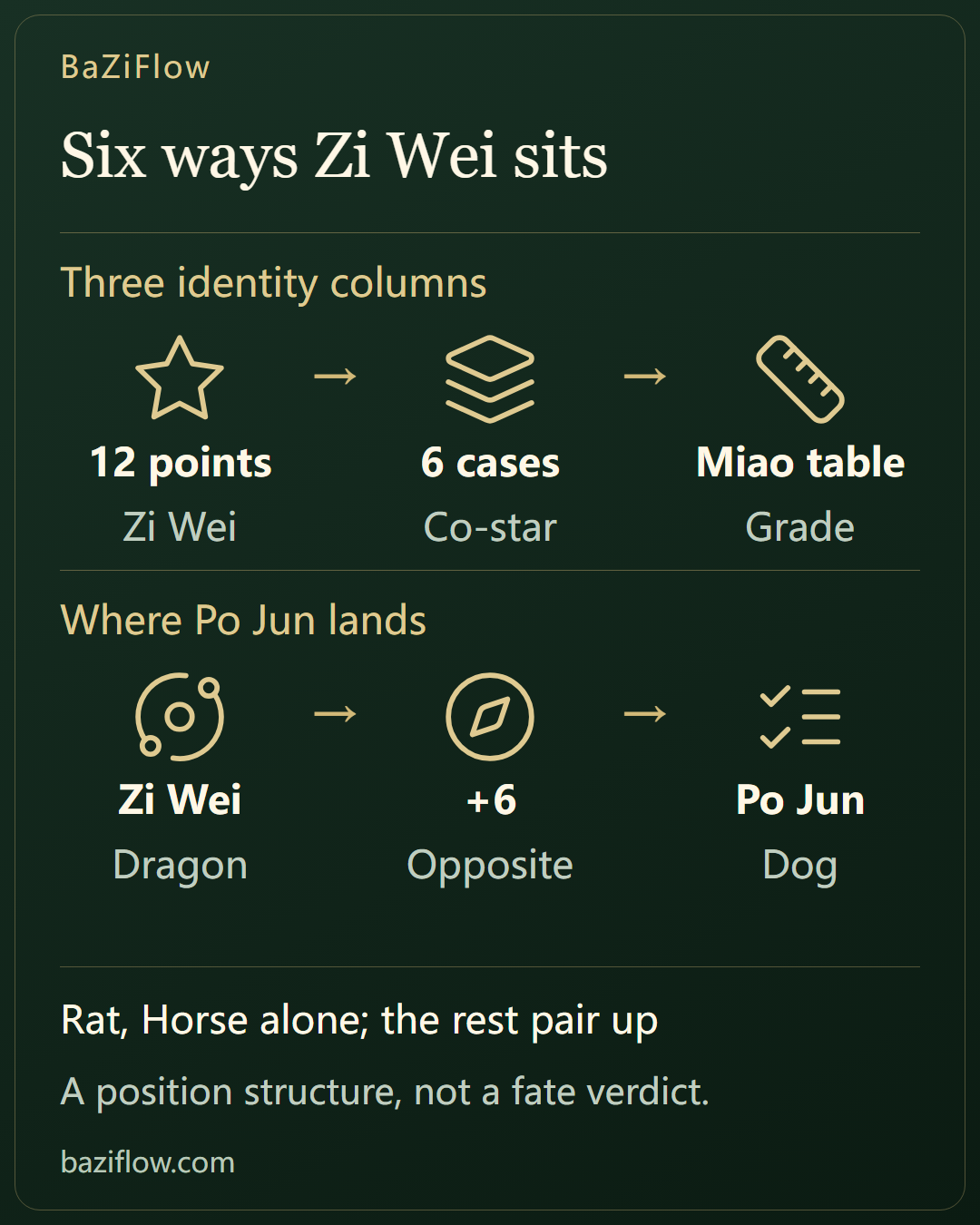
Zi Wei is Earth and heads the six-star Zi Wei sequence. With juan 1 and 2 of the Quan Shu and an engine-checked table: its six co-residents, whether "meeting Po Jun" is same or opposite palace, and the Miao/Wang table.
The short version7 min read
Zi Wei is the first name in the placement of the fourteen major stars: wherever it lands, the other thirteen positions follow, and the star that can share its palace comes in only six patterns.
- Zi Wei has twelve possible landing points. The Rat and Horse positions leave it alone, and each of the other ten pairs with one fixed co-resident.
- The same phrase "meeting Po Jun" means the same palace on the Ox and Goat positions but the opposite palace on Dragon and Dog, so work out the geometry first.
- The grade table and the "idle palace" list are two separate records in the book; quote a grade together with star, branch and source.
Read first
The fourteen major stars: learn the roster and its structure ↗
One star fixes thirteen others
Zi Wei (紫微) is the first name in the placement of the fourteen major stars. Once you know its branch, the other thirteen positions follow. Zi Wei has twelve landing points, yet the star sharing its palace comes in only six patterns.
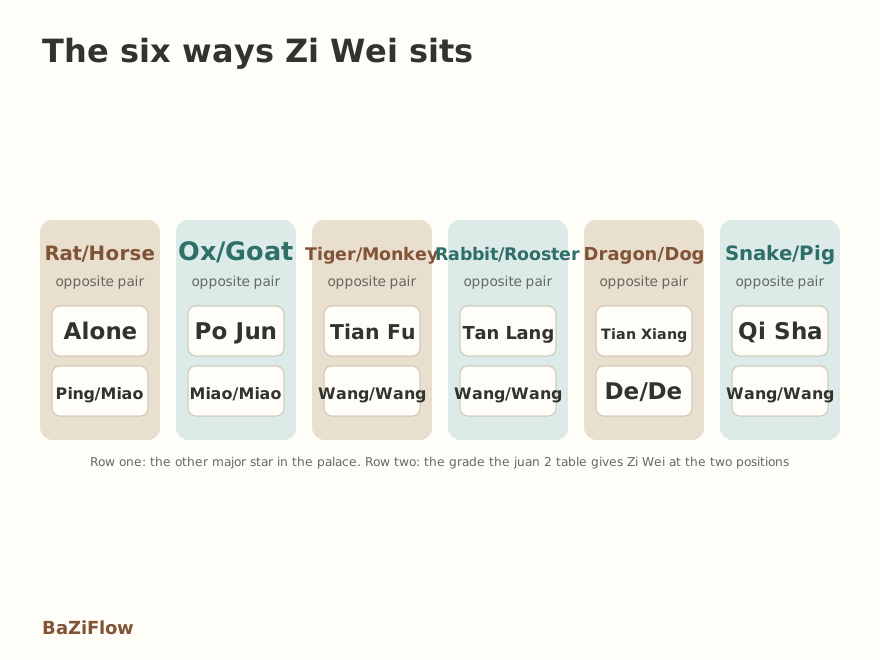
Comparison sketch: co-residents come from the placement verse and were checked on 1,296 iztro charts; grades are the juan 2 Miao/Wang table, which iztro 2.6.0 matches on these twelve cells.
The picture pairs the twelve branches into six columns of opposite positions, and each column is one way of sitting. On the Rat and Horse positions Zi Wei stands alone. On Ox and Goat it shares with Po Jun (破軍), on Tiger and Monkey with Tian Fu (天府), on Rabbit and Rooster with Tan Lang (貪狼), on Dragon and Dog with Tian Xiang (天相), and on Snake and Pig with Qi Sha (七殺). The entry for the Life palace in juan 2 of the Zi Wei Dou Shu Quan Shu (紫微斗數全書) lists exactly these five plus the solitary case.
The table was not worked out by guessing from the verse. We generated more than twelve hundred charts with iztro 2.6.0 and compared all fourteen major stars on each one; none departed from the rule that Zi Wei fixes the position and the rest follow the verse.
The columns the book fills in for Zi Wei
Juan 2 carries a catalog headed "which Dipper each star belongs to, what it transforms into, and its element", one line per star. Under the entry for the Life palace the Zi Wei line is expanded into this sentence:
Zi Wei is Earth; Northern and Southern Dipper alike turn it into the Throne; it rules the Career palace.
Read it as three columns, each answering one question.
- Earth, belonging to both Dippers (the catalog calls it the "central-sky star"): the element and Dipper column.
- Its qi title is "Throne" (帝座). A qi title (化氣) is a fixed label written beside the star name, a different thing from the four transformations that change with the birth-year stem.
- Ruler of the Career palace (官祿主). In the same catalog Tai Yang (太陽), Lian Zhen (廉貞) and Tian Xiang are also written as Career rulers, so this column records a pairing and does not require Zi Wei to sit in the Career palace.
Enlarge diagram · scroll sideways to read
Juan 1 adds a passage from Master Yuchan that pictures Zi Wei as a ruler with a court: Zuo Fu and You Bi as ministers, Tian Xiang and the literary stars as attendants, Kui and Yue as messengers, Sun and Moon as branch officers, Lu Cun and Tian Ma in charge of rank, and Tian Fu keeping the storehouse. When the court is short of people, the same section supplies a ready-made condition:
Without Fu and Bi walking with it, it is a lone ruler: a fine jade, yet not enough.
"Lone ruler" (孤君) is a conditional sentence. It reminds the reader to check where Zuo Fu (左輔) and You Bi (右弼) fall at the same time, instead of staring at the one name Zi Wei. How those two are placed is covered in supporting, malefic and minor stars.
"Meeting Po Jun": same palace, opposite palace, or something else
The verse on Zi Wei in a man's chart, juan 2, has the line "Zi Wei at Dragon or Dog meeting Po Jun: rich but not eminent, a name without substance". The Xiyi passage in juan 1 says "if it meets Po Jun at Dragon, Dog, Ox or Goat". The same word "meets", falling on different branches, names different geometry, and the geometry can simply be computed.
Enlarge diagram · scroll sideways to read
With Zi Wei at Dragon, the star in its own palace is Tian Xiang, while Po Jun sits six positions away at Dog. Working through all twelve landing points gives this pattern.
| Zi Wei at | Po Jun at | Relation |
|---|---|---|
| Ox, Goat | Ox, Goat | same palace |
| Dragon, Dog | Dog, Dragon | opposite palace |
| Rabbit, Snake, Rooster, Pig | Pig, Rooster, Snake, Rabbit | trine positions |
| Rat, Horse, Tiger, Monkey | Tiger, Monkey, Rat, Horse | one palace between |
Taken together the two quotations cover exactly the same-palace case (Ox, Goat) and the opposite-palace case (Dragon, Dog). The trine relation on Rabbit, Snake, Rooster and Pig, and the one-palace gap on Rat, Horse, Tiger and Monkey, are not mentioned in either line. When you meet the word "meets", fix which relation it is, then see what the book says about that combination.
In the grade table Zi Wei uses only four of seven grades
The juan 2 table places seven grades on the twelve branches. Zi Wei is distributed as follows:
- Miao (廟): Ox, Horse, Goat.
- Wang (旺): Tiger, Rabbit, Snake, Monkey, Rooster, Pig.
- De (得): Dragon, Dog.
- Ping (平): Rat.
Zi Wei appears in none of the Li, Bu or Xian rows. Laid out by opposite pair, only the Rat/Horse pair differs:
Enlarge diagram · scroll sideways to read
Juan 2 also holds a second list, "stars that fall into idle palaces", and it writes Zi Wei under "Rat, Dragon, Pig are idle palaces". In the grade table those three positions read Ping, De and Wang. The book sets the two lists side by side without merging them or giving a conversion, so cite each one with its own source.
Four steps to put Zi Wei back on a chart
Find the branch of Zi Wei first
Only one of the twelve landing points belongs to your chart; the other thirteen major stars follow from it.
Then check who shares the palace
Compare with the first picture: Rat and Horse alone, five pairs with a fixed co-resident. A different combination on the chart means going back to the chart settings.
Look up the two tables separately
The grade table gives the grade and the idle-palace list says whether the position is on it. Each has its own source and neither replaces the other.
Only then name the palace
Which palace Zi Wei occupies depends on the branch of the Life palace of this chart; then bring in the three-sides-four-directions and the supporting stars.
Two exercises
Zi Wei at Rabbit: who shares the palace, and what grade does the table give?
The Rabbit and Rooster pair shares with Tan Lang; the Rabbit position is graded Wang in the table.
Zi Wei at Pig: co-resident, opposite-palace star, and both lists?
Pig shares with Qi Sha and the opposite Snake holds Tian Fu; the grade table gives Wang and the idle-palace list also names Pig.
Continue with how the fourteen major stars are classified and read to see the six-star positions in one picture, and with star brightness levels for how grades work with a star's nature. The next star beside Zi Wei is Tian Ji.
Questions readers ask next
Is a chart with Zi Wei in the Life palace automatically good?
The book writes Zi Wei as a ruler and then attaches conditions: assistants should walk with it, its grade matters, and the surrounding stars matter. Each condition has to be checked on the chart. Treating the word "throne" as the verdict drops the limits the text itself lists.
What separates Zi Wei at Rat from Zi Wei at Horse?
Both are solitary, yet the table grades them differently: Ping at Rat, Miao at Horse. Beyond that, Tian Fu lands at Dragon in one chart and Dog in the other, so the remaining twelve stars shift by six places. One label, "Zi Wei alone", covers two quite different charts.
The book says Zi Wei is Earth, so why does the site table also say Yin?
The book's catalog records element and Dipper attribution only. The Yin/Yang column comes from the star table of iztro 2.6.0, the engine behind the site charts, which gives Zi Wei as Earth and Yin. Each source owns one column, so cite them separately.
Was this article helpful?
Sources & references
Continue reading
Tian Ji (天機): A Six-Rung Grade Ladder and the Co-residents Behind It ↗