

Qian (乾): from hidden dragon to overreach
Content version · · Sources & references
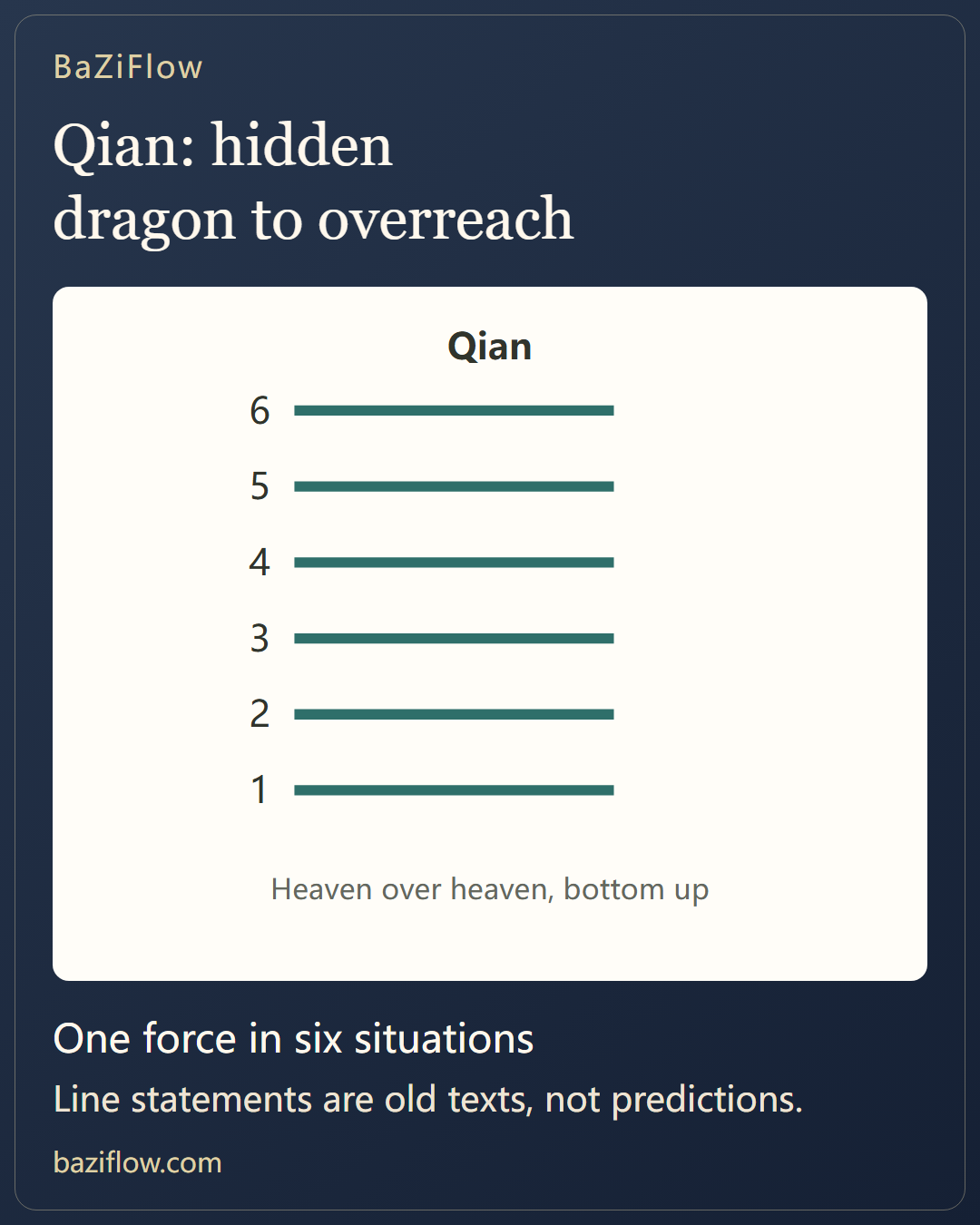
Qian is the first of the 64 hexagrams: six yang lines, with Qian (heaven) as both trigrams. Read its text in layers: the judgment, the Image, and six line statements that move a dragon from the depths to the heights.
The short version5 min read
Qian has one kind of line, six unbroken yang lines. Its text uses the position of a dragon to follow one force from hiding to appearing, vigilance, testing, height and excess.
- Qian stacks Qian (heaven) on Qian (heaven), so all six lines are yang. The Shuo Gua says "Qian is strength", and the Image ends on strengthening oneself without rest.
- The judgment is four words. The Wenyan explains each as a virtue: yuan the chief of what is good, heng the gathering of fine things, li the harmony of what is right, zhen the trunk of undertakings.
- The six line statements run through six positions (the third line's subject is the noble person): hidden, seen, wary, testing, flying, overreaching. Each gets a short Small Image comment; "using nine" speaks of dragons without a head: good fortune.
Read first
The Sixty-Four Hexagrams: How Upper and Lower Trigrams Form One Figure ↗
Judgment and Line Statements: Whole Hexagram or Single Line? ↗
Six yang lines, heaven over heaven
Qian (乾) is the first hexagram of the Zhouyi: six unbroken yang lines, counted from the bottom as first, second, third, fourth, fifth and top. It is built from two trigrams, and both are Qian, which is why it is read as Qian above Qian. The Shuogua gives the trigram one word, "strength", and its image is heaven.
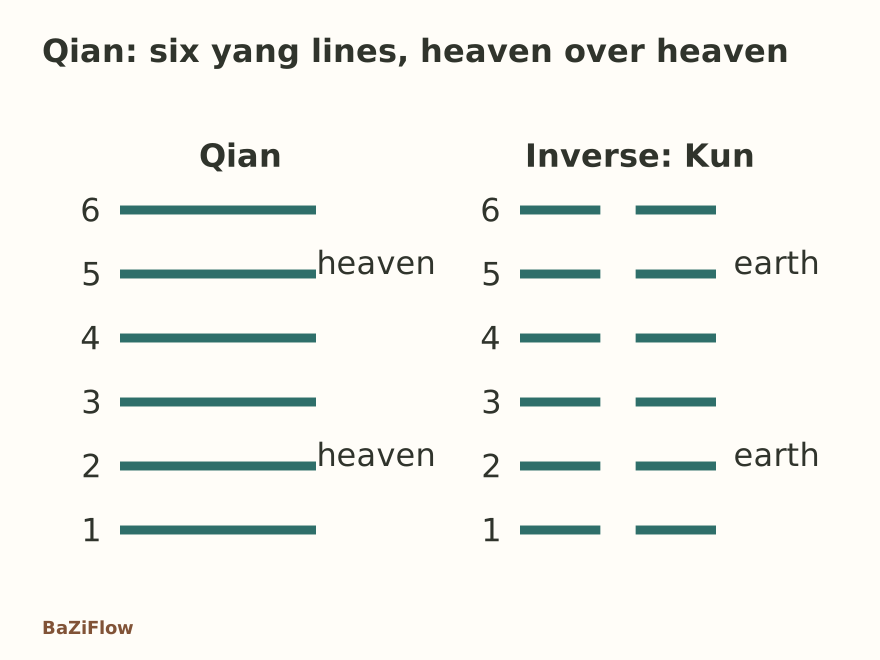
Qian and its inverse Kun: the inverse changes every line to the opposite polarity.
Enlarge diagram · scroll sideways to read
Three terms before reading
- Figure
- The pattern the six lines make from the bottom up. Qian is six unbroken lines, with none of them broken.
- Upper and lower trigram
- The six lines split into two groups of three, each a trigram. In Qian the two groups are the same: Qian.
- Line position
- Lines are counted from the bottom: first, second, third, fourth, fifth, top. A yang line is called "nine" and a yin line "six", so Qian's lines are first nine, nine in the second place, and so on up to top nine.
A four-word judgment: yuan, heng, li, zhen
The judgment of Qian is four words, yuan heng li zhen. Literally, yuan is the beginning or the greatest, heng is passing through freely, li is what suits, and zhen is staying with what is right.
Great is the primal power of Qian: the ten thousand things take their start from it, and it governs heaven. Clouds move and rain falls; the many kinds of things take their forms.
The Commentary on the Judgments first singles out yuan for praise: everything takes its start from it. There are two ways to divide the four words: as two phrases, "yuan heng" and "li zhen", or as four separate virtues. The Wenyan takes the second and explains the words one by one; that is the "four virtues of Qian" that later writers keep mentioning. Both readings are in use, so say which one you follow when you speak of Qian's judgment.
Enlarge diagram · scroll sideways to read
The Image: heaven moves with strength
The Image for Qian says: heaven moves with strength; the noble person strengthens the self without rest. The Great Images follow a fixed pattern: first the natural image from the two trigrams together, then what a noble person (in some hexagrams the ancient kings, a ruler or a great person) takes from it as a way of acting. Qian over Qian is heaven, whose movement does not stop, so the noble person strengthens the self and does not rest.
Enlarge diagram · scroll sideways to read
The same pattern gives Kun its Image: the earth's condition is receptive; the noble person carries things with ample virtue. Read the two side by side: Qian takes the movement of heaven, Kun the lay of the earth, and one ends on strengthening the self without rest while the other ends on carrying things with ample virtue.
Six lines: from the hidden dragon to the overreaching one
In the six line statements the subject is nearly always a dragon, and the dragon's position moves up one step at a time. After each statement the Small Image (小象) gives a short comment.
Enlarge diagram · scroll sideways to read
The first line sits at the bottom and the dragon hides: "do not act". The second line has it appear in the fields: "fitting to meet a great person". The third line changes the subject to a "noble person", who works all day and stays wary at night: "danger, but no blame". The fourth line says "perhaps leaping, perhaps in the depths". The fifth line, "a flying dragon in the sky", is the fullest position. The top line, "an overreaching dragon will regret", gets this comment: "fullness cannot last".
Qian and Kun: the inverse, the sequence and how to read
Change every line of Qian to the opposite polarity and you get Kun; this pairing is called the inverse hexagram (错卦). Turn Qian upside down and it is still Qian, so its reversed hexagram (综卦) is itself, and its nuclear hexagram (互卦) is also Qian. The Xu Gua begins with "only when there were heaven and earth did the ten thousand things come to be", and the traditional commentators match heaven and earth to Qian and Kun, which is why they stand at the head of the sixty-four.
Enlarge diagram · scroll sideways to read
Questions readers ask next
Does Qian always mean a smooth career?
No. Its lines contain "do not act", "danger" and "regret". From start to finish the hexagram describes one force at different positions, and the text warns against moving too early and against going too far.
How should the words "yuan heng li zhen" be divided?
There are two common readings: two phrases, "yuan heng" and "li zhen", or four words that each name a virtue. The Wenyan follows the second, so tradition explains the words one by one. When you quote the judgment, say which reading you use.
Why does not every Qian line mention a dragon?
Line 3 names its subject, "the noble person works at it all day", and line 4, "perhaps leaping, perhaps in the depths", states none. Sitting between the dragon lines, both read like the actions of a person. That shift is worth noticing when you read the lines.
Was this article helpful?
Sources & references
Continue reading
Kun (坤): six yin lines, read from stepping on frost to dragons fighting in the wilds ↗
The Sixty-Four Hexagrams: How Upper and Lower Trigrams Form One Figure ↗
Judgment and Line Statements: Whole Hexagram or Single Line? ↗