

Reading the BaZi classics
Content version · · Sources & references
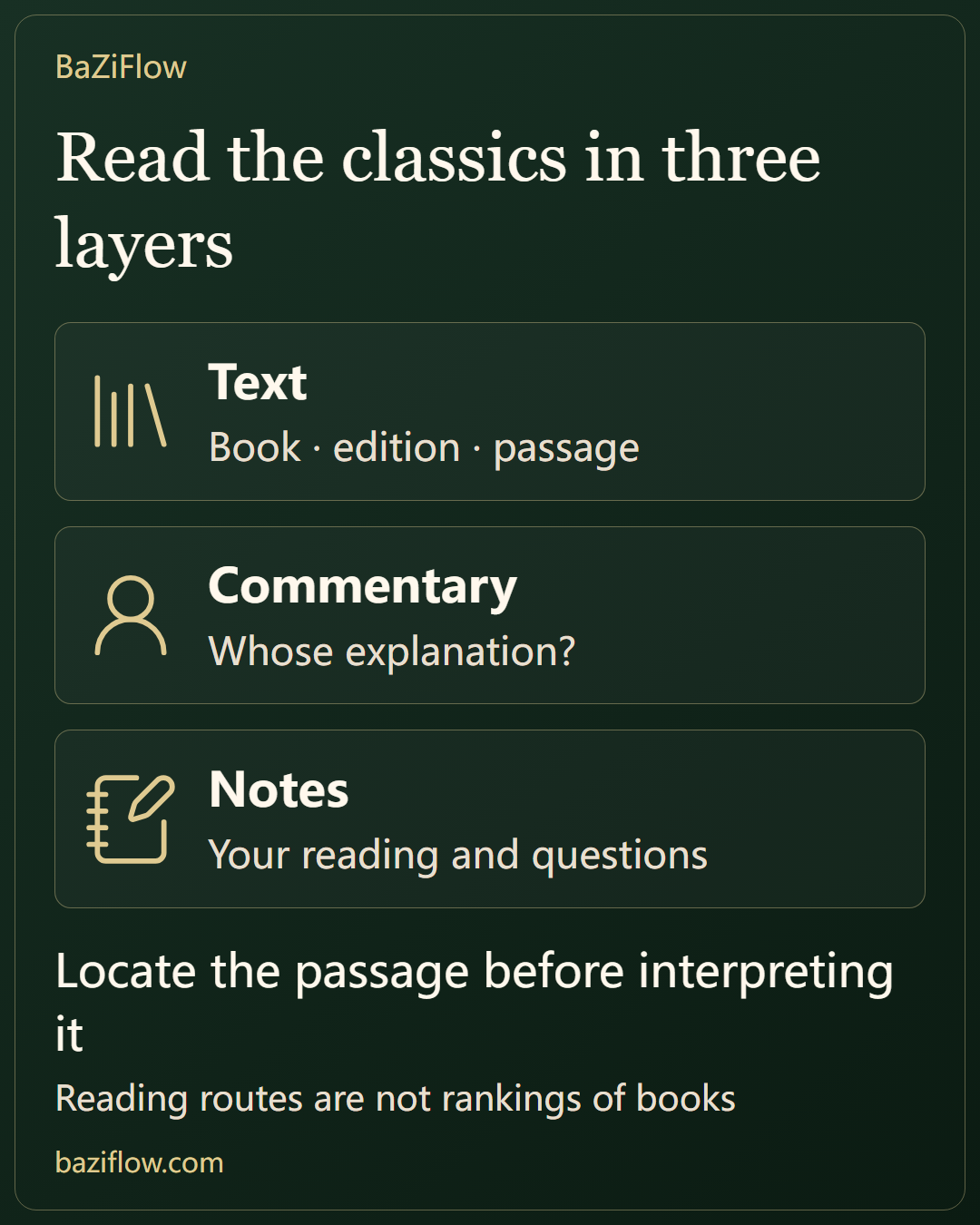
Use Sanming Tonghui, Ziping Zhenquan and Ditian Sui to practice different reading tasks. Track editions, commentary and local definitions instead of merging every familiar term.
The short version5 min read
Test the word yong against its passage. Record the chapter and reference point, then distinguish the base text, a commentator and your own explanation. A glossary entry becomes useful when it preserves the question the passage was answering.
- The three works offer selected entrances for rules, pattern conditions and body/function; these are not exclusive descriptions of their contents.
- A base text, corrections and modern comments can appear together, but their claims retain different owners.
- The same word may address different questions; compare its reference points before assigning one universal definition.
Read first
Reading a BaZi chart for the first time: the four pillars and the Day Master ↗
Test a glossary entry against the passage
Suppose your reading notes translate every occurrence of yong as “the favorable element.” The shortcut seems efficient until a passage assigns body and function in several different ways. At that point, the useful task is to revise the glossary, rather than force the passage to fit it.
The body-and-function section of Ditian Sui provides just such a test. Its explanation considers more than one reference point and distinguishes the function in that pairing from the use in “useful god.” This does not supply a universal replacement definition. It shows why a term needs its sentence, reference point and surrounding conditions.
Write a provisional definition with a location attached: “in this section, this term refers to…” A second book may ask a different question. The discussion of useful and favorable factors can help identify the distinction, but a modern glossary cannot replace the passage you are trying to understand.
Body and function
- Identify the reference
Useful factor
- Read the local definition
Keep text, commentary and notes distinct
- Edition
- The particular base text, transcription or annotated version consulted.
- Textual layer
- The owner of a base passage, quotation, correction, comment or personal interpretation.
Work backwards from a conclusion
Now try a different reading exercise in Ziping Zhenquan. Instead of copying a verdict about status or success, follow the argument backwards. Which condition made that verdict possible? Did the passage depend on the month context, a visible stem, its position or another supporting factor?
Its chapters on formation, failure, rescue, climatic conditions and luck periods offer places to practise this. The purpose is to recover the author's internal argument, not to establish that its predictions work. A list of conclusions without their conditions is poor evidence even for what the book itself teaches.
Keep your own inference separate. If you add a missing step because it sounds plausible, mark it as your interpretation. That makes a later comparison with another passage possible without accidentally attributing your reconstruction to the text.
Check which voice supplied the words
An electronic edition can put a base text, corrections and modern comments on one screen. In the Dongli edition, the editorial policy explains how corrections and the editor's comments are marked. The book introduction discusses differing chapter counts and editions. Neither an editor's objection nor a modern account of transmission becomes an original sentence merely by appearing beside it.
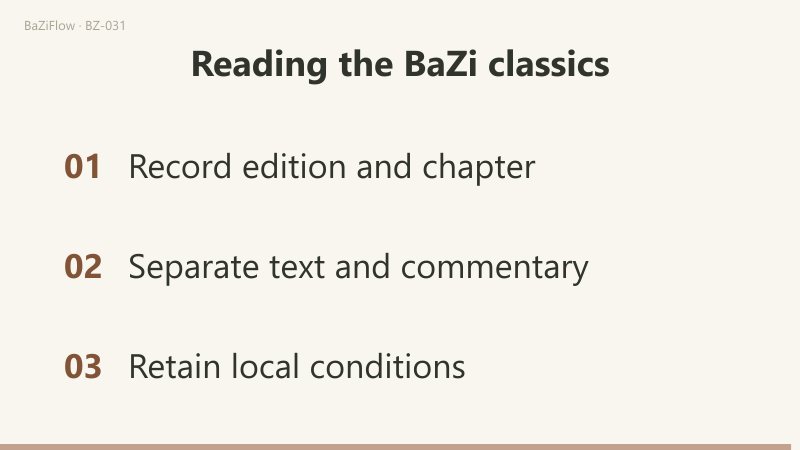
For a quotation, record book, edition, chapter and textual layer. For a paraphrase, retain the same information: removing quotation marks does not remove the need to identify whose claim you are summarizing. Traditional title-page attributions also do not settle disputed authorship or dating by themselves.
Base text
The recorded claim
Editorial layer
Corrections and comments
Reader
Your reconstruction
Keep collected voices distinct
This matters in Sanming Tonghui as well. Volume two collects rules and discussions of solar terms, month and hour derivation, timing and branch relationships. A reference to another book or another saying can mark a change of voice. When accounts differ, retain their individual contexts before proposing a synthesis; an average of two rules may belong to neither source.
Source one
- Its conditions and voice
Source two
- Its different context
Choose the next lookup after identifying the gap
These three books are not a ranked reading list. The map offers selected entrances, not exclusive descriptions of everything each work contains.
| Gap in your notes | Passage to investigate | Evidence to bring back |
|---|---|---|
| A rule has no stated conditions | Sanming Tonghui, volume two | The surrounding rule and cited voice |
| A verdict has no traceable argument | Relevant Ziping Zhenquan chapter | The conditions that connect to it |
| A familiar word changes meaning | Ditian Sui, body-and-function section | Its reference point and explanation |
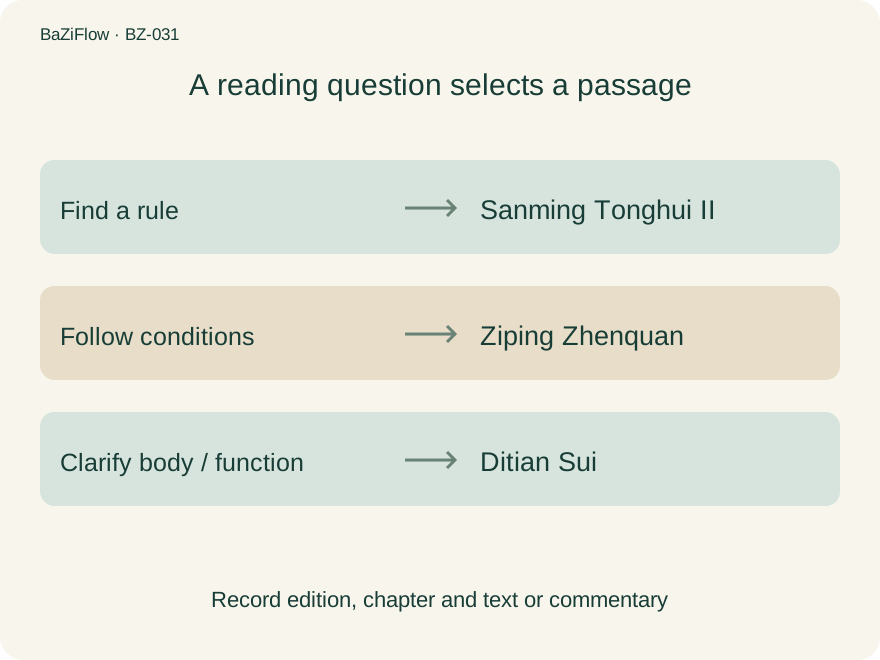
Original BaZiFlow reading map based on the selected passages. These are entry points, not exclusive descriptions or rankings of the books.
A contents page helps locate material but cannot prove that you have read the entire work. The ordinary Wikisource contents page used here explicitly lacks volumes ten through twelve of Sanming Tonghui. State that limitation when describing your reading; access to some chapters is not evidence of complete coverage.
Rules
- Selected entry
- Sanming Tonghui II
- Evidence to retain
- Rule and cited voice
Conditions
- Selected entry
- Ziping Zhenquan
- Evidence to retain
- Argument and changes
Body/function
- Selected entry
- Ditian Sui
- Evidence to retain
- Reference and explanation
For a concrete note, the listed body-and-function explanation begins one route by taking the Day Master as body, then discusses factors in the month context as function. Record the reference first: Day Master; record the relation next: how the month context is used with it. Later routes take other references, including the month context and the four pillars. This is why one fixed element is not an adequate translation for every occurrence of function. The exercise describes the explanation in this edition, not a verified attribution or a judgment about a personal chart.
Leave room for disagreement in the notes
A comparison card should be able to end with an unresolved difference. Use separate spaces for the passage, your explanation and the unanswered question. If two texts use a similar term for different tasks, preserving that difference is more informative than making the glossary appear tidy.
Historical judgments about gender, rank, illness, lifespan or family also require this separation. Understanding their role in a traditional argument does not make them reliable assessments of a present-day person. Do not turn a shared chart symbol into permission to repeat a severe old judgment.
When your next question concerns a reported life event, move to the case-study reading method. There the source problem extends beyond wording: the recorded chart, the interpretation and the reported outcome each need their own evidence. A good reading note makes clear which of those you have actually checked.
Location
- What belongs here
- Edition and passage
Explanation
- What belongs here
- Local meaning and conditions
Question
- What belongs here
- Unresolved difference
Locate one occurrence
Record the book, edition and passage containing yong rather than only copying a glossary label.
Recover its question
State the reference point and surrounding conditions; label your paraphrase as an explanation.
Compare another passage
Retain both agreements and unresolved differences without attributing the new synthesis to either original.
Questions readers ask next
Must these books be read in one fixed order?
No. The guide selects entrances by question rather than ranking the books or prescribing an exclusive sequence.
Does every paragraph on an electronic page belong to the original author?
No. Base text, older commentary and modern editorial notes may share a page. Check its stated edition and conventions.
Can useful god always have one definition across books?
First identify the passage’s task, reference point and conditions. Shared spelling alone does not establish shared meaning.
Was this article helpful?