

Ge: from ox hide to tiger and leopard
Content version · · Sources & references
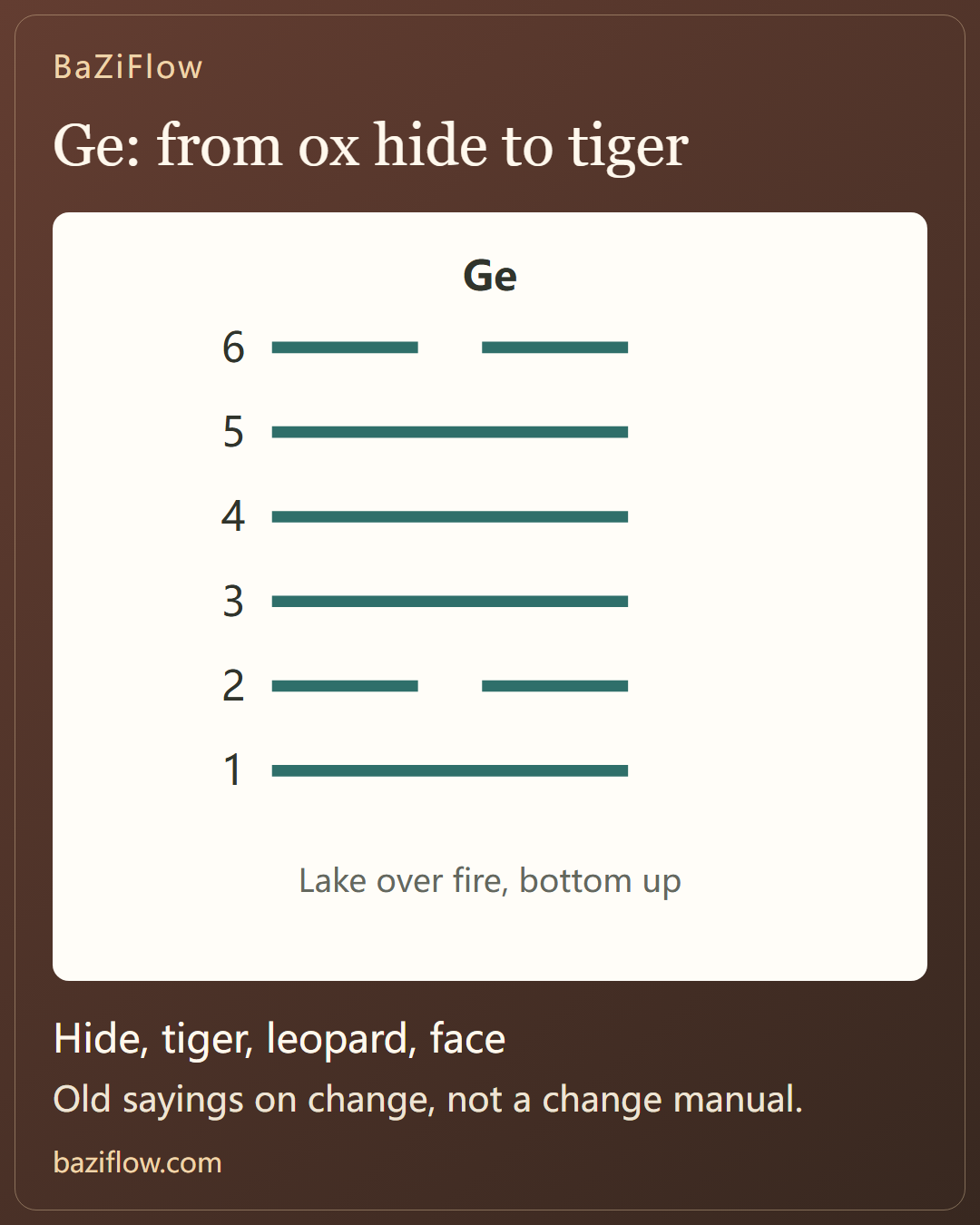
Ge is the 49th hexagram: Dui (lake) above Li (fire). Read the name explained by two daughters whose wills differ, “the day has come, then trust”, the Image’s calendar, and change from ox hide to tiger stripes.
The short version7 min read
Ge is the hexagram of change, yet it writes waiting first: the judgment says “the day has come, then trust”, and line 1 binds things fast with ox hide and says it is no time to act. How deep the change goes comes out only layer by layer.
- Ge puts Dui (lake) over Li (fire). The Commentary explains the name not by “change” but by “water and fire, two daughters living together, their wills not agreeing”; in the Shuo Gua Li is the middle daughter and Dui the youngest.
- The judgment and line 2 both say “the day has come”, and the judgment and lines 3, 4 and 5 all speak of trust. The Image ends on ordering the calendar and making the seasons clear: change relies on the time, and on being believed.
- In the lines the change grows more concrete: ox hide, “the day has come”, “completed three times”, changing the mandate, the tiger, the leopard, the face. The Small Images call the tiger’s patterns “brilliant” and the leopard’s “luxuriant”.
Read first
The Sixty-Four Hexagrams: How Upper and Lower Trigrams Form One Figure ↗
Judgment and Line Statements: Whole Hexagram or Single Line? ↗
Fire inside the lake: Dui above, Li below
Ge (革) is Dui (lake) above and Li (fire) below. A lake is water, and fire in the water cannot stay with it; the Commentary uses exactly this to explain the name. In the Shuo Gua Li is fire and also the “middle daughter”, while Dui is the lake and the “youngest daughter”. A middle daughter and a youngest one share one hexagram, which is where the Commentary’s “two daughters living together” comes from. Counting from the bottom the lines are yang, yin, yang, yang, yang, yin.
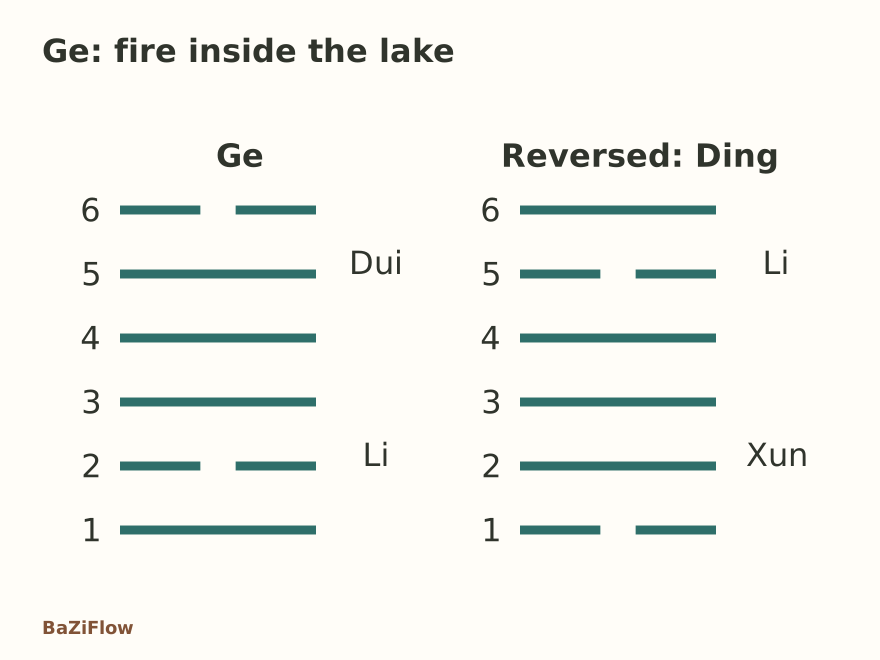
Ge and its reversed hexagram Ding: turn Ge upside down and its upper Dui (lake), inverted, becomes Xun at the bottom, while its lower Li (fire), unchanged when inverted, rises to the top.
Enlarge diagram · scroll sideways to read
Three words before reading
- Ge
- Its first meaning is an animal hide with the hair removed. Line 1 uses exactly that meaning; the Commentary uses the word for change: heaven and earth change and the four seasons are completed.
- The day has come
- The judgment and line 2 both begin “when the day has come, then…”. Tradition usually reads it as the time when the days are full and the moment has arrived.
- Trust
- Sincerity, being believed. The judgment and lines 3, 4 and 5 all speak of it.
The judgment and the Commentary: first a quarrel, then trust, then the large scale
The judgment has four short clauses: when the day has come, then trust; primal success; fitting to stay on course; regret vanishes. The Commentary on the Judgments unfolds them layer by layer.
Ge: water and fire cause each other to cease; two daughters live together, and their wills do not agree: that is called Ge. “When the day has come, then trust” means change, and be believed. Bright in civility and glad, greatly successful through uprightness: change that is fitting, and then regret vanishes. Heaven and earth change and the four seasons are completed. Tang and Wu changed the mandate, following heaven and answering to people. The meaning of the time of change is great indeed!
Enlarge diagram · scroll sideways to read
The Commentary does not explain “change” by “change”; it starts from a state of not getting along: “water and fire cause each other to cease”, a word that tradition reads both as putting out and as breeding; “two daughters live together, and their wills do not agree”: two girls in one house whose wills do not meet. The name comes out of disagreement.
Only then does it return to the judgment: “when the day has come, then trust”, and the Commentary adds “change, and be believed”: change has to be made so that people trust it. “Bright in civility and glad” can be checked against the figure, since the Shuo Gua says that Li is brightness and Dui is gladness. “Change that is fitting, and then regret vanishes”: regret goes only once the change fits.
The last stretch is the widest: heaven and earth change and the four seasons are completed; Tang and Wu changed the mandate, following heaven and answering to people. The Commentary runs from the small to the large: from disagreement, to trust, to heaven and earth and the change of dynasty.
The Great Image: fire in the lake, ordering the calendar
The Great Image (大象) of Ge reads: in the lake there is fire, Ge; the noble person orders the calendar and makes the seasons clear.
Enlarge diagram · scroll sideways to read
To order the calendar is to put it in order, and to make the seasons clear is to give the time of year its definite marks; the first verb is traditionally read as to set right, to revise. The Image does not choose the violence of upheaval; it chooses the calendar, the regular change of the four seasons each year. Looking back over the hexagram, the words about time come in three layers: “the day” in the judgment and line 2 is one day, “the four seasons” in the Commentary are the seasons, and the “calendar” in the Image is the whole scheme of time. Put side by side, they tie change to timing.
Six lines: from ox hide to the tiger and the leopard
In the six statements the thing that changes becomes more concrete at every step.
Enlarge diagram · scroll sideways to read
Line 1: “bind it fast with the hide of a yellow ox”. The yellow ox’s hide is used to tie things down firmly. It is the only place in the hexagram where the character for Ge (革) means hide. The Small Image: no time to act.
Line 2: “when the day has come, then change it; going is fortunate; no blame”. Only when the day comes is it changed. The Small Image: going has merit.
Line 3: “going brings misfortune; steadfastness is in danger. The word of change has been completed three times, and there is trust.” Tradition usually reads the middle phrase as the word of change being settled in three rounds, and after that there is trust. The Small Image: where else is there to go?
Line 4: “regret vanishes. With trust, to change the mandate is fortunate.” The Small Image: the will is trusted.
Line 5: “the great person changes like a tiger: even before divining, there is trust.” The Small Image: his patterns are brilliant.
Line 6: “the noble person changes like a leopard; the small person changes only his face. Going brings misfortune; staying steadfast brings good fortune.” The Small Image: the patterns are luxuriant; and the small person follows the ruler, yielding.
Taken together, the changes land at different levels. Line 1 is the hide, the material for binding. Line 5 is the tiger and line 6 the leopard, a change of the whole coat of patterns; by “the small person changes only his face”, only a face changes. Trust has a rhythm too: lines 3, 4 and 5, three yang lines in a row, each mention it once.
Ding, Meng and Gou: the neighbors and the Xu Gua
The reversed hexagram (综卦) of Ge is Ding (鼎): turn Ge upside down and Dui, inverted, becomes Xun at the bottom, while Li, unchanged when inverted, rises to the top. The inverse hexagram (错卦) is Meng (蒙), which flips every line of Ge. The nuclear hexagram (互卦) is Gou (姤): inside the middle four lines of Ge are Xun and Qian, and Xun below Qian is exactly Gou.
Enlarge diagram · scroll sideways to read
In the Xu Gua, Ge follows Jing because a well’s way must at some point be renewed. After Ge comes Ding, which the Xu Gua names as the vessel best suited to changing things. Ge’s nuclear hexagram is Gou, which the Xu Gua glosses as meeting; linking it to the Commentary’s “two daughters living together” is only an association, and the text does not make it.
Questions readers ask next
Does Ge encourage overthrowing a dynasty?
The Commentary does mention Tang and Wu changing the mandate, but the judgment and the early lines first set out conditions. The judgment first requires that the day has come and then trust, line 1 binds things fast and its Small Image says “no time to act”, and line 3 still says “going brings misfortune”. The text sets several conditions on change.
How should “the day has come, then trust” be read?
Literally trust comes only once the day has come. Tradition usually takes the first phrase as the day when the time is full; both the judgment and line 2 use it. The Commentary’s explanation is “change, and be believed”: change must be made so that it is trusted.
What does “the word of change completed three times” mean?
Tradition usually reads it as the word of change being settled in three rounds. Opinions on the phrase differ; the statement goes on to say “there is trust”. The Small Image comments: where else is there to go?
Was this article helpful?
Sources & references
Continue reading
Jing: water above the wood, from “mud in the well” to “do not cover the well” ↗
Ding: fire over wood, read from the upturned feet to the jade carrying bar ↗
The Sixty-Four Hexagrams: How Upper and Lower Trigrams Form One Figure ↗
Judgment and Line Statements: Whole Hexagram or Single Line? ↗