

The Siblings palace: the entry for siblings and peers
Content version · · Sources & references
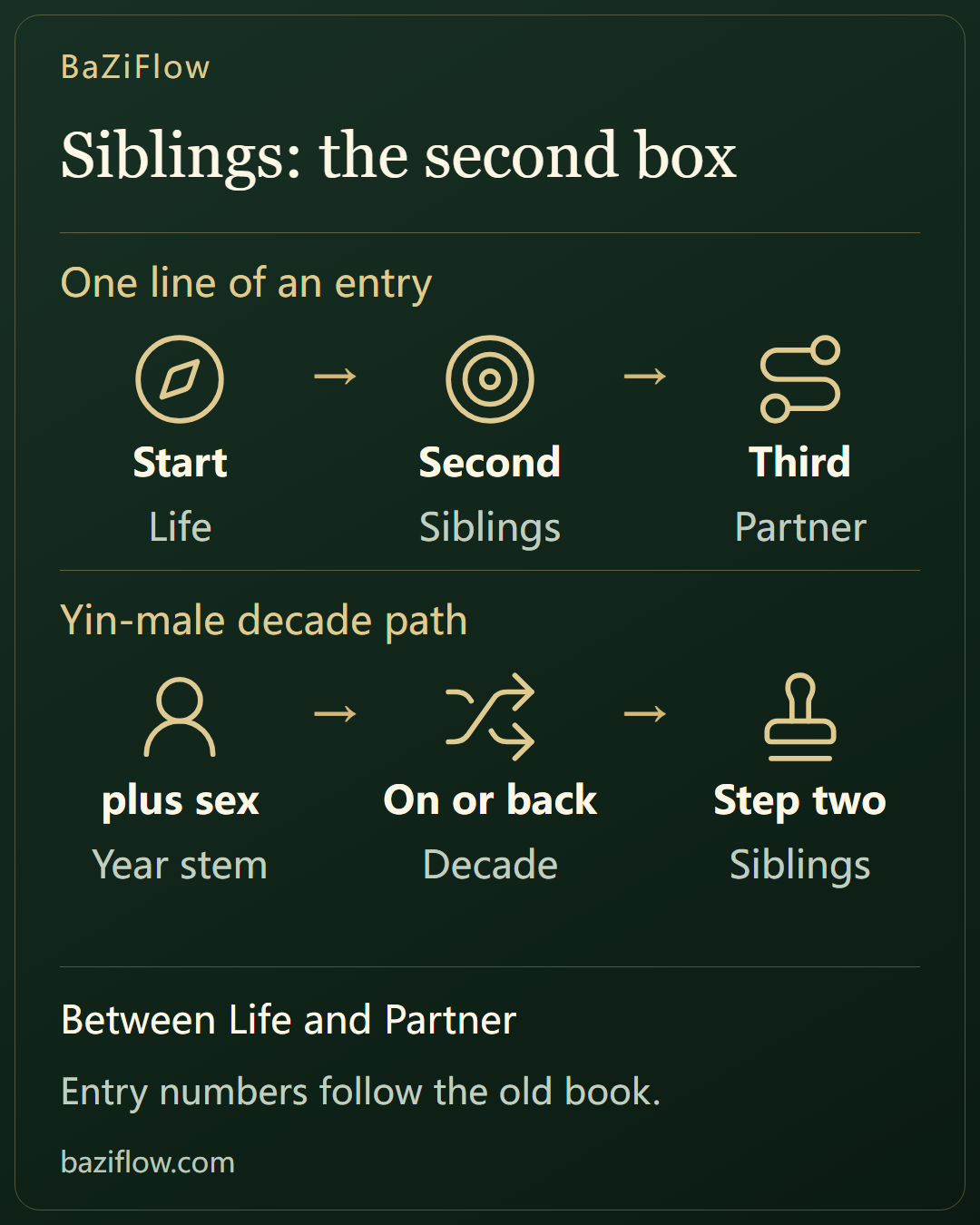
The Siblings palace follows Life in the order. A ring diagram shows its neighbors, one line of the juan 2 entry is taken apart, and the second decade of yin-male and yang-female charts is traced into this box.
The short version7 min read
The Siblings palace is the second box in the order, right after Life, and covers siblings and peers; its neighbors are Life and Partner, and the second ten-year limit of a yin-male or yang-female chart enters it.
- Siblings is flanked by Life and Partner, faces Friends across the ring, and shares a trine with Health and Property.
- One line of the juan 2 Siblings entry is built from three parts: a star with its brightness, another star in the same palace, and whether harsh stars are added; each part rewrites the headcount or the relationship.
- A yin-male or yang-female decade path goes from Life to Siblings, a yang-male or yin-female path goes to Parents; every palace entry ends with a Dou Jun line.
Read first
The second box, right after Life
Count one box on from Life and you reach the Siblings palace, which covers siblings and peer relationships.
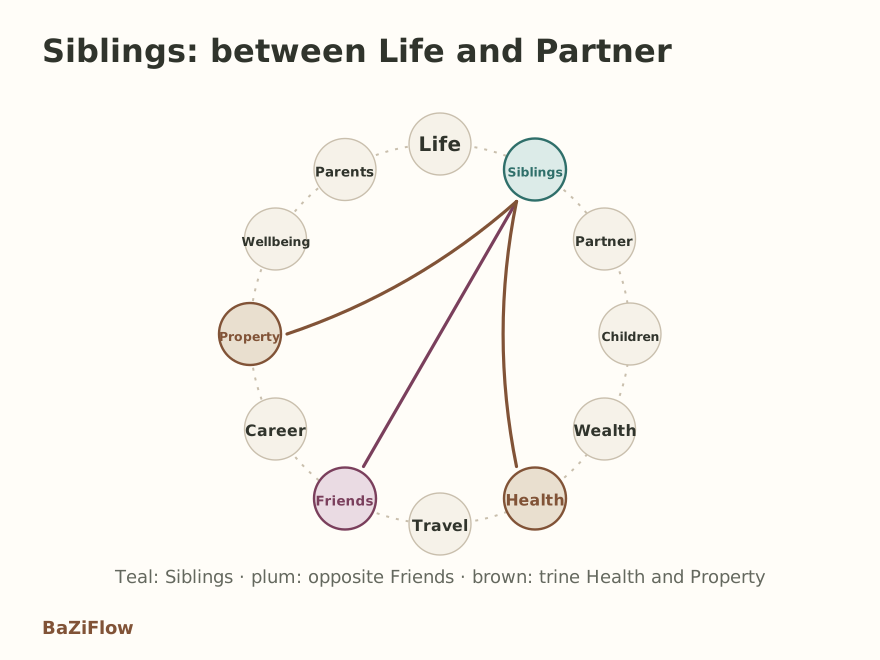
Sketch: the highlighted Siblings palace faces Friends across the center and forms a triangle with Health and Property; the ring is drawn clockwise for readability, while real palace names run backward along the branches.
In the picture Siblings sits to the right of Life. On an actual chart it falls on the branch just before Life's branch: with Life on the Pig, Siblings is on the Dog. Its position takes one sentence: Life and Partner are its two neighbors, Friends is straight across, and the other two boxes of the trine are Health and Property. For which palaces count as "flanking" and which as "opposite", see opposite, flanking and converging palaces.
One line of a juan 2 entry, taken apart
Each of the twelve palaces has its own entry in the Zi Wei Dou Shu Quan Shu (紫微斗数全书), set down in juan 2, and an entry goes through the stars one by one. In the Siblings entry the line for Tian Ji is a good specimen. In our translation it runs: "Tian Ji, bright: two siblings; with Ju Men: two; dim: at odds, not of one heart; with Tian Liang: two; with Tai Yin: two or three; meeting Qing Yang, Tuo Luo, Huo Xing or Ling Xing: some exist but harm one another."
Broken into pieces, each piece reports something different:
Enlarge diagram · scroll sideways to read
The whole line uses only three kinds of part: a star with its brightness, another star in the same palace, and whether harsh stars are present. Each time one appears, the headcount or the relationship is rewritten. Entries for other palaces use the same parts and swap "how many" for their own questions: the Partner entry asks about early or late and harmony, and the Wealth entry about whether resources gather.
The numbers belong to the old book's judgments. Quote them with the source, the juan 2 Siblings entry, and go back to the chart to check that the star really sits in that spot and what its brightness is. Learn to split an entry into pieces before discussing any conclusion.
The second decade of a yin-male or yang-female chart enters Siblings
The name Siblings also turns up among the decade limits. Juan 2 gives the rule in two sentences, "An Da Xian Jue" (安大限诀):
Yang male, yin female: start from the palace before Life and go forward; that is the Parents palace. Yin male, yang female: start from the palace after Life and go backward; that is the Siblings palace.
"The palace before Life" is the box that comes before Life in the palace order, which is Parents; "the palace after Life" is the box that comes after it, which is Siblings. A yang male or yin female means a man whose birth-year stem is one of the five yang stems, or a woman whose stem is one of the five yin stems; a yin male or yang female is the reverse. The site engine moves its decades the same way as these two sentences.
Enlarge diagram · scroll sideways to read
Take a worked chart: 17 May 1990, hour of the Dragon (a Geng Wu year, Life on the Ox, Fire-six bureau). The first decade starts at age 6 and each step lasts ten years (counted in the traditional way). Two people born at the same moment have the same Life palace, yet their next decade goes to different boxes: for the man (yang male) ages 16–25 sit in Parents, and for the woman (yang female) ages 16–25 sit in Siblings, followed by Partner at 26–35 and Children at 36–45.
Here the palace name is only borrowed to label that ten-year period. Which branch the decade Siblings palace sits on is worked out from the decade Life position, and the natal Siblings palace stays where it was. For how the layers stack, see natal, decade and annual layers.
Two doors for peers: Siblings and Friends
Siblings and Friends face each other on the ring, six places apart in the order. For questions about peers they are two side-by-side entrances, one inside the family and one outside it.
Enlarge diagram · scroll sideways to read
The book's word for the Friends palace, "servants", carries the master-and-servant relationship of its time, and today the palace is read as friends, collaborators and groups. Each palace keeps its own subject, and being opposite says something about position and nothing about which one decides the other. The scope of each of the twelve can be checked against the map of the twelve palace topics.
The closing line shared by all twelve entries: Dou Jun
Every one of the twelve palace entries ends with a line about "Dou Jun" (斗君). Juan 2 defines it at the end of the Life entry: Dou Jun governs the first day of the first month, favorable stars give a favorable reading and harsh ones a harsh reading, and one reads it by month. The Siblings entry closes with this:
When Dou Jun passes through the Siblings palace, with favorable stars the siblings get along for that year.
You can see that the last line of each entry has moved from "what this box is in the natal chart" to "a time marker arriving at this box", which is the time layer. The headcounts and relationships before it are the natal way of writing, and the last line hooks the entry up to the annual and monthly layers through Dou Jun.
Enlarge diagram · scroll sideways to read
Two small sums
A woman born on 17 May 1990 in the hour of the Dragon (Geng Wu year, Life on the Ox, Fire-six bureau): which palace holds her decade of ages 16–25?
The year stem is Yang Metal, so she is a yang female and so the path runs backward: after Life comes Siblings. Ages 16–25 sit in Siblings.
A man born at the same moment: which palace holds his ages 16–25?
A yang male runs forward, and the box before Life in the order is Parents. They share a Life palace, yet the second decade is not in the same box.
The next box is the Partner palace; to go back to the starting point and see how the twelve are counted from the Life palace.
Questions readers ask next
Does the Siblings palace only cover brothers and sisters?
The name means siblings, and modern guides usually widen it to peer relationships. How far to widen it is a choice of school, so name the method you use. Friends and collaborators have their own palace, Friends.
The book gives headcounts. Does this site calculate them too?
Those numbers are how the Zi Wei Dou Shu Quan Shu writes its entries, while the site engine produces star positions and brightness. When quoting a headcount, cite the juan 2 Siblings entry and check that the star is really in that spot in the chart.
Is the decade Siblings palace the same box as the natal Siblings palace?
No. A decade relabels the palace names starting from where that ten-year period begins, so the branch of the decade Siblings palace is worked out from the decade Life position. The natal Siblings palace stays on its own branch.
Was this article helpful?
Sources & references
Continue reading
The Life Palace (命宫): Where the Twelve Palaces Start Counting ↗
The Partner Palace (夫妻宫): Three Names, One Box, and the Years Tian Ma Lands in It ↗