

Three Wonders: three stem sets, in order
Content version · · Sources & references
The Three Wonders (三奇) ask whether the four stems form Yin Wood, Yang Fire, Yin Fire or two other sets in pillar order. Sanming Tonghui sources, why the first set lines up, four charts from real dates, the doubters.
The short version9 min read
The Three Wonders read the four stems and ignore the branches: whether three stems form a set in year, month, day, hour order. The old books do not agree on one set, and give three.
- The first set, Yin Wood, Yang Fire and Yin Fire, is the standard one, the "Heavenly Three Wonders". The second set has two names and the third is called baseless; three sets with three sources, not one list.
- The reason the first set lines up is that its Nobleman "virtue spots" fall on Ox-Tiger-Rabbit in the yang run and Goat-Horse-Snake in the yin run. A check against the rule confirms it, but the same adjacency also holds for two other triples.
- The book asks for the pillar order, and for the right time and place; another line says that wonders found only in the month, day and hour pillars, without the year, are "lonely". One book holds several standards.
Read first
Symbolic Stars in BaZi: Check the Reference and Rule Before the Meaning ↗
Three stem sets, three accounts
The Three Wonders (三奇) ignore the branches and look only at whether, among the four stems of year, month, day and hour, three stems of one set stand in order. The Sanming Tonghui (三命通会) has a chapter on them in its third fascicle, and it begins by explaining the word "wonder", quoting Luo Lu Zi:
A wonder is a noble thing; "wonder" means strange, as a thing is strange when it is noble.
The site's chart pages do not mark the Three Wonders, so what follows is gathered from the old books.
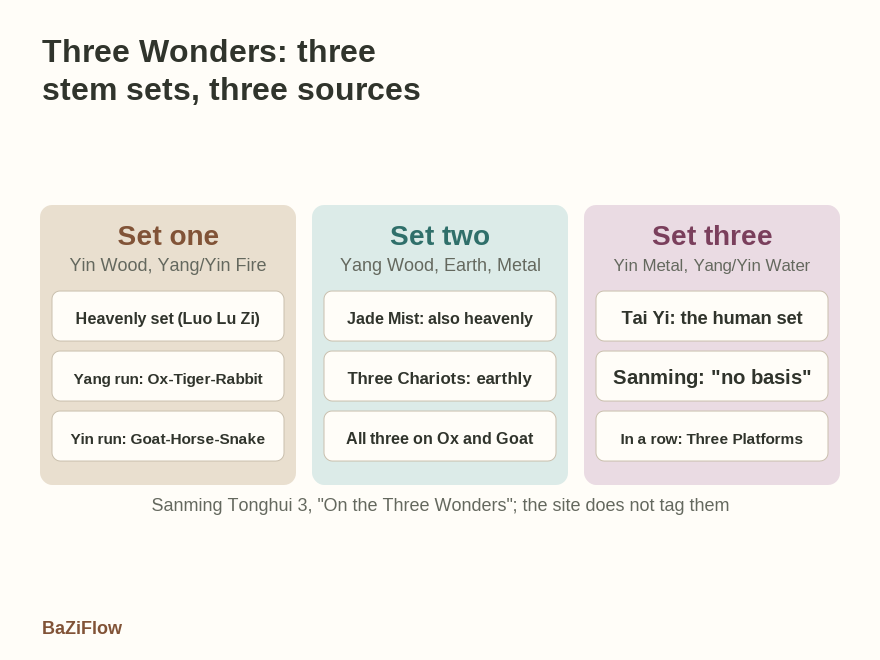
Comparison sketch: three columns for the three stem sets and their sources. Yin Wood, Yang Fire and Yin Fire are the Heavenly Three Wonders of Sanming Tonghui juan 3; the second set has two other names; the third is called baseless.
Three sets of stems appear. Yin Wood, Yang Fire and Yin Fire lead and are the "Heavenly Three Wonders", and the Jade Mist Treasure Mirror (玉霄宝鉴) gives them names: the sun rises through Wood, so Yin Wood is the Sun Wonder; the moon lights the night and the world turns bright at the Yang Fire place, so Yang Fire is the Moon Wonder; the Old Man star shows itself at the Yin Fire place, so Yin Fire is the Star Wonder.
Yang Wood, Yang Earth and Yang Metal have two accounts: the Jade Mist book also calls them heavenly, since all three have their Nobleman on Ox and Goat, while the Three Chariots (三车一览) takes Yang Wood as the head of yang Wood, Yang Earth as the ruler of yang Earth and Yang Metal as the essence of yang Metal, and calls them the "Earthly Three Wonders", a reading the chapter judges "forced". Yin Metal, Yang Water and Yin Water are the "Human Three Wonders" of the Tai Yi Classic, and the chapter's verdict is "the claim has no basis", granting only that a run of the three, called the Three Platforms, is also rare.
The chapter also mentions a "four wonders" theory from a Purple Void source and dismisses it on the spot: a wonder is an odd number, and four makes an even one.
Why Yin Wood, Yang Fire and Yin Fire line up
For the first set the book argues from the way the Heavenly Nobleman is laid out. In the yang run, starting at Rat and going forward, the virtue of Yang Wood is on Rat, Yin Wood on Ox, Yang Fire on Tiger and Yin Fire on Rabbit; in the yin run, starting at Monkey and going backward, Yang Wood is on Monkey, then Yin Wood on Goat, Yang Fire on Horse and Yin Fire on Snake.
Enlarge diagram · scroll sideways to read
Checked against the rule, the virtue spots of the three stems do form three adjacent places in each run. The same adjacency is not special to this set: Yang Wood, Yin Wood and Yang Fire sit on Rat, Ox and Tiger (Monkey, Goat and Horse in the yin run), and Yin Earth, Yang Metal and Yin Metal on Goat, Monkey and Rooster (Ox, Rat and Pig in the yin run), also three adjacent places. Luo Lu Zi's reason is that this is the only set of the ten stems of its kind, the rest being cut apart by the Sky Net or the Empty Sky, or unable to recur; yet by the rule those two triples are adjacent too, so the book's reason does not match its own rule, and the site has not fixed it.
The reason for the second set is quite different: their Heavenly Nobleman spots coincide, and all three stems are on Ox and Goat. The site engine's Heavenly Nobleman table agrees, giving Ox and Goat for each of the three, as the book's phrase "all three face Ox and Goat" says.
In order, and in the right time and place
The chapter states the requirement on arrangement outright:
The Three Wonders must be laid out in order and not jumbled.
"In order" means the three stems stand in consecutive pillars, in year, month, day, hour order, running through the set. The book then adds several conditions:
Four conditions beyond the order
Day and night fit
The first set born at night, the second set born by day.
A Pig or Monkey in the chart
A Pig among the first set's pillars, a Monkey among the second set's.
Branches on the right words
The first set on Ox, Tiger, Rabbit, Goat, Horse or Snake; the second set on Ox and Goat.
More help
The first set with a Metal or Wood group, the second with Water or Fire; the Six Yi (六仪) of the ten-day span.
On whether the order may run either way the book itself is of two minds. Juan 3 records one account: Yin Wood in the year, Yang Fire in the month and Yin Fire in the hour is refined qi coming down and means only the ordinary; Yin Wood in the hour, Yang Fire in the day and Yin Fire in the year is refined qi going up, and is noble instead. For the second set it says "forward is noble". So when you read the words "in order", first ask which line they come from.
Four dates, four sets of stems
The four charts below are made up. A calendar tool laid out their pillars from the date and hour, all in Beijing time with no true-solar-time correction, and we read their four stems:
Enlarge diagram · scroll sideways to read
Chart A has the first set in order across year, month and day. It was born at 20:00, at night, and its branches hold Rabbit and Goat, so it sits in the right place; it has no Pig, so it lacks "something to lean on". Chart B has the second set in order across month, day and hour; born at 16:00, by day, with a Monkey in the chart, so it has something to lean on, but no Ox or Goat, so it is not in the right place. Chart C is the third set, which the book counts as the "Human Three Wonders" while saying the claim has no basis. Chart D reverses the whole order, which under the two accounts above can be read either as "jumbled" or as "going up".
One more line applies to chart B: the chapter has a sentence that if the Three Wonders are found in the month, day and hour but not in the year pillar they are "lonely". Within one book, order, place and pillar position each speak in their own voice and do not merge into one test.
What the books praise, and who pours cold water
The chapter lists many good things for "anyone whose chart meets the Three Wonders", and it records later remarks too; the Yuanhai Zi Ping (渊海子平) and the Di Tian Sui (滴天髓) speak in other tones:
Enlarge diagram · scroll sideways to read
The Di Tian Sui's lines on kin are the most direct:
The two Virtues and the Three Wonders are empty good talk; The Salty Pool and the Traveling Horse need no careful weighing.
The Sanming Tonghui leaves a note of its own: "the books say", a petty official on the road surely has a Traveling Horse, and a gambler in the market may have the Three Wonders beside a Nobleman. Together these make the Three Wonders in the books a good name with conditions, and not a verdict that stands alone.
The Nobleman is one source of the set; see the Heavenly Nobleman. The chapter also says that Three Wonders meeting the Primary Star (元辰) or the Salty Pool (咸池), or clashed by the Sky Net and Earth Net, are "of no use". To place such stars within a whole chart, see where shensha sit.
Questions readers ask next
My chart has Yin Wood, Yang Fire and Yin Fire stems. Is that the Three Wonders?
The book wants them side by side in year, month, day, hour order, as Yin Wood, Yang Fire, Yin Fire. Having the three among four stems, in a scrambled order, is the case the text calls "do not want it jumbled", though another account reads it otherwise. The site does not tag the Three Wonders.
Is the Three Wonders read from the day stem or the whole chart?
Neither: it reads the order in which the year, month, day and hour stems stand, and has no fixed basis pillar. That differs from stars such as the Traveling Horse or Peach Blossom, which start from the day or year branch.
The books praise having the Three Wonders. Is that the consensus?
No. The Di Tian Sui, writing about women's charts, calls the two Virtues and the Three Wonders "empty good talk", and the Sanming Tonghui itself records the saying that even a market gambler may hold the Three Wonders beside a Nobleman, a reminder not to judge from one name.
Was this article helpful?
Sources & references
Continue reading
Virtue and Refinement Nobleman (德秀): The Month Group Sets Two Stem Lists ↗
Heavenly Virtue Combination: The Five-Combination Partner of the Month's Virtue ↗