

How brightness grades are looked up
Content version · · Sources & references
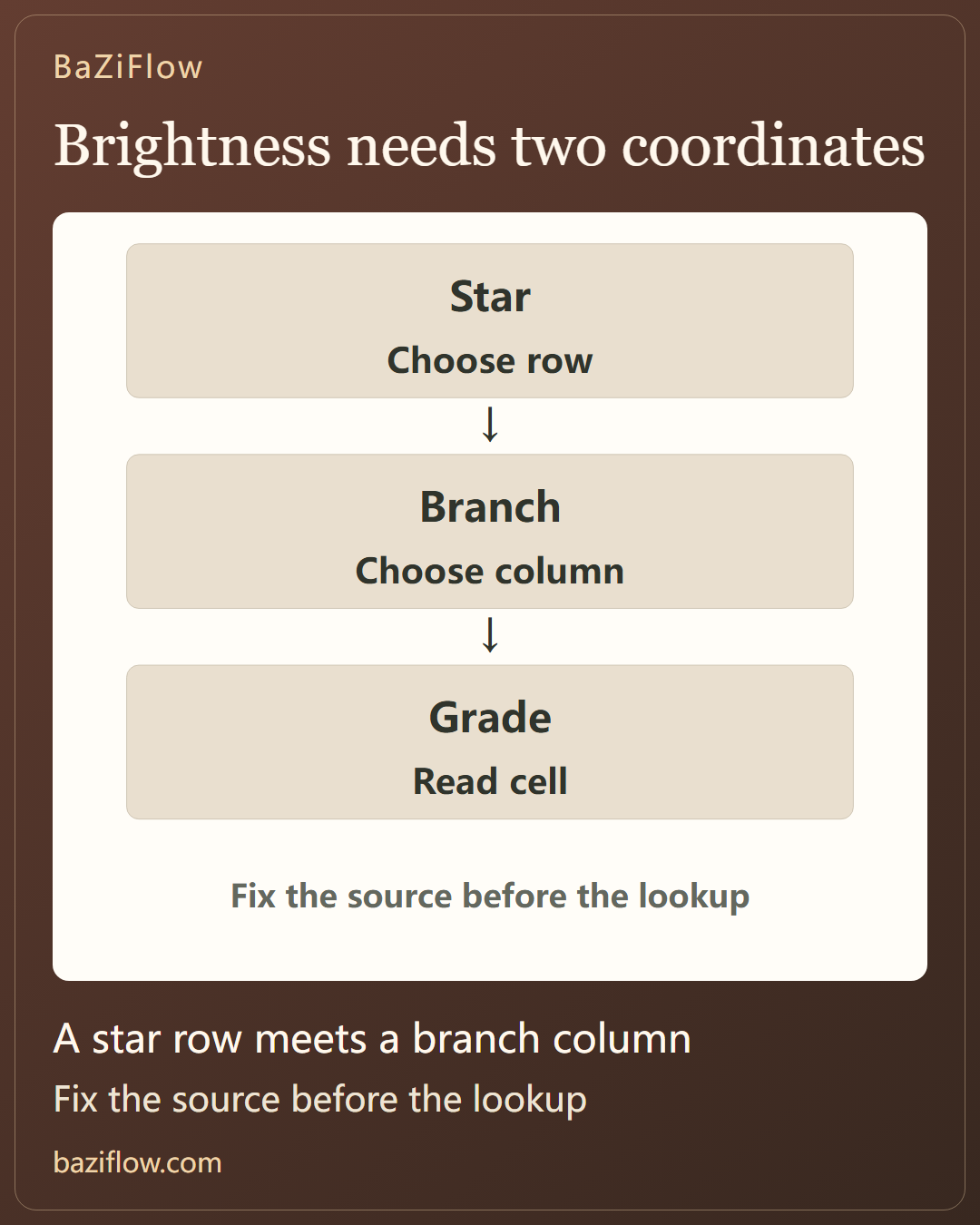
Check six Sun and Moon entries in a named brightness table. Learn why the star, branch position, grading system and source version must be kept together.
The short version6 min read
Brightness is an entry at the intersection of a star and a branch in a specified table. Tai Yang changes between Mao and Wu, while Tai Yin at Wu has the valid grade Bu. Repeating the lookup separates positional changes from differences between tables.
- A brightness entry needs the star, branch and source; Tai Yang and Tai Yin need not have the same grade at one position.
- The cited table gives Tai Yang Miao at Mao and Wang at Wu; Tai Yin at Wu has Bu, a category in the seven-grade vocabulary.
- Four and seven grades have no automatic conversion; preserve original terms and source versions, and keep missing data separate.
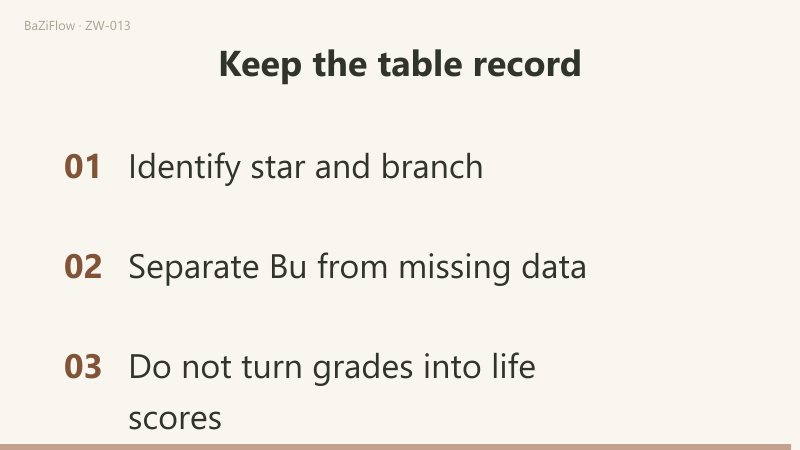
Read first
The fourteen major stars: learn the roster and its structure ↗
Would you automatically give the Sun its highest grade at noon?
In traditional reading, these grades describe how a star’s qualities are supported or constrained at a particular position, often discussed as appropriate or inappropriate placement. Miao (廟) and Wang (旺) usually indicate more supportive placement; Xian (陷) indicates greater restriction. The star’s nature, combinations and chosen system still matter. The cited seven-grade order is Miao (廟), Wang (旺), De (得), Li (利), Ping (平), Bu (不), Xian (陷); it supplies no universal numerical intervals and does not rank a person’s ability or character.
Giving the midday Sun the top grade sounds intuitive, but intuition is not how to reproduce a Zi Wei brightness table. In the iztro table used here, Tai Yang is graded Miao at Mao and Wang at Wu. Replacing the Wu entry with Miao because the midday Sun seems brightest would alter the source.
The exercise illustrates a basic reading skill: separate a traditional lookup rule from an everyday association. The branch position is part of a chart convention, and “brightness” here is a technical grading vocabulary. It is not an astronomical measurement of observed light.
Below are six entries from one explicitly named table. Romanization preserves the original grade names rather than replacing them with potentially misleading scores.
| Star | Mao | Wu | Zi |
|---|---|---|---|
| Tai Yang | Miao | Wang | Xian |
| Tai Yin | Xian | Bu | Miao |
Treat the lookup as an intersection. Fix the cited iztro table, select the Tai Yin row and locate the Wu column: the result is Bu. Change only the row to Tai Yang while keeping Wu, and the result becomes Wang. Keep Tai Yin but change the column to Zi, and the result becomes Miao. Changing one coordinate at a time makes the reason for each difference visible.
A note containing only Bu cannot tell the next reader whether it refers to Tai Yin at Wu or another entry. Restoring the subject restores the data itself. The exercise checks faithful use of a stated table; it supplies no new evidence about someone’s character.
Tai Yang
- Wu
- Wang
Tai Yin
- Wu
- Bu
Read across the row and down the column
Tai Yang changes grade across these three positions, so knowing the star name alone is insufficient. At Mao, Tai Yang and Tai Yin receive different grades, so knowing the position alone is also insufficient. The lookup requires both coordinates.
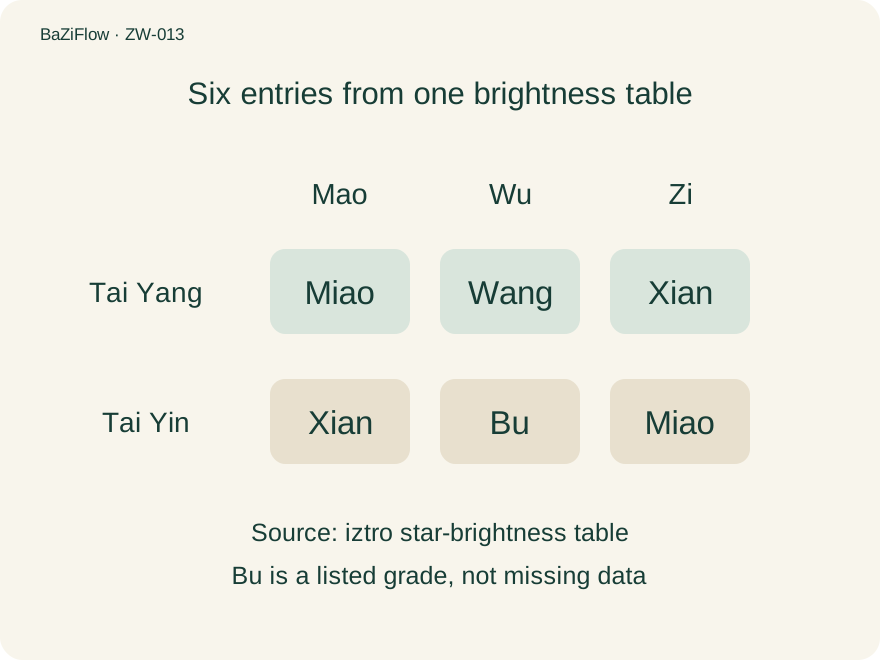
Original BaZiFlow lookup exercise using the cited iztro brightness table. Other schools may use different grades or tables.
The table supplies no personal birth data and compares no people's abilities. It is a reproducible excerpt for learning how to locate an entry. Calling an entire person “fallen” because a star receives Xian would turn a classification into an unsupported judgment of human worth.
Keep a note with four fields: star, branch position, original grade and source version. “Tai Yin; Wu; Bu; the cited iztro table” is recoverable. A note that only says “weak” loses both its precise label and the evidence needed to check it.
Fix the source before the lookup
Different grading systems need an explicit comparison
The source describes a four-grade vocabulary—Miao, Wang, Li and Xian—and a seven-grade vocabulary—Miao, Wang, De, Li, Ping, Bu and Xian. Shared names do not provide a complete conversion rule between the two.
Do not silently squeeze the additional categories into the four-grade system. If a school supplies a correspondence, cite that method; otherwise preserve each source's original terms. A disagreement between two displays may be a rule difference rather than an error in the entered birth date.
The iztro configuration documentation also permits brightness tables to be customized. A tool version and any selected rules therefore matter when reproducing an output. A configuration example designed to demonstrate customization should not be mistaken for the default table or a universal historical standard.
An ordered set of grades is not automatically an equal-interval scale. Assigning Miao one hundred points and Xian twenty points does not establish that the difference has been measured. Adding such invented numbers across the chart would not produce a validated life score.
Four grades
- Miao · Wang · Li · Xian
Seven grades
- Miao · Wang · De · Li · Ping · Bu · Xian
Bu is an entry; an absent value is a different state
In the seven-grade vocabulary just listed, Bu is an actual category. Tai Yin at Wu therefore has a specified entry in this table. It is not a shorthand statement that data are unavailable.
A blank field, a dash or an omitted star-position pair needs the source's own explanation. Do not fill every absent value with the lowest grade. That would convert missing information into an apparently negative finding.
A screenshot can create another kind of absence: the brightness field may simply be hidden. “Not displayed here,” “not defined by this source” and “assigned Xian” should remain separate records. They call for different follow-up checks.
Hidden
- Next check
- Open full display
Not listed
- Next check
- Read source notes
Listed as Xian
- Next check
- Keep the grade
Interpretation still needs the rest of the conditions
The Tai Wei Fu (太微賦) passage of Zi Wei Dou Shu Quan Shu (紫微斗數全書), volume 1, discusses further relationships even when mentioning favorable brightness conditions. It can be read as evidence that the traditional method attends to more than one grade word. It is not statistical verification of outcomes for modern chart owners.
The star's palace topic, accompanying stars, referenced positions, transformations and timing layer still need to be identified. The major-star introduction helps establish the subject to which a grade belongs. Brightness does not replace those fields with a summary verdict.
For a borrowed-star reading, preserve the star's actual location and consult the selected method's handling of attributes. Moving a borrowed reference into the focus palace and silently looking up a new grade would change the record before the interpretation even began.
Combinations
Transformations
Timing layer
Reproduce the six entries
To test your understanding, hide the six answers above and look them up again in the cited table. Pay particular attention to Tai Yang at Wu and Tai Yin at Wu. If another source differs, record the exact disputed cell and retain both versions. A successful lookup shows that you can reproduce a rule; it does not show that a person's future has been measured.
Tai Yang / Wu: Wang
Tai Yin / Wu: Bu
Tai Yin / Zi: Miao
Questions readers ask next
Can a brightness grade be determined from the palace alone?
No. At Mao in the cited table, Tai Yang is Miao while Tai Yin is Xian. The branch alone loses the star coordinate. Select the star row and then locate the branch column in the same source.
Does Bu for Tai Yin at Wu mean that data are missing?
No. Bu belongs to this source’s seven-grade vocabulary. It is distinct from an empty or hidden field. Consult the list of grades before deciding whether a displayed symbol is a category or a missing-value marker.
Should I change the birth time when two tools show different grades?
First compare their grading systems, tables and custom settings for the same star-position pair. A rule difference need not be an input error. Change birth information only when separate evidence supports doing so.
Was this article helpful?
Sources & references
Continue reading
Empty palaces and borrowed stars: keep the source location ↗