

Heavenly Nobleman: the branches of a day stem
Content version · · Sources & references
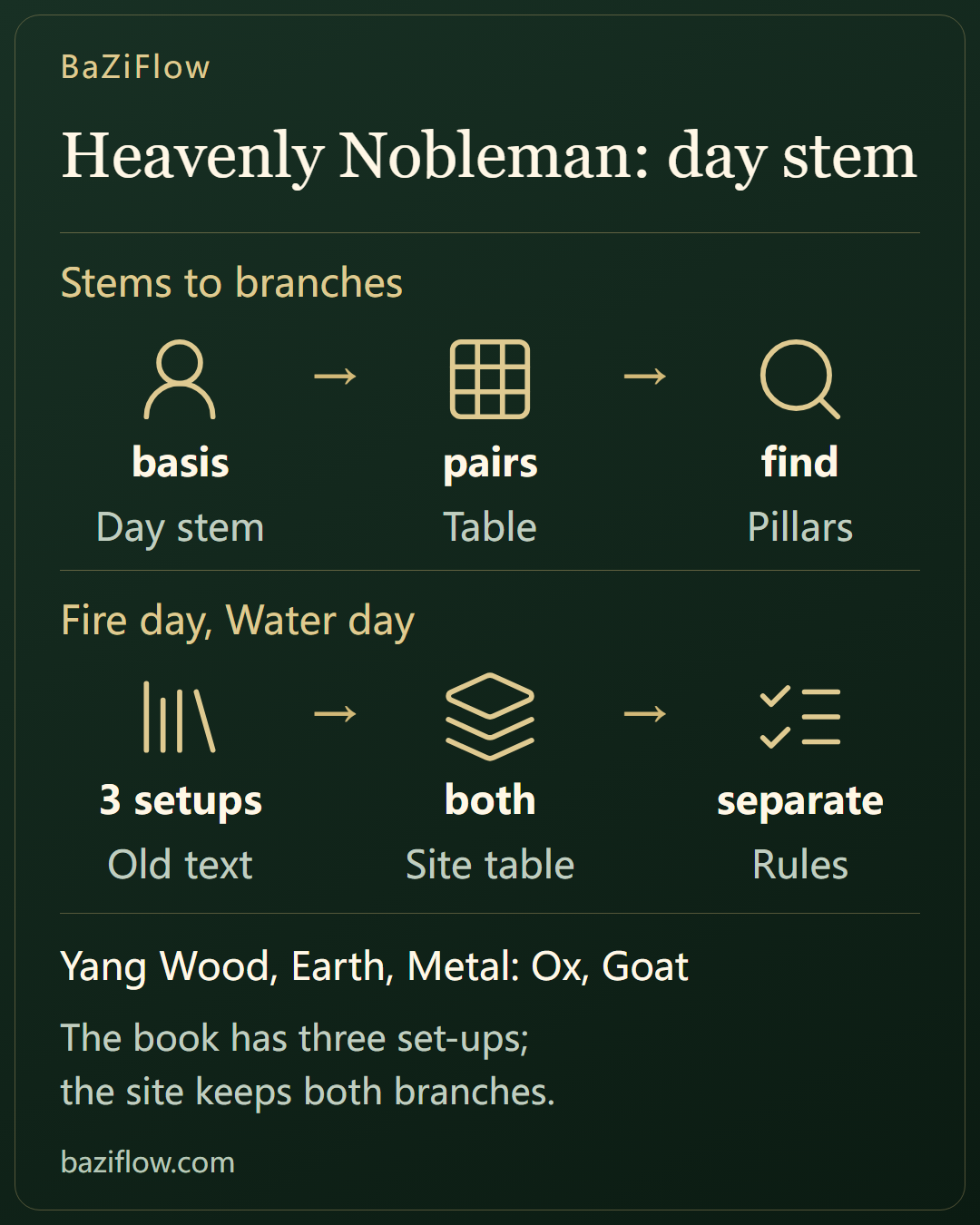
The Heavenly Nobleman looks only at the Day Master stem. Each stem maps to two branches, searched in the four pillars. A table, two worked charts and three set-ups from the Sanming Tonghui, juan 3.
The short version8 min read
The Heavenly Nobleman has one of the shortest look-ups among the site's Symbolic Stars: take the Day Master stem as the basis and search the year, month, day and hour branches for the two characters it maps to.
- The ten day stems fall into five groups: Wood, Earth and Metal Yang stems share Ox and Goat, the Yin Wood and Yin Earth stems get Rat and Monkey, the Fire stems get Rooster and Pig, the Water stems Rabbit and Snake, and Yin Metal gets Tiger and Horse.
- Juan 3 of the Sanming Tonghui sets out three ways to derive the table: Yang and Yin nobles, day and night nobles, and a solstice split. The site lists both branches of every stem.
- The same chapter lists conditions for reading a hit: strong state, no clash or break, not void. It also records a rebuttal that for the Fire and Water stems the noble spots already sit at Death and Severance. The site's table only says whether a hit exists.
Read first
Symbolic Stars in BaZi: Check the Reference and Rule Before the Meaning ↗
One day stem, two branches
The basis of the Heavenly Nobleman (天乙贵人) is the Day Master stem, the character on top of the day pillar. The look-up returns two branches, and those are searched for among the branches of the four pillars.
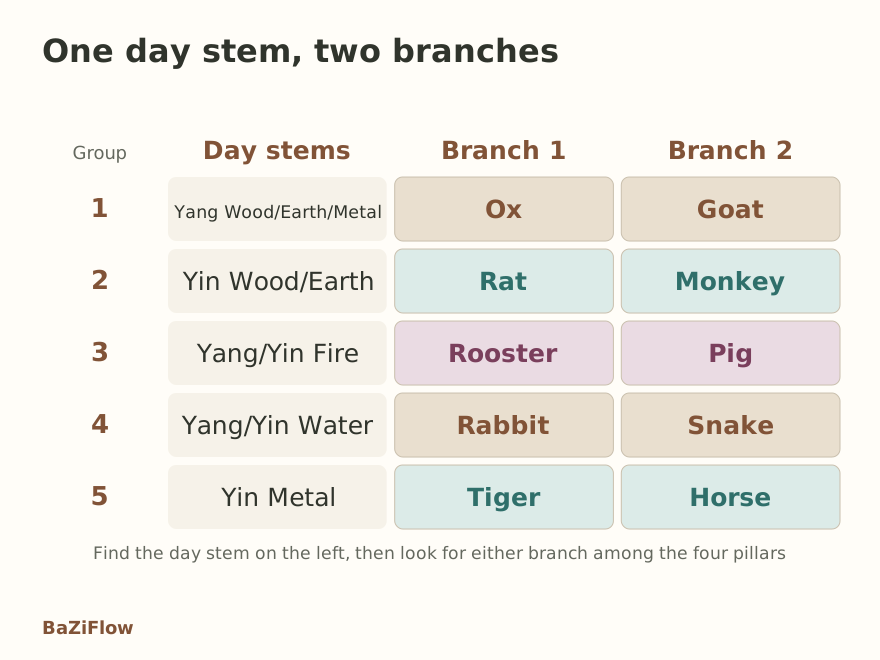
Look-up sketch: each row gives the Day Master stems of one group and the two branches to find among the four pillars. Data from the site engine's Heavenly Nobleman table.
The picture splits the stems into five groups. Yang Wood, Yang Earth and Yang Metal share Ox and Goat. Yin Wood and Yin Earth share Rat and Monkey. Yang Fire and Yin Fire share Rooster and Pig. Yang Water and Yin Water share Rabbit and Snake. Yin Metal stands alone with Tiger and Horse. In a chart, the year, month, day and hour branches are all checked, every match counts, and the branch of the day pillar itself is included.
Two charts, finding the Nobleman each time
The first chart has a Yang Fire Day Master, which looks up Rooster and Pig. Its four branches are Rooster, Rabbit, Dragon and Pig, so the year pillar and the hour pillar each match once. The second chart has a Yin Water Day Master, which looks up Rabbit and Snake. Its branches are Rat, Rabbit, Snake and Dog: the month pillar matches Rabbit, and the day pillar's own Snake matches too. Only four of the sixty day pillars hit the Nobleman on their own branch, Yin Fire Rooster, Yin Fire Pig, Yin Water Rabbit and Yin Water Snake: for the other eight day stems the noble branches have the opposite polarity, so the stem can never sit on them.
Enlarge diagram · scroll sideways to read
For the site's Symbolic Stars based on the day branch (Traveling Horse, Peach Blossom, Canopy Star, General Star), the day pillar's own branch is left out. The Heavenly Nobleman and the Literary Star that follows it use the day stem as the basis and treat all four branches alike. That small difference is worth remembering when comparing tools.
Three set-ups in the old text
Juan 3 of the Ming-dynasty Sanming Tonghui (三命通会) devotes a chapter to the Heavenly Nobleman. It first presents Tian Yi as a god in the sky and gives his position:
His home is at the Ox, in the Dipper and Ox lodge; he comes out at the Goat, in the Well and Ghost lodge.
Ox and Goat are exactly the noble positions of the Wood, Earth and Metal Yang stems. The same chapter then sets three ways of deriving the table side by side:
Enlarge diagram · scroll sideways to read
On Hu Zhong Zi, the book is explicit:
It is better simply to split Yin and Yang at Tiger and Monkey: use the Yang noble after the winter solstice and the Yin noble after the summer solstice.
On that reading, a Yang Wood Day Master looks at one branch after the winter solstice and at the other after the summer solstice. The site is more generous: both branches of every stem are listed, with no day and night split and no solstice split, so for a Yang Wood Day Master both Ox and Goat count as hits. The Qing-dynasty Xieji Bianfang Shu (协纪辨方书), juan 7, quoting the Lihai Ji, also gives two sets, Yang nobles and Yin nobles; put together, the two branches it assigns to each of the ten stems match the site's table item for item. Which set counts as "Yang" is another matter: Cao Zhengui and the Tong Shu, both quoted in the same juan, say exactly opposite things.
Why these pairs
The Guang Lu (广录), quoted in the same chapter, gives a reason for each of the five groups.
The reasons the book gives for the five groups
All like the earth positions
"The Goat is the proper place of Earth, the Ox is the quiet ground of Earth, so Ox and Goat are the nobles."
Yin Wood and Yin Earth want a flourishing ground
Yin Earth likes strength and growth, Yin Wood loves Yang Water, so Rat and Monkey are chosen; Yin Wood especially likes Rat, Yin Earth especially Monkey.
Fire is stored at Dog, where the noble cannot stand
Dragon and Dog are Kui Gang ground and the noble does not go there, so the Fire nobles are lodged at Rooster and Pig.
Water is stored at Dragon, the same thought
Water is stored at Dragon, where the noble likewise does not go, so the Water nobles are lodged at Rabbit and Snake.
Yin Metal likes strong Yang Fire
Yin Metal likes the ground where Yang Fire is strong, so the Horse and the Tiger are chosen.
Two ideas run through the five reasons: the earth positions together with places of strength and growth, and the Kui Gang ground at Dragon and Dog where the noble "does not come". They explain why the table is paired this way, as imagery the old authors found for the table, and not as a result counted from a batch of charts.
The book's conditions, which the site's table leaves out
The chapter also quotes the Zhu Shen Jing (烛神经) on where a noble must sit to be effective:
Wherever the noble stands, it generally likes strength, no clash or break, ... and no fall into the void.
Another source adds that "a noble with no qi is as good as none". So in the old books, finding the noble is only the first step: one also asks whether its branch is strong, whether it is clashed or broken, and whether it falls into a void (more in the stage table and voids). The site's look-up does not judge these.
The compiler of the chapter also adds a rebuttal: to say a noble dislikes Death and Severance forgets that for the Fire and Water stems the noble spots already lie at Death and Severance. Checked against the site's twelve-stage table, the Yang Fire stem has Death at Rooster and Severance at Pig, and Yang Water has Death at Rabbit and Severance at Snake, which matches the remark.
Enlarge diagram · scroll sideways to read
Write down the day stem and the pillar that matched
For example "Yang Fire Day Master, Rooster in the year pillar, Pig in the hour pillar". That is a fact anyone can check.
Then compare the book's conditions
Look at the strength of the branch, whether it is clashed or broken, whether it is void, and name which of the set-ups is being followed.
Finally return to the whole chart
The weight a Symbolic Star carries next to the month, pattern and Useful God is a separate step; the article on placing Symbolic Stars covers it.
The next Symbolic Star, which also takes the day stem as its basis but maps each stem to a single branch, is the Literary Star.
Questions readers ask next
My Day Master is Yin Metal. Why are my nobles Tiger and Horse rather than Ox and Goat?
The table is grouped by stem, and Yin Metal stands alone. The old explanation is that Yin Metal needs the strong fire of Tiger and Horse to be forged into shape, while the Wood, Earth and Metal Yang stems take the earth positions Ox and Goat.
None of the four pillars matched. Does that mean nobody will help me?
It means only that this table found no hit among the four branches. Real support in a life depends on what actually happened to a person, and the old books treat a noble as one clue in the whole argument, behind the month, the pattern and the Useful God.
Two websites show different Heavenly Nobleman results for the same person. Which one is right?
Check which set-up each one follows. Every stem has two branches, and the old text itself sets side by side a day and night split, a summer and winter split and a version that counts both. Write down the day stem, the pillar that matched and the rule version, and the difference can be traced to one step.
Was this article helpful?