

Li Nine: the brightness and Fire of due south
Content version · · Sources & references
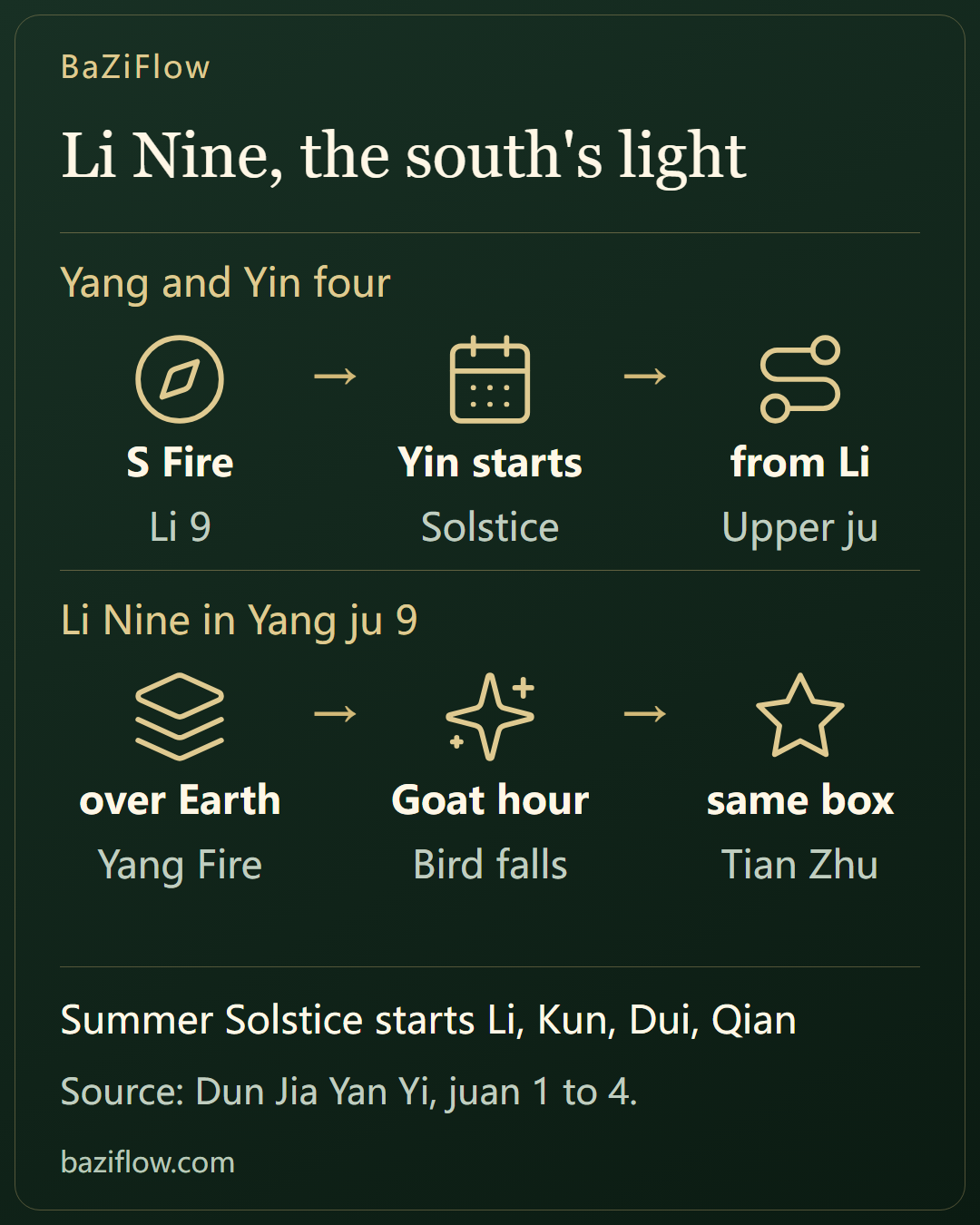
Li Nine is the due-south box of the nine palaces: number 9, trigram Li, element Fire. Facing south, the Summer Solstice, the wonders at Li, Flying Bird in a Yang ju 9 chart and the daily round's last stop show its role.
The short version9 min read
When the Summer Solstice brings the first yin, the four Yin-mode trigrams are counted from Li Nine, the due-south box with Luoshu number 9, the Li trigram and Fire. In the Yang ju 9 chart for the Yin Metal Goat hour, Yang Fire also turns into this box, over Yang Earth, for Flying Bird Drops into the Pit.
- In the Shuo Gua Li is brightness, and the sage "faces south" to hear the world; with south drawn at the top, Li Nine is the middle of the top row.
- Yang mode starts from Kan, Gen, Zhen and Xun at the Winter Solstice and Yin mode from Li, Kun, Dui and Qian at the Summer Solstice, so Li is the first of the Yin four; the upper ju of both Summer Solstice and Rain Water start from Li Nine.
- Juan 3 calls Yang Fire at Li "the land of Peak" because Li is the Horse position; in the Yang ju 9 chart of the Yin Metal Goat hour, Yang Fire lies over Yang Earth in Li Nine beside the Metal star Tian Zhu.
Read first
Meeting in Li: facing south, the Fire at the top of the grid
Li Nine (离九) is the due-south box of the nine palaces: number 9, trigram Li, element Fire. On the picture it stands in the middle of the top row, with Kan One directly below it on the other side of the center.
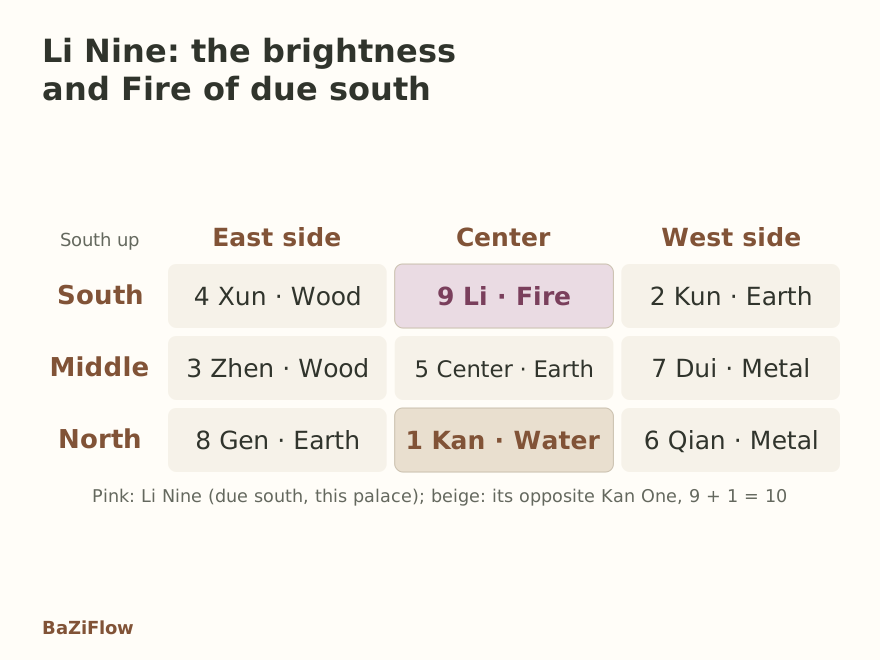
Nine-palace base grid with south at the top and east on the left; elements follow the usual assignment and numbers are the Luoshu numbers. Pink marks Li Nine and beige its opposite, Kan One.
Chapter 5 of the Shuo Gua (说卦) ties Li to brightness and to meeting face to face: the myriad things see one another there, which is why Li is the trigram of the south, and the ancient sage who sat facing south to hear the world's affairs, turned toward the light to rule, is said to have taken his posture from it. Elsewhere in the same text chapter 6 compares fire to the force that dries things out, chapter 7 glosses the name Li as "clinging" (attaching), and chapter 10 ranks it as the middle daughter. When juan 3 allots the sky's fields to the trigrams, it matches Li in the south with the regions of Yang province and Wu and Yue. Nine and one face each other across the center, one Fire and one Water.
One yin is born at the Summer Solstice: Yin mode starts at Li
Juan 1, telling how Feng Hou (风后) made Qimen, splits the trigrams into two groups, each in charge of twelve solar terms. The group that governs Yin mode is:
From the Summer Solstice, when yin is born, begin with the four trigrams Li, Kun, Dui and Qian, which govern twelve terms.
Li is the first of this group, and juan 3 lists its three terms as Summer Solstice, Minor Heat, Major Heat. Set the eight outer palaces in clockwise order from Kan One, and the first four are the Yang-mode trigrams and the last four the Yin-mode ones, with the dividing line exactly between Xun Four and Li Nine:
Enlarge diagram · scroll sideways to read
Li Nine also starts ju nine in both modes. Juan 3 gives the three ju of the Summer Solstice the opening palaces nine, three and six, and a worked case in juan 1 reads "the upper ju of Rain Water, Yang mode nine, starting Yang Wood Rat from the Li palace". Yin ju 9 and Yang ju 9 both put the Yang Earth (戊) of the first cycle on Li Nine, yet the instruments then run in opposite directions:
Enlarge diagram · scroll sideways to read
Wonders at Li Nine: the land of Peak
When the wonders of juan 3 reach Li, each gets a name: Yin Wood is "White Rabbit in the Sun", Yang Fire is "the land of Peak", and Yin Fire is "riding the peak, too blazing", with a note that Yin Fire can "melt and burn all things, violent and unsteady". Seen against the element of Li, Yin Wood feeds Fire, and the two Fire stems share its element.
The Yang Fire row can be checked. Juan 4, in a passage about telling direction by where the Dipper points, says:
The Dipper handle is at Horse, pointing due south, on Li.
So Li holds the Horse (午) position. In the twelve-stage table Yang Fire grows at Tiger, bathes at Rabbit, comes of age at Dragon, is established at Snake and peaks at Horse, and this site's BaZi table says the same. The juan 3 phrase "land of Peak" agrees with that count. The sentence goes on with a condition on the hour: if the duty star falls on a Rat or Horse hour, it should not be used in a hurry, while Tiger, Monkey, Dragon and Dog hours are fine. The name comes first, and the condition follows it.
Flying Bird Drops into the Pit in Li Nine: Yang ju 9, the Yin Metal Goat hour
Juan 2 gives the name Flying Bird Drops into the Pit (飞鸟跌穴) to "Yang Fire over Yang Wood", and one of the cases it lists ends in Li Nine:
Take the middle ju of Major Cold, Yang mode nine, on a Yang Wood or Yin Earth day, the Yin Metal Goat hour. Yang Fire is then on palace seven; the duty star Tian Ying is carried over to the hour stem Yin Metal, on palace three, so Yang Fire comes down on the Yang Wood, hidden under Yang Earth, on palace nine. This is named Flying Bird Drops into the Pit.
Re-laying this hour with the site's rotating engine gives the same result. On the Yang ju 9 ground plate Yang Fire is at Dui Seven and Yin Metal at Zhen Three. Tian Ying, the duty star whose home is Li Nine, is sent to Zhen Three, where the hour stem lies, so the heaven layer rotates two steps counterclockwise around the outer ring; Yang Fire therefore travels from Dui Seven to Li Nine and comes to rest on the earth-layer Yang Earth, as the book says. That box holds more than one layer:
Enlarge diagram · scroll sideways to read
The two entries are about different layers. Flying Bird looks at the heaven-layer Yang Fire over the cycle head of the earth layer, which here hides under Yang Earth. Metal entering the home of Fire looks at where a star lands; at the end of the entry on Metal entering Fire, juan 2 says: "Tian Xin and Tian Zhu reaching the Li palace is likewise Metal entering the home of Fire." When several sayings meet in one box, first sort out the layer each one reads, and keep them as separate readings instead of folding them into one score.
"Yin Wood and Yin Earth, the Rooster, fly to the boundary of Li": the last stop of the daily round
In the daily scheme the Rest Gate moves to a new palace every three days and walks once around the eight outer palaces; Li Nine is stop eight, where the lap ends. The line of the juan 1 rhyme that belongs to Li is:
Yin Wood and Yin Earth, the Rooster, fly to the boundary of Li.
The Rooster is the branch You. Li Nine has two stops, opening on a Yin Wood Rooster day (乙酉) and on a Yin Earth Rooster day (己酉), three days each: Yin Wood Rooster, Yang Fire Dog and Yin Fire Pig, then Yin Earth Rooster, Yang Metal Dog and Yin Metal Pig. Why every stop of a palace opens on the same branch is explained in Qian Six. A lap starts from Kan One and ends at Li Nine, so its start and end are opposite palaces, and 9 plus 1 is 10. The verse of juan 1 takes its example from this same pair:
Where the god of Heavenly Yi stands, a great general should hold the palace and strike the opposite. Suppose the duty star is at Li Nine: with Tian Ying seated there, strike at Tian Peng.
With the duty star on Li Nine and Tian Ying, Li's home star, seated there, what is to be "struck" is the opposite palace, which holds Tian Peng, the home star of Kan One.
Enlarge diagram · scroll sideways to read
Two self-checks
In the Yang ju 9 chart of the Yin Metal Goat hour, which palace does Tian Ying move to, and by how many steps does the heaven layer turn?
It moves to Zhen Three, where the hour stem sits; the heaven layer turns two steps counterclockwise, which carries Yang Fire from Dui Seven to Li Nine.
After "the land of Peak", what condition does the book add for Yang Fire at Li?
A condition on the hour: Rat and Horse duty-star hours are not for hasty use, and Tiger, Monkey, Dragon and Dog hours are fine.
The opposite palace, Kan One, covers the start of the daily round; the home gate has its own page, the View Gate and where it falls.
Questions readers ask next
Yang mode also has ju nine; is Li Nine the same thing as "Yin ju 9"?
No. Li Nine is a palace and ju nine is a way of starting a chart. The upper ju of the Summer Solstice is Yin ju 9 and the upper ju of Rain Water is Yang ju 9, and both start the Yang Wood Rat cycle at Li Nine, but the instruments then run in opposite directions: Yang ju 9 puts Yang Earth, Yin Earth and Yang Metal on Li, Kan and Kun, Yin ju 9 on Li, Gen and Dui.
Li is Fire; is a Metal star like Tian Zhu bad when it lands there?
It cannot be read that way. The book records Tian Xin or Tian Zhu reaching the Li palace as "Metal entering the home of Fire", which is a statement about the direction of the elements, Fire controlling Metal. Whether it applies and how much it weighs depends on the stems, gate and seasonal strength in the same palace; one label settles nothing.
Why are Li Nine and Kan One so often discussed together?
They are opposite palaces, south against north, a Fire and a Water that add up to 10. The daily round of the Rest Gate starts at Kan One and ends at Li Nine, and the verse in juan 1 takes its example from this very pair: the duty star at Li Nine striking at Tian Peng.
Was this article helpful?
Sources & references
Continue reading
Gen Eight: the Northeast Corner Where Ending Turns into Beginning ↗