

Well: the ring turns south
Content version · · Sources & references
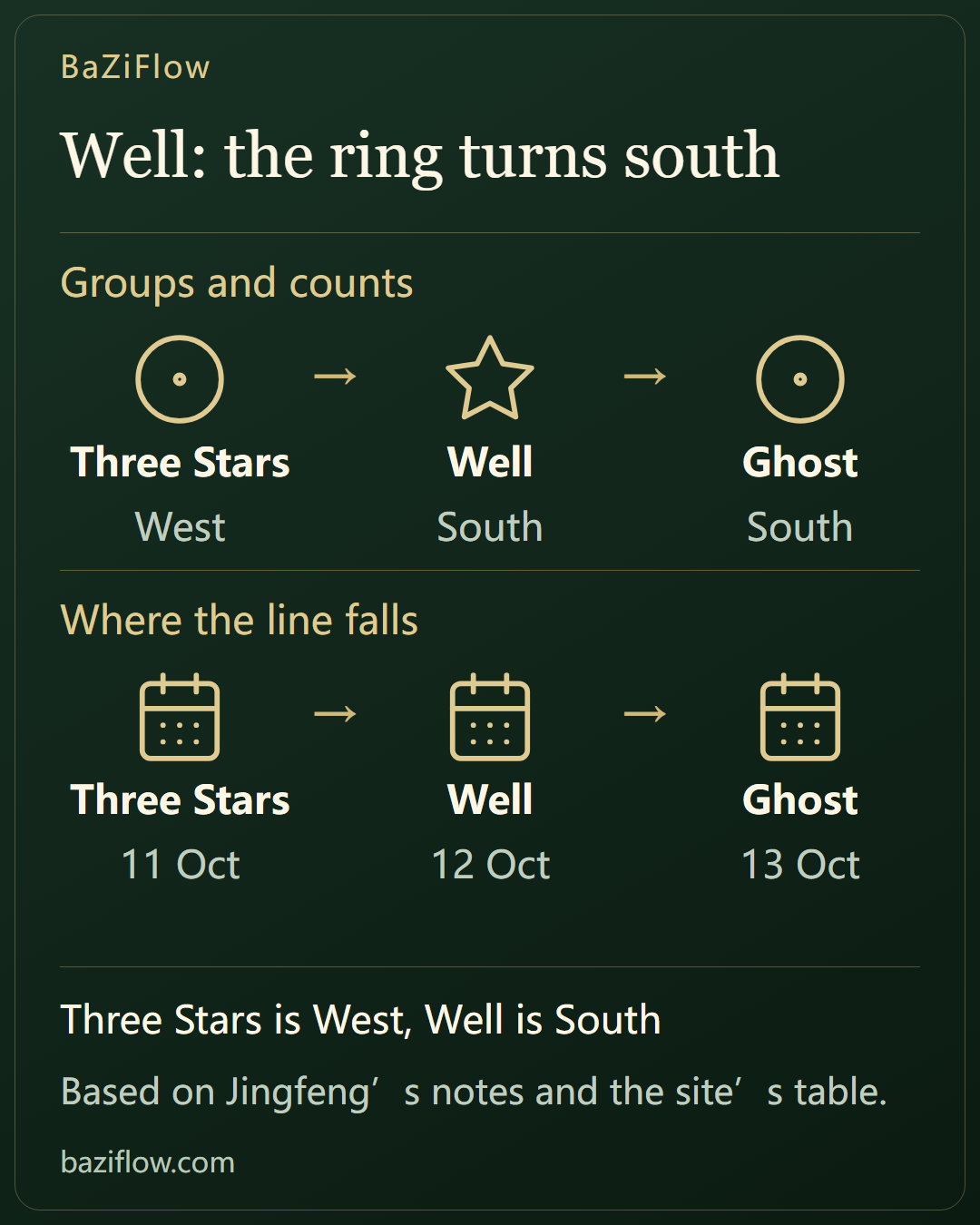
Well (井) is position 5, the first South mansion. All 27 direction tags in Jingfeng’s notes match the site’s four-group table, the group line falls inside a house, and five consecutive days cross it.
The short version6 min read
Well (井, Sei in Japanese) is position 5 on the site’s ring, between Three Stars and Ghost. Counting round the ring, this is where the White Tiger of the West gives way to the Vermilion Bird of the South, and Well is the Bird’s first mansion.
- Jingfeng ends each mansion note with "a mansion of such a direction"; all 27 tags equal the site’s four-group table, seven mansions each for East, South and West and six for North.
- The group line lies between Three Stars and Well, but the house line comes after Well’s third foot: Well gives three feet to the Couple house and only the last foot to the Crab house.
- Well is in the same "light and restless" class as Neck, Girl, Emptiness and Rooftop, and in the luminary table Jupiter pairs with Well, alongside Hairy Head with Mercury and Neck with Saturn.
Read first
What is Sukuyō astrology? How a birth mansion is found ↗
Sukuyō 27 mansions vs the 28 lunar mansions: what is the difference? ↗
Where the ring turns from West to South
Counting round the ring from Hairy Head, the first four mansions belong to the White Tiger of the West, and at position 5, Well (井, Sei in Japanese), the ring crosses into the Vermilion Bird of the South, with Well as the Bird’s first of seven.
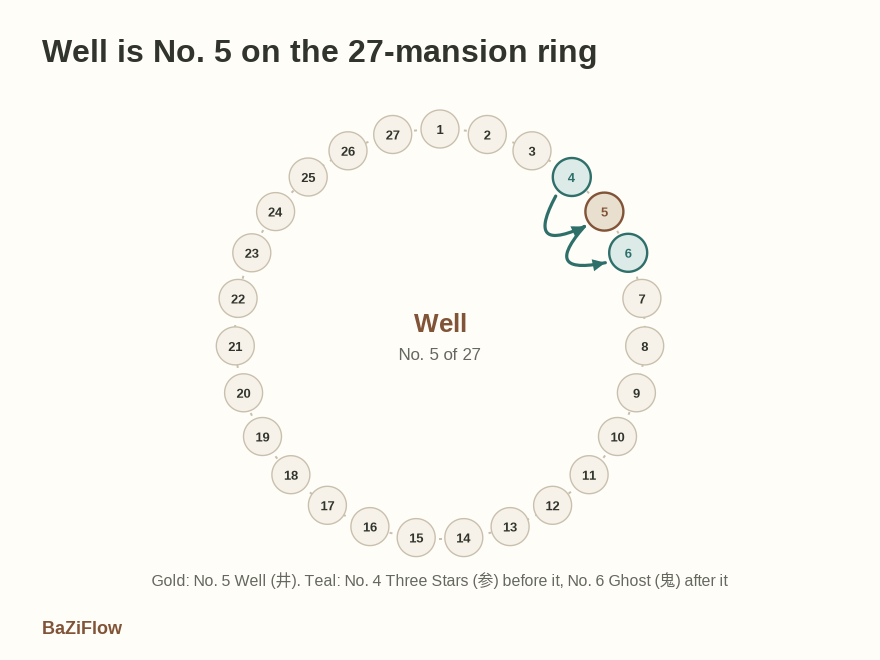
At Well, position 5, the ring passes from the White Tiger of the West to the Vermilion Bird of the South.
The sutra’s Well picture begins:
Well has two stars shaped like a roof beam. It is a sun deity.
Beneath it Jingfeng’s note supplies the Chinese-astronomy star count and also a direction:
In Chinese astronomy Well has eight stars and governs the heavenly gate. It is a southern mansion.
The two layers give two stars against eight, a gap of six, another of the early mismatches alongside the one-against-ten of Three Stars. Its closing phrase, "a southern mansion," is the clue to follow here.
Twenty-seven notes, twenty-seven directions
Every picture’s note ends on one of "an eastern," "a southern," "a western" or "a northern mansion." Setting the 27 tags beside the site’s four-group table, not one differs, and the counts the site gets are:
Enlarge diagram · scroll sideways to read
Seven, seven, seven and six make 27. The 28-mansion list has seven in each direction, and the ring leaves out Ox, so the North is one short; under the sutra’s own Ox picture Jingfeng also wrote "northern."
The group line is not the house line
The Turtle Beak page described the sutra’s other way of slicing the ring: twelve houses, nine feet each and four feet per mansion. Lay the 27 mansions out from Hairy Head as a ruler at four feet each: Hairy Head runs from 0 to 4, Net 4 to 8, Turtle Beak 8 to 12, Three Stars 12 to 16, Well 16 to 20, Ghost 20 to 24 and Willow 24 to 28. On that ruler the Ox house ends at 10, the Couple house runs from 10 to 19 and the Crab house from 19 to 28.
The West–South line is between Three Stars and Well, at 16 on the ruler, yet the Couple house does not finish until 19, so the first three feet of Well are still in the Couple house and only the last foot goes to the Crab house.
Enlarge diagram · scroll sideways to read
Seen this way, "Well is southern" and "Well’s three feet are in the Couple house" do not conflict: the first is the direction of the whole mansion and the second is the ledger of feet, and their lines fall in different places.
A class and a luminary pair: Well in two more tables
The sutra sorts mansions by the character of the days they govern, and Well is in this class:
Well, Neck, Girl, Emptiness and Rooftop are the five "light and restless" mansions, also called the travel mansions.
In the table of the seven luminaries, Jupiter pairs with Well, and the sutra calls this set of pairs the "Vajra Peak days":
…Well with Jupiter… these seven days are called the Vajra Peak days.
With the two tables side by side, it is noticeable that Well and Neck each appear in both:
Enlarge diagram · scroll sideways to read
Class and luminary table are two different groupings; a mansion can appear in both without the two places being related.
Five days in a row across the line
10 to 14 October 2025 are five consecutive mansions: Turtle Beak, Three Stars, Well, Ghost and Willow. In Japan’s old calendar, with the new moon taken at Tokyo time, the mansion of month 8, day 1 is Horn (East); by day 19 the count has gone 18 places, around the end of the ring and into the West at Turtle Beak. Day 20 is Three Stars, and day 21, after 20 places, is Well, from which the count is in the South.
Enlarge diagram · scroll sideways to read
Listing every Gregorian day of 2025 that lands on Well gives 13: 11 Jan, 7 Feb, 7 Mar, 3 Apr, 1 May, 28 May, 24 Jun, 21 Jul, 20 Aug, 15 Sep, 12 Oct, 8 Nov and 6 Dec.
The mansion before it is Three Stars and the one after is Ghost. The missing Ox mansion is discussed in 27 versus 28 mansions; for sources whose directions or star counts disagree, see checking Sukuyō sources and editions.
Questions readers ask next
Why is Well called the first mansion of the South?
The site’s four-group table puts Hairy Head, Net, Turtle Beak and Three Stars in the West, and the South begins at Well: Well, Ghost, Willow, Star, Extended Net, Wings and Chariot make seven. Jingfeng’s notes agree: Three Stars is tagged "a western mansion," Well "a southern mansion," so the line falls between the two.
North has only six mansions. Is one missing?
No. The 28-mansion list has seven in each direction, and the 27-mansion ring leaves out Ox, which used to belong to the North; so the North holds Dipper, Girl, Emptiness, Rooftop, Encampment and Wall. The sutra’s own note under the Ox picture also says "northern." The 27 split as 7, 7, 7 and 6.
Are a mansion’s "feet" and its direction the same kind of thing?
No. The direction (the four groups) sorts whole mansions, and Well as a whole is southern. The "foot" is the unit of the twelve-house ledger, and Well’s four feet are split three to the Couple house and one to the Crab house. The two divisions meet at different places and must be read separately.
Was this article helpful?
Sources & references
Continue reading
Three Stars (参): One Star Against Ten, a List Written Twice, and a Count Across the Seam ↗
Ghost (鬼): Two Class Lists in One Sutra, 27 and 28, and a Leap Month That Counts It Twice ↗