

Center Five: the middle box with no direction
Content version · · Sources & references
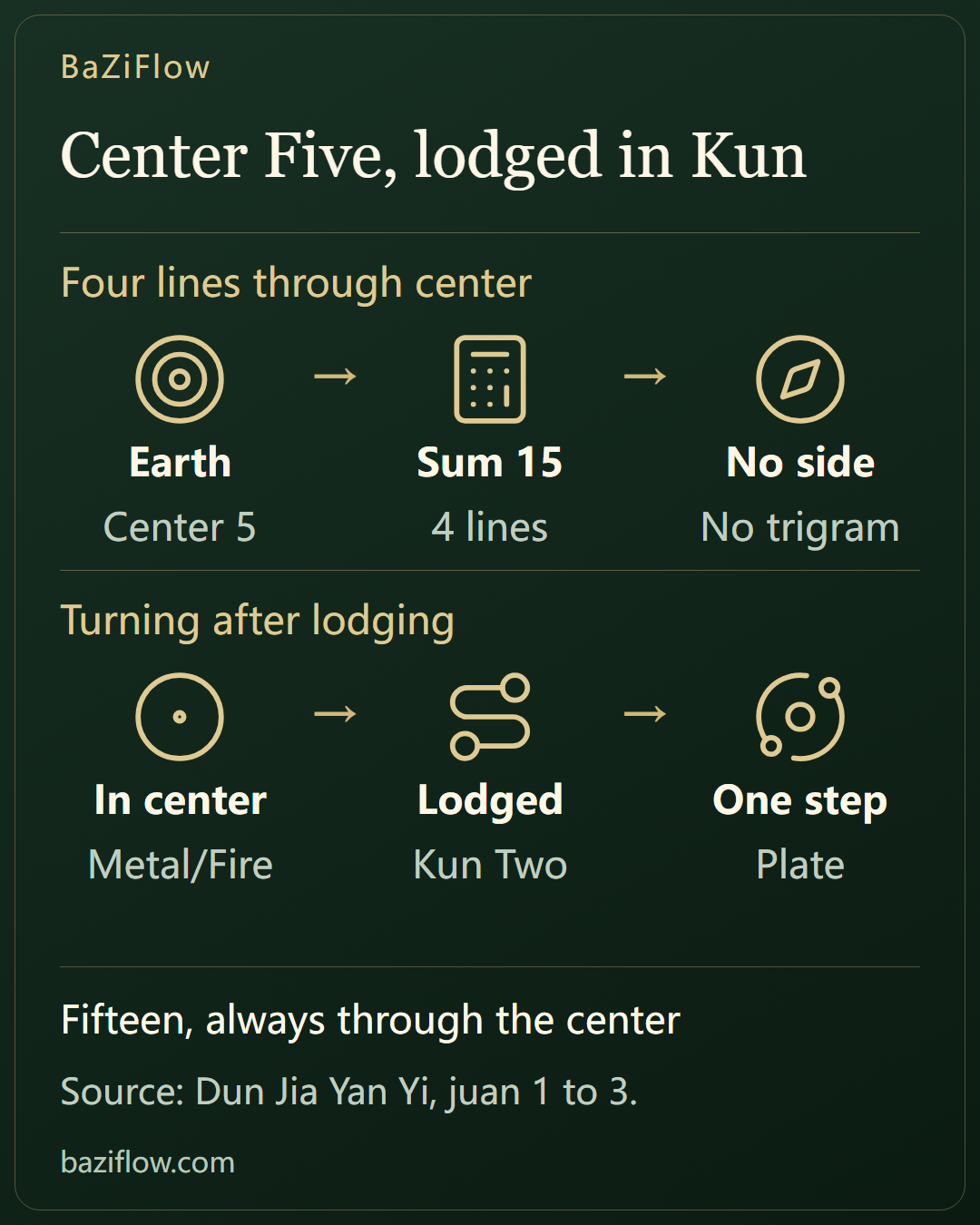
Center Five is the middle of the nine palaces: number 5, element Earth, no trigram or direction. Lines of fifteen, the daily round that skips it and the original "lodge Five in Kun" line show how the center is handled.
The short version8 min read
Center Five, the middle box of the nine palaces, has only the Luoshu number 5 and the element Earth: no trigram, no direction and no gate. Dun Jia Yan Yi lodges whatever lands here in Kun Two; other methods lodge it differently, for example in Gen Eight in Yang mode and Kun Two in Yin mode.
- Center Five is the box the nine palaces have beyond the eight trigrams: trigrams, gates and spirits come in eights, nine stars exist, and the extra one, Tian Qin, has its home in the center. The row, column and two diagonals through it each sum to 15.
- In the daily example the Rest Gate cycles only among the eight outer palaces, and the twenty-four solar terms are shared three each among the eight trigrams, so no term falls to the center.
- The book lodges the fifth palace in Kun Two, calls that "after all not a proper place" and says to note "avoid five". That is the book's wording; this site marks the convention as pending review.
Read first
Middle, Earth, five: the heart of the grid
At the heart of the grid sits Center Five (中五): number 5, element Earth, with no direction and no trigram of its own.
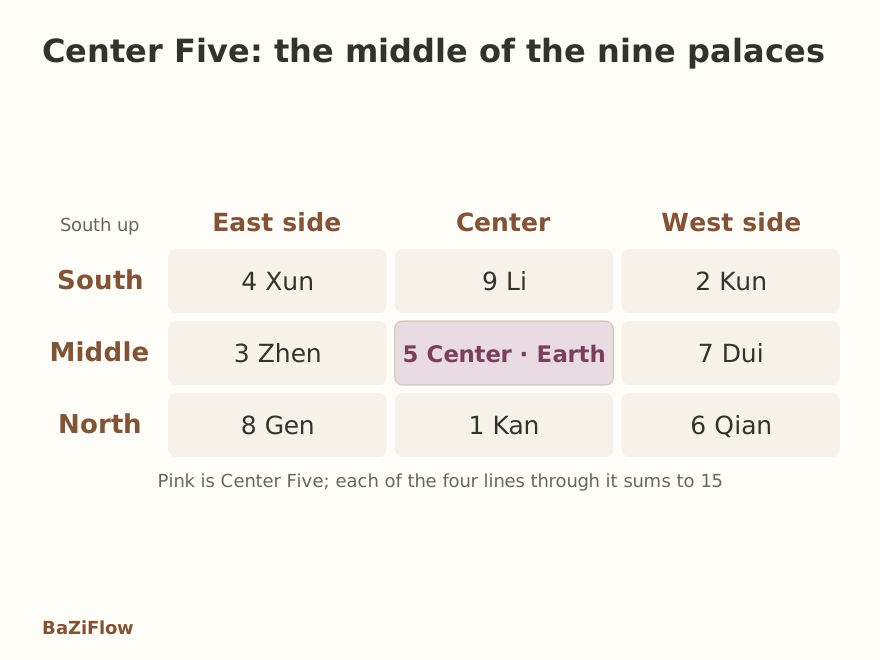
Nine-palace base grid with south at the top and east on the left; the element of Center Five follows the usual assignment and its number is the Luoshu number. Pink marks Center Five, which has no trigram or direction.
On the south-up, east-left grid the other eight boxes form a ring around it, four on the main directions and four at the corners, while the middle box belongs to no direction at all. Chapter 5 of the Shuo Gua gives the directions of eight trigrams, and the eight trigrams fit the eight outer palaces; the box the nine palaces have beyond the trigrams is Center Five, and no ninth trigram is added for it.
Lines of fifteen: every line through the middle carries a 5
The first juan of the Ming-dynasty compendium Dun Jia Yan Yi (遁甲演义) reproduces a verse text, the Yan Bo Diao Sou fu (烟波钓叟赋), that explains how to set out the nine palaces:
First lay out the nine palaces on the palm: across and down, fifteen is within them.
"Across and down fifteen" means that along every row, column and diagonal the three numbers add up to 15. Four lines pass through the center: the middle row 3, 5, 7; the middle column 9, 5, 1; and the two diagonals 4, 5, 6 and 2, 5, 8. The middle number of each is 5.
Enlarge diagram · scroll sideways to read
Five is the number sitting exactly in the middle of 1 to 9. The two end numbers of each line add up to 10: 3 and 7, 9 and 1, 4 and 6, 2 and 8, and these four pairs are the palaces that face each other as opposites. So the center is not put there casually; it is the one number that all four lines share, which is also why it has no opposite of its own.
The daily round and the solar terms both go around the center
On the daily side, the Rest Gate visits only the eight outer palaces, and after its fourth halt at Xun Four it jumps straight to Qian Six (the sequence is laid out in Kan One). The solar terms behave the same way: juan 3 shares the twenty-four terms among the eight trigrams, three each, and three times eight is twenty-four, so not a single term goes to the center.
Enlarge diagram · scroll sideways to read
Gates, spirits, terms and the Rest Gate's round come in eights, and the outer palaces divide them exactly. What is left for the center to deal with is only what lands inside this box, meaning stars, stems and cycle heads, and the next two sections show how the book writes it.
The hourly scheme: when the cycle head falls on five
In the hourly examples each cycle has a head. The landing points of the six heads in Yang ju 1 are laid out in Kan One, and the Yang Wood Dragon cycle falls on five. In the Yin-mode ju 9 example of juan 1, the Yang Wood Dragon cycle falls on five as well.
Enlarge diagram · scroll sideways to read
The method of lodging is set out most clearly in the layout section of juan 3:
To lay out the fifth palace is to lodge it in earthy Kun, on the saying that Earth reaches Growth at Monkey. This lodging is after all not a proper place, so when the duty star and duty gate are in five, one notes "avoid five" beneath the hour, lest people use it by mistake.
The passage works in three layers. The method is to lodge in Kun, treating whatever sits in the fifth palace as being in Kun Two. The reason is that five is Earth and Kun is Earth too, which the book ties to the saying that Earth reaches Growth at Monkey. And the book itself admits that this is "after all not a proper place", so when the duty star and gate fall on five the hour is annotated "avoid five". The end of the same section adds a ruling: where a lodging is involved, even if a wonder is obtained it is not suitable for undertakings. That is the ruling of Dun Jia Yan Yi, not a conclusion of this article.
The summer-solstice example: how the Yang Fire of the center turns with Kun
Juan 3 also has a summer-solstice middle-ju example. It is Yin-mode ju 3, starting Yang Wood Rat at Zhen, and on the earth plate Yang Fire and Tian Qin are in the center. In the example the hour is Yang Fire Monkey, and its hour stem, Yang Fire, falls exactly in the center.
Enlarge diagram · scroll sideways to read
The book's reading is that an hour stem in the center is lodged in Kun, so the duty star Tian Ying is added onto Kun Two; from Li Nine to Kun Two is one step along the outer ring, and the whole heaven plate turns one step with it. Tian Qin, which set off from the Kun Two position carrying Yang Fire, arrives at Dui Seven; Tian Xin carrying Yin Fire goes from Qian Six to Kan One; Tian Fu carrying Yin Wood goes from Xun Four to Li Nine. The book concludes that "Qin with Yang Fire reaches Dui, Tian Xin with Yin Fire reaches Kan, Fu with Yin Wood reaches Li", which agrees with what we have just counted.
So what is in the center is not dropped; it borrows the position of Kun Two when it has to be placed. Put differently, the Kun Two palace here carries its own contents and the center's. The book adds a verdict on this example, which we do not repeat; only the positions are checked.
Two checks by hand
On a line through the center one end is 8; what is the other?
8 + 5 + ? = 15, so 2: this is the southwest-to-northeast diagonal, where 8 and 2 are opposite palaces.
On the Yang ju 2 earth plate, which stem sits in the center?
Start the Six Instruments at Kun Two and move up one palace per stem: the fourth stem, Yin Metal, reaches the center, and the book records it as lodged in Kun.
Next read Qian Six, to carry on from the northwest corner around the nine palaces.
Questions readers ask next
Why does Center Five have no direction and no trigram?
There are only eight trigrams, and they are assigned to the eight outer palaces, one direction each; the box the nine palaces have beyond the trigrams is the center. The Shuo Gua speaks of the directions of the eight trigrams and gives the middle no trigram of its own. On a Qimen chart it exists as the Luoshu number 5 and the element Earth.
Does "lodged in Kun" mean the contents of the center are moved into Kun Two?
More exactly, when the contents of the center need a position they are treated as being in Kun Two. In the book's Grain Buds middle-ju example the Yin Metal of the center is written "in the center, lodged in Kun"; in the Yin ju 3 example the hour stem Yang Fire lands in the center and the duty star is added to Kun Two. There are still nine boxes, and Kun Two gains no extra one.
Do all sources treat the center the same way?
Not necessarily. Dun Jia Yan Yi lodges the center in Kun and explains this by "Earth reaches Growth at Monkey"; other methods differ, for instance Gen Eight in Yang mode and Kun Two in Yin mode, and this article has not traced each school's source. The site's BaZi table puts the Growth stage of Yang Earth at Tiger instead. The site's experimental Qimen chart marks the lodging as pending and checks two steps separately: lodging before the duty gate counts, and where it lodges when the count ends in the center.
Was this article helpful?
Sources & references
Continue reading
Xun Four: the Southeastern Corner Palace and the Last Trigram of Yang Mode ↗
Qian Six: the Metal Corner of the Northwest the Book Calls the Heaven Gate ↗