

Guandi and Guanyin lots
Content version · · Sources & references
Compare two named first-lot samples, preserve their identifiers and commentary layers, and avoid turning local usage into universal subject rules.
The short version6 min read
Identify the material before comparing meanings. Keep each collection’s number, labels, poem and commentary together, then distinguish local guidance from broader claims about either tradition.
- One temple can provide more than one collection, so place alone may leave identity unresolved.
- Yang Wood–Yin Metal (甲辛) contains two stems; a printed identifier does not establish a birth date.
- A named commentary section and an independently established author are different claims.
Read first
Why the same oracle-lot number can have different versions ↗
Read the poem, allusion, and commentary as distinct layers ↗
Two first lots are not one interchangeable entry
The selected Guandi text begins with an image of standing high among the clouds; the selected Guanyin page opens with heaven and earth making a favorable connection. Both are numbered one. The shared number is therefore not enough to transfer an explanation from one to the other.
Our comparison uses the first entry of Guan Sheng Di Jun Ling Qian as transcribed on Wikisource and the Chinese Temples Committee's Guanyin lot-one page. These are named samples, not an exhaustive comparison of every Guandi and Guanyin collection. The electronic Guandi text is not presented as the current paper used at Lungshan or Hsing Tian Kong.
Compare visible fields before assigning a meaning
| Field | Selected Guandi text | Selected Guanyin page |
|---|---|---|
| Number | First lot | First lot |
| Additional labels | Yang Wood–Yang Wood (甲甲) and a highly favorable grade | Upper grade and the Zhongli allusion heading |
| Opening line | Lofty, striding alone up among the clouds | Heaven opens, earth breaks ground, making a good bond |
| Explanatory layout | Several separately titled sections | A separately labeled remarks (解曰) block |
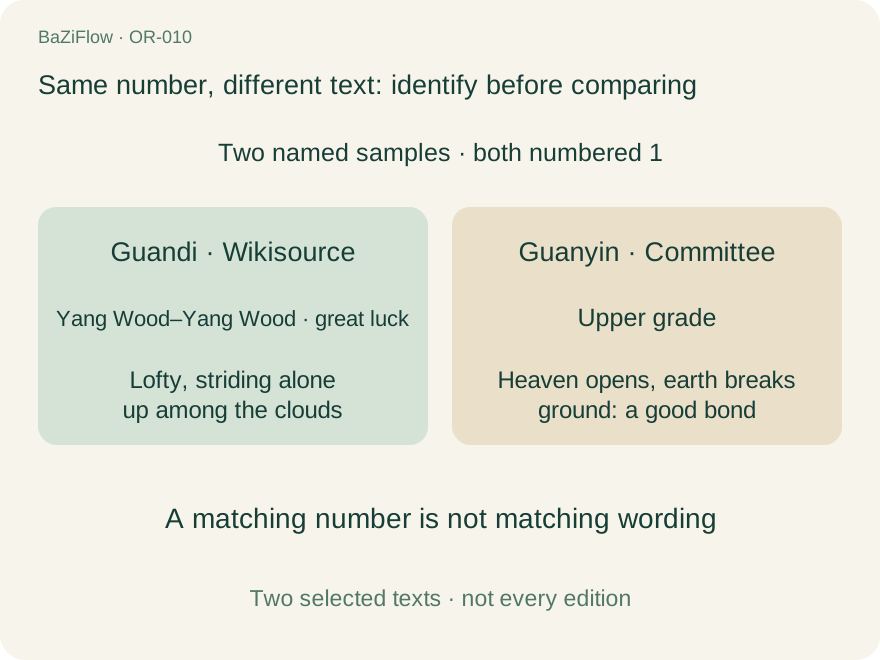
Original BaZiFlow comparison of two specified samples. Their formats are not asserted to represent every edition.
This limited comparison establishes a real difference without turning it into an absolute rule about either tradition. A mismatch in an opening line, label, or story title should send the reader back to the material, not toward whichever online explanation best fits the desired answer. Same-number edition differences develops that check.
The source labels matter as much as the words. A historical transcription and a current institutional presentation can both be read, but they should not silently acquire each other's date, location, or authority. State which sample supports each observation.
Selected Guandi first lot
- Different opening wording
Selected Guanyin first lot
- Same number, distinct text
Keep collection, place and wording together
- Material label
- The number or wording printed in the collection, retained in its original role.
- Authorship claim
- A historical attribution requiring evidence beyond a visible section title.
A temple name may still leave the collection unresolved
Lungshan's official guide discusses Guanyin lots and separately notes Guandi lots at the Guan Sheng Di Jun hall. Thus even a record saying “obtained at Lungshan” may not identify the relevant collection. Keep the devotional object, place of acquisition, and material title where available.
If a visit involves two sets, preserve two complete records. Do not combine one poem with the more detailed commentary attached to the other. Being available within the same temple does not erase their textual identities. Nor does a shared location establish a universal correspondence between their numbers.
Local actions require their own check as well. Hsing Tian Kong's procedure uses its own sample identifiers when explaining number confirmation and receipt of the poem. That guidance does not establish every other site's procedure; see local custom and procedure.
One temple
- May provide several collections
Identified collection
- Own number and wording
Preserve stem-like labels without converting them into birth data
The selected first Guandi entry carries the label Yang Wood–Yang Wood (甲甲). Hsing Tian Kong's official examples include number eight with Yang Wood–Yin Metal (甲辛) and number twenty-two with Yang Fire–Yin Wood (丙乙). Record the printed number and label together rather than keeping only a derived interpretation.
Yang Wood and Yin Metal are both heavenly stems, so that label is not a stem-and-branch pair. Their appearance as a lot identifier does not supply a calendar date, an hour, or a visitor's birth-chart information. These examples also do not justify inventing a universal encoding algorithm for every collection.
If number and label appear inconsistent, check the original for a copying error, a different index, or a wrong paper. Do not rewrite the source to make it agree with a search result. The objective is to preserve the identifier actually encountered before deciding what, if anything, can be derived from it.
Yang Wood–Yin Metal
- Stem plus stem
Yang Wood–Rat
- Stem plus branch
A deity name does not establish an exclusive subject category
Lungshan's guide says work concerns may also be brought to Guan Sheng Di Jun. This is a local usage statement, not a rule that all work questions everywhere belong exclusively to Guandi lots. The selected Guandi entry's “sacred intent” (圣意) section includes both official achievement and marriage among its subjects, so at least this sample is not restricted to a single topic.
Where an institution gives a specific scope, retain that setting and respect its guidance. Do not promote a familiar local association into a prohibition applying to every collection. Equally, the name of a deity does not establish which text will be more accurate for a particular reader; that is a different claim requiring different evidence.
Useful questions are concrete: which material does this place provide, how does it describe its use, and what does this entry actually say? They are more answerable than a rigid division of all human concerns into two labels before either text has been read.
Local work guidance
- A statement about this setting
Universal allocation
- Not established by this example
Commentary headings are not automatic authorship certificates
The selected Guandi transcription has sections labeled “sacred intent” (圣意), Dongpo's explanation, Bixian's annotation (碧仙注), remarks (解曰), exposition, and reported fulfilments. Keeping the headings helps distinguish the layers. The presence of Dongpo's name in a heading alone does not establish that Su Shi personally authored the passage.
Reported fulfilments are likewise narratives included in that text, not independent prediction tests performed for this article. They should not be converted into a verified accuracy claim. Textual layers and checking allusion sources explain the separate tasks of identifying a passage and examining its attribution.
Once both materials are properly identified, differing interpretations can remain visible. Check the original question and wording before treating one reading as canceling the other, and do not retain only the more welcome fragments. A careful comparison preserves differences that can be traced; it does not need to rank two traditions or blend them into a single answer.
Dongpo heading
- Visible editorial title
Su Shi authorship
- Requires historical evidence
Keep both first-lot records
Record the Wikisource Guandi page and Committee Guanyin page separately, including their different openings.
Detect a cross-page combination
A record containing the Guandi poem and the Guanyin explanation must be checked against both sources rather than justified by the shared number.
Restore the source boundaries
Return each passage to its documented edition and retain the correction. This repairs identification without ranking predictive accuracy.
Questions readers ask next
Does the temple name identify the collection?
Not always. The Lungshan guide documents separate materials within the same setting, so collection and wording remain useful identifiers.
Why is a label like Yang Wood–Yin Metal not automatically a Day Pillar?
Both characters are stems, and the record uses them as a lot identifier rather than verified birth information.
Does a Dongpo heading establish Su Shi as author?
It identifies a section in the consulted text. Historical attribution requires additional edition and authorship evidence.
Was this article helpful?
Sources & references
Continue reading
Recording an oracle-lot source: identifiers, dates, and gaps ↗
Oracle-lot procedures and local customs: keep the setting ↗
Check an oracle-lot allusion against the passage, not a title ↗
Guanyin Hundred Lots: collection size, editions, and identity ↗